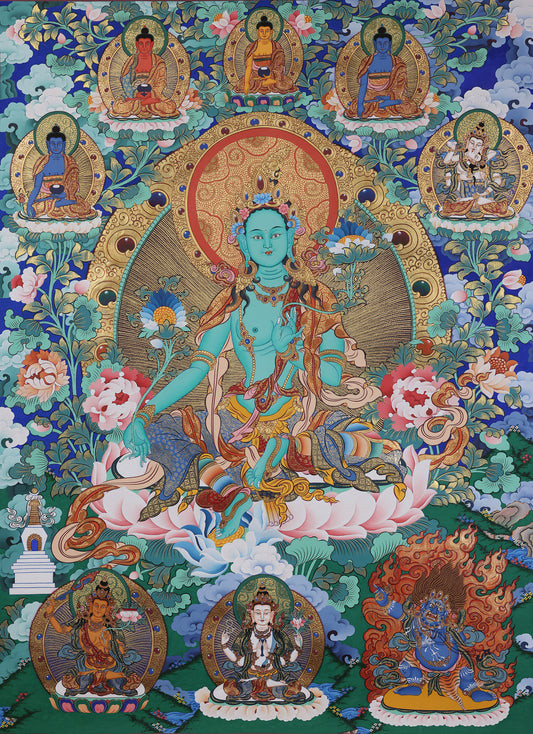
Product Specifications
- Main Deity: Four-Armed Avalokiteshvara (Tibetan Buddhism’s "Bodhisattva of Compassion," symbolizing universal care, emotional healing & connection to all beings)
- Origin: Nepal
- Dimensions: 3.5cm × 4.5cm (thangka core + titanium steel casing)
- Casing: Vintage gold-gilded pattern titanium steel protective shell
1. Deity Culture: Four-Armed Avalokiteshvara—The Bodhisattva of “Boundless Compassion”
In Tibetan Buddhism, the Four-Armed Avalokiteshvara (known as Chenrezig in Tibetan) is the embodiment of universal compassion—the force that connects all beings and heals emotional pain. His four arms symbolize the ability to care for others while nurturing oneself: a balance lost in many modern lives.
A beloved Nepalese legend tells of a village ravaged by a plague, where grief left families isolated and bitter. Avalokiteshvara appeared with four arms: one holding a lotus (purity), one a prayer bead (connection), one a vase of healing water (comfort), and one open (to receive pain). He touched the vase to the village well, and those who drank felt their grief soften—not erased, but held with kindness. “Compassion is not about fixing pain,” he said. “It’s about holding it together.”
This spirit of “boundless care” defines every detail of the Avalokiteshvara in this pendant:
-
Four Arms & Symbols: The lotus (purity of intent), prayer bead (connection to others), and open palm (willingness to receive) represent the balance of giving and receiving compassion—a reminder that caring for yourself is not selfish.
-
Gentle, Radiant Expression: His soft smile (a hallmark of Tibetan Avalokiteshvara iconography) conveys: Your pain is seen. You are not alone.
-
Adorned with Blue & Pink: The blue of his crown (calm) and pink of the lotus (tenderness) mirror the legend’s healing water—colors that evoke emotional softness.
2. Craftsmanship: Nepalese Mini Thangka—“Compassion Woven Into Tiny Strokes”
Nepalese thangka art is a practice of embedding heart into every detail, and this 3.5×4.5cm piece honors Avalokiteshvara’s legacy of care through intentional, patient craft:
1. Thangka Core: Mulberry Paper & Traditional Techniques as “Vessels of Kindness”
The pendant’s core uses Himalayan mulberry paper (harvested from high-altitude trees, valued for its ability to hold fine, delicate strokes):
-
Wolf-Hair Brush Precision: To paint the tiny petals of the lotus (each smaller than a pinhead) and the intricate prayer bead details, artisans use a single wolf-hair brush. It takes 10 days to complete one pendant—no rushing, no shortcuts. This slowness mirrors Avalokiteshvara’s lesson: Compassion requires presence, not speed.
-
Symbolic Color Palette: The soft pink of the lotus (tenderness), blue of his adornments (calm), and gold of the background (radiance of care) are mixed using traditional Nepalese methods—no synthetic dyes. These hues resist fading, just like the compassion they represent.
2. Gold-Gilded Titanium Steel Casing: Tradition Meets Modern Utility
Traditional thangka pendants are too fragile for daily wear, but this piece uses gold-gilded titanium steel to bridge ancient reverence and contemporary life:
-
Stupa-Inspired Scrollwork: The casing’s geometric patterns are copied from the murals of Boudhanath Stupa (Nepal’s most sacred Buddhist site), tying the pendant to a 1,000-year history of compassionate practice.
-
Daily-Wear Durability: Hypoallergenic, scratch-resistant, and tarnish-free, it’s designed to be worn—not stored. Clip it to a work bag (a reminder to speak with kindness in tense meetings), tuck it under a collar (a nudge to be gentle with yourself), or wear it during difficult conversations (a prompt to hold space for others). It’s a companion, not a “sacred object” locked away.
3. Contemporary Value: “Not a Religious Symbol, but a ‘Compassion Tool’ for Life”
You don’t need to practice Buddhism to wear this pendant. You just need to be a person who has ever felt isolated, overwhelmed, or in need of kindness (which is all of us):
-
A Ritual of Care (No Rules Required): When you feel alone or harsh with yourself, touch the pendant. Take one deep breath and say: I am held, and I can hold others. It’s a small, intentional moment to soften.
-
Wearable Compassion for Every Context: Pair it with a blazer for a stressful workday (to ground yourself in kindness), or clip it to a backpack for a walk (to notice the world with tenderness). It doesn’t draw attention—it cultivates it.
-
A Story to Share (Without Jargon): When someone asks about it, say: “This is Avalokiteshvara—he’s the bodhisattva who helped a village feel less alone in their grief.” It’s a way to talk about emotional care and connection without overcomplicating it.
Hashtags
#3.5x4.5cmNepaleseFourArmedAvalokiteshvara
#TibetanBuddhistCompassionAmulet
#GoldGildedTitaniumKindnessPendant
#NepaleseThangkaCraftDailyWear
#WearableBodhisattvaOfCare
#HeartCenteredJewelry