I. Theme: The Mandala of Samantabhadra's "Perfect Practice"
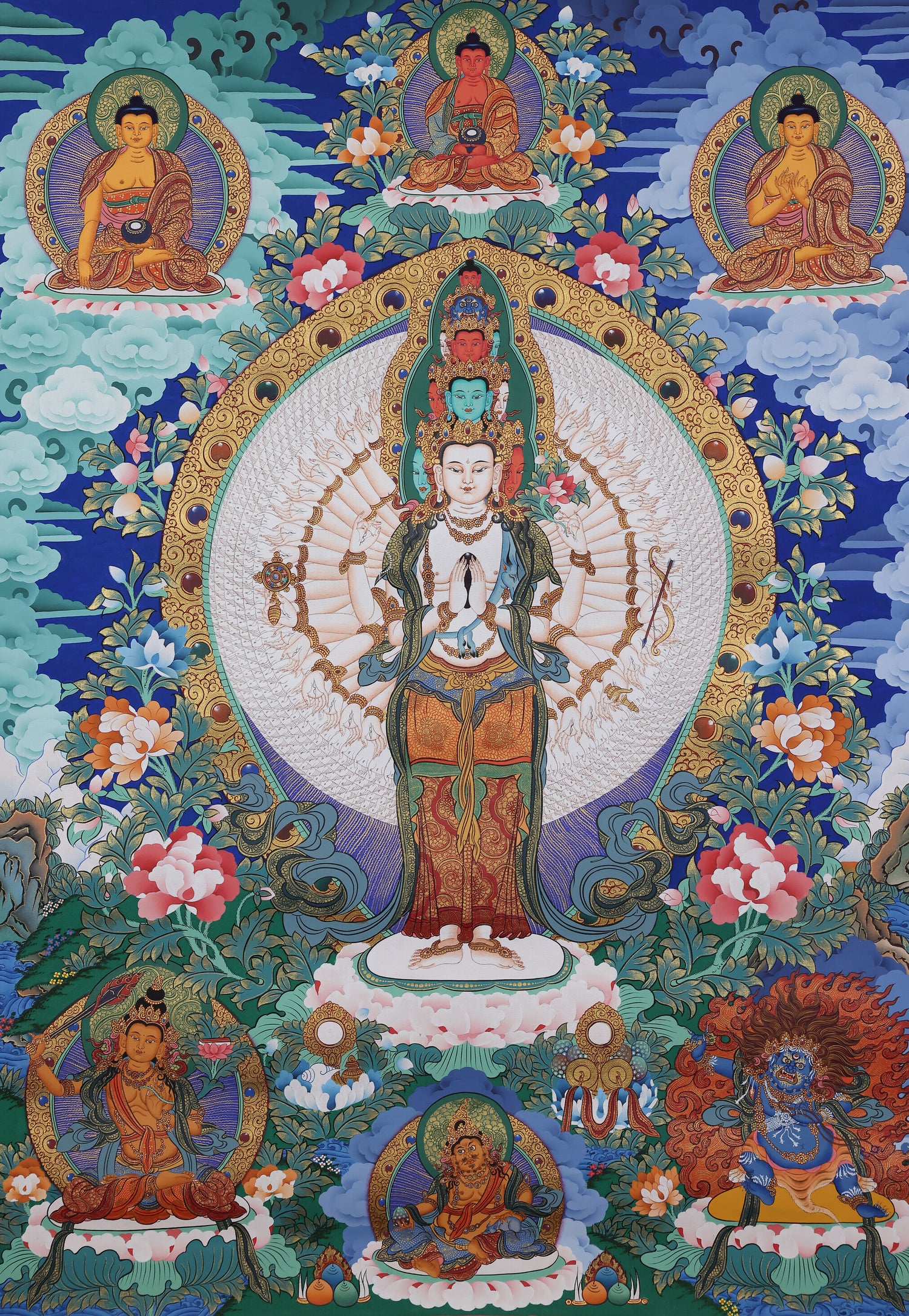
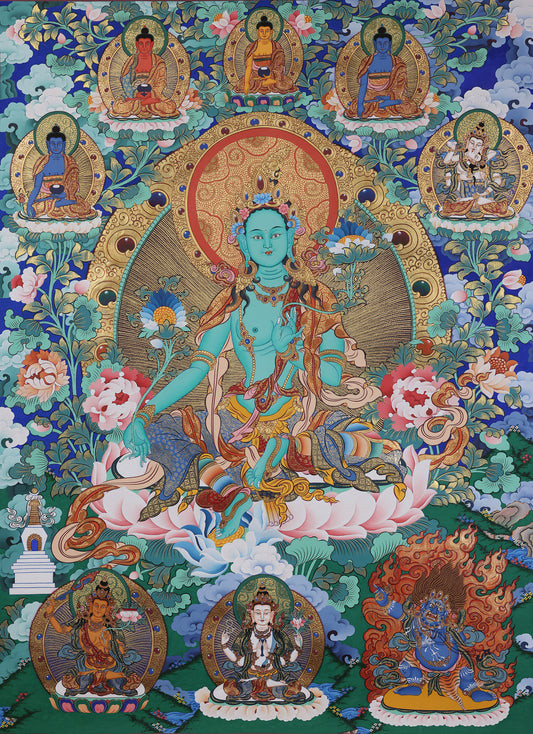
This thangka centers on Samantabhadra Bodhisattva, forming a "Mandala of the Power of Great Practice Vows" with profound symbolic significance. Within the Tibetan Buddhist system, Samantabhadra Bodhisattva is revered as the highest embodiment of perfecting the Bodhisattva path. Together with Manjushri Bodhisattva's wisdom, they represent the core Buddhist principle of "the union of compassion and wisdom." This thangka is not merely a religious artwork but a microcosm of a complete practice system and cosmic order.
The mandala's structure visually interprets Samantabhadra's "Ten Great Vows." Every compositional layer and symbol embodies "practice"—the transformation of wisdom into altruistic action through concrete deeds. In Vajrayana practice, visualizing this mandala signifies merging oneself with Samantabhadra's vast vows, seeking blessings to translate virtuous aspirations into tangible actions. For modern practitioners, it transcends being a mere object of devotion; it serves as a spiritual compass that inspires diligence, overcomes inertia, and grounds lofty ideals in everyday life.
II. The Principal Deity: Samantabhadra Bodhisattva's Iconography and Religious Significance
Samantabhadra Bodhisattva (Tibetan: Kuntu Zangpo) at the composition's center meticulously adheres to the Treatise on Iconometry while encapsulating the philosophical essence of the Avatamsaka Sutra. Each detail is a doctrinal allegory.
-
Form and Color: The principal deity typically exhibits a serene and compassionate countenance, with a tranquil expression and gently lowered eyes, symbolizing profound concentration and inner peace amid boundless practice. The body is often white or light-skinned. In Tibetan Buddhist color symbolism, white represents "purity" and the "Wisdom of Equality," signifying Samantabhadra's undiscriminating compassion toward all beings.
-
Attire and Attributes: Adorned with a Five-Buddha Crown symbolizing the wisdom of the Five Dhyani Buddhas and dressed in resplendent celestial robes and jeweled ornaments. This ornamentation signifies not worldly wealth but the adornment of the spiritual path with immeasurable merit. The hand gestures (mudra) or ritual implements—such as a wish-fulfilling jewel or a stupa—are paramount. The wish-fulfilling jewel represents the compassionate fulfillment of all virtuous aspirations, while the stupa symbolizes the indestructible power of practice vows. Together, they embody the essence of "Great Practice": wisdom-guided, vow-powered, and action-realized.
-
Mount: The Esoteric Meaning of the Six-Tusked White Elephant: Samantabhadra sits serenely upon a six-tusked white elephant, his most iconic symbol. The white elephant embodies immense strength and steadfast stability, reflecting the perseverance required for Bodhisattva vows. The "six tusks" explicitly correspond to the core Mahayana practices—the Six Perfections (paramitas): generosity, ethical discipline, patience, diligence, meditative concentration, and wisdom. This illustrates that all-encompassing Bodhisattva conduct must be founded upon these six fundamental virtues.
III. Attendant Deities: The "Supportive Conditions" in the Mandala System
Although this black-and-gold thangka may feature a simplified mandala emphasizing the principal deity, its design is rooted in a complete attendant system, with each element supporting the "Great Practice."
-
Above: The Source of Wisdom: If a Buddha (e.g., Shakyamuni or Amitabha) appears at the top, it represents the ultimate source and fruition of all practice vows—the Buddha's complete teachings and enlightenment. This clarifies that "practice" is inseparable from the guidance of "wisdom."
-
Protective Forces in the Background: Within the intricate background patterns (e.g., auspicious clouds, scrolling vines), symbolic elements of protector deities like the Eight Classes of Gods and Demons are often integrated. They represent the protective energies that清除 obstacles and dispel laziness and afflictions on the path.
-
Followers of the Practice Vows: Sometimes, figures like the seeker Sudhana (善财童子) appear at the bottom, symbolizing all beings who aspire to follow Samantabhadra's vows. This conveys that anyone who sincerely commits to practice can ascend the path to awakening.
IV. Painting Technique: The "Material and Spiritual Duality" of Black-and-Gold Thangkas
This thangka belongs to the distinguished category of "Black-and-Gold Thangkas," where the exquisite artistry of schools like Rebgong converges with strict religious protocols.
-
Base and Background: The "Canvas of Emptiness": Premium thickened cotton cloth is repeatedly coated with glue, layered with ground material, and polished to a smooth, mirror-like finish. The black background, painted with natural mineral ink or meticulously prepared lampblack ink, must be even, deep, and rich. In tantric symbolism, this profound black represents the "Wisdom of the Dharmadhatu" and the emptiness of phenomena—the foundational "space" from which all merit manifests.
-
Gold Outlining: The Manifestation of "Eternal Merit": All patterns are outlined and painted using 24K pure gold powder or paste from ground gold leaf. This demands exceptional skill and devotion. Artists employ "iron-wire lines" to delineate the principal deity's firm contours and "scrolling vine lines" for fluid background motifs. By modulating gold density and brushstroke layering, they create nuanced texture and luminosity on the deity's form, garments, implements, and decorative elements. Here, gold transcends ornamentation; it symbolizes the luminous wisdom and everlasting merit arising from emptiness.
-
Composition and Style: A Focused Field for Contemplation: Black-and-gold thangkas eschew complex colors, relying solely on the stark yet harmonious contrast between black and gold. This minimalist visual language eliminates distraction, allowing practitioners to concentrate deeply on the deity's form and symbolism. Its dignified, serene, and radiant quality aligns perfectly with the tantric practice of uniting calm abiding (shamatha) and insight (vipashyana).
V. Cultural Depth: The Black-and-Gold Thangka as a "Material Support for Practice Vows"
In Tibetan Buddhist culture, such a black-and-gold Samantabhadra thangka holds multidimensional significance:
-
A Sacred Ritual Object: Throughout the painting process—from stretching the canvas to the final gold stroke—accomplished artists observe pure conduct and recite mantras, infusing the artwork with spiritual energy. Thus, it is considered a blessed support, a potent link between the practitioner and Samantabhadra's vow-power.
-
A Practice Manual: The image itself is a visual rendition of the Chapter on the Practices and Vows of Samantabhadra. Daily veneration, visualization, and reflection on it remind devotees to integrate the Ten Great Vows—such as paying homage to all Buddhas, praising the Tathagatas, making vast offerings, and repenting misdeeds—into their thoughts and actions.
-
A Philosophical Diagram: The interplay of black and gold visually expounds the profound doctrine of "dependent arising and emptiness" (pratityasamutpada-shunyata). The black ground of emptiness and the golden manifestations of merit are non-dual. This teaches practitioners to actively create virtuous causes while understanding the empty nature of all things, engaging widely in altruistic deeds.
Conclusion
This Black-and-Gold Thangka of Samantabhadra Bodhisattva is a treasure born from the fusion of wisdom and artistry from the Tibetan plateau. It is both a masterpiece of great aesthetic value, worthy of preservation across generations, and a "portable mandala" encapsulating Buddhism's complete practical philosophy. For contemporary seekers of spiritual depth, it stands as a silent yet potent guide, ever reminding us that a truly fulfilled life begins with making vast vows like Samantabhadra and enacting them through resolute, wise, and unwavering practice.
#SamantabhadraThangka
#BlackAndGoldThangka
#TibetanBuddhistArt
#MandalaArt
#HandPaintedThangka
#BuddhistPractice
#VajrayanaArt
#SacredArtCollector
#MeditationArt
#GoldOnBlackArt
#BodhisattvaArt
#ThangkaPainting
#HimalayanArt
#SpiritualPractice
#BuddhistIconography