The Immediate Embodiment of Compassion: An Introduction to Tara in Tibetan Buddhism

Amidst the sacred mountains and holy lakes of Tibet, and in the whispers of pilgrims spinning prayer wheels, "Drolma" (the Tibetan term for Tara) is an omnipresent sacred symbol. Unlike the distant majesty of the Buddha or the awe-inspiring wrath of fierce deities, she embodies maternal compassion, making her the "Mother of Deliverance" who is closest to all sentient beings in Tibetan Buddhism. Whether it is believers facing disasters or modern people seeking spiritual solace, all can find strength in the faith of Tara. This article will take you on a comprehensive journey to understand this "immediate embodiment of compassion" — from her origin and identity, her position in the Buddhist pantheon, to the symbolic system of the Twenty-One Taras, uncovering the mystery of this sacred female deity in Tibetan Buddhism.
I. Who is Tara? — From the Sanskrit "Tārā" to the Tibetan "Drolma"
1. Basic Definition and Multiple Identities
Tara, known as "Tārā" in Sanskrit (transliterated as "Dare") and "sgrol ma" (Drolma) in Tibetan, was historically referred to as "Avalokiteśvara Bodhisattva of the Many Lotuses" or "Guanyin of the Many Lotuses" in Chinese. She is also called the "Holy Savior Buddha-Mother". In Tibetan Buddhist teachings, she holds three core identities:
1. Manifestation of Avalokiteśvara Bodhisattva: Her most fundamental identity — Tara is a female deity manifested by the compassionate Avalokiteśvara Bodhisattva to deliver sentient beings. Together with Avalokiteśvara Bodhisattva and Padmasambhava, she is known as the "Three Supreme Beings of the World", jointly undertaking the mission of widely delivering all beings.
2. Mother of the Buddhas of the Three Times: Endowed with wisdom and compassion, she nurtures the virtuous roots of all sentient beings. Thus, she is revered as the "Mother of the Buddhas of the Three Times" and "Mother of All Sentient Beings", symbolizing the origin of life and the hope of liberation.
3. Deity of Delivering from Suffering: With "savior" as her core mission, she can dispel the "eight inner calamities and eight outer calamities" (such as disasters caused by lions, fire, imprisonment, illness, etc.), and is regarded by believers as "compassion that responds immediately".
2. Origin Myths: From Princess Wisdom Moon to the Tears of Guanyin
The origin of Tara is intertwined with touching Buddhist narratives, with two core legends:
4. The Vow of Princess Wisdom Moon: According to Buddhist scriptures, in the distant "World of Various Lights" during the era of Buddha Drum Sound, there was a princess named "Wisdom Moon". She offered countless virtuous roots to the Buddha and the sangha. When advised to vow to transform into a male body to attain Buddhahood, Princess Wisdom Moon firmly declared: "There is no distinction between male and female. I wish to deliver sentient beings in a female form, saving millions of sentient beings every day, manifesting from the tears of Avalokiteśvara Bodhisattva to share in his mission of delivering beings." After cultivating through countless eons, she finally fulfilled her great vow and became the origin of Tara.
5. Manifestation from Guanyin's Tears: Avalokiteśvara Bodhisattva, using his wisdom eye to observe the six realms, saw that the suffering of sentient beings had not diminished. Overwhelmed by sorrow, he shed two tears. The tears fell to the ground and transformed into lotus flowers, from which White Tara and Green Tara emerged. The two Taras vowed to Guanyin: "We are willing to assist you in widely delivering sentient beings and freeing all suffering beings from calamities." Later, they further manifested into the Twenty-One Taras, forming a complete system of deliverance.
These myths not only endow Tara with the unique trait of "female compassion" but also highlight her core mission of "proactive deliverance" — she does not passively wait for believers' prayers but takes the initiative to observe suffering and respond immediately.

II. Tara's Position in the Buddhist Pantheon: The Core Symbol of the Female Deity
In the Buddhist pantheon, which is traditionally dominated by male deities, Tara holds a particularly special position. She is not only an "assistant" but also an "independent deity" and a spiritual symbol for female practitioners.
1. Relationship with Core Deities
6. "Deliverance Branch" Subordinate to Avalokiteśvara Bodhisattva: Tara is the embodiment of Avalokiteśvara Bodhisattva's compassion. All her merits and missions originate from Guanyin's great vows, so she is regarded as Guanyin's "manifested retinue". However, unlike ordinary retinues, Tara possesses an independent deity status, with her own mantras, rituals, and practice systems. She is a core deity group collectively revered by all schools of Tibetan Buddhism (such as the Gelug, Sakya, and Kagyu schools).
7. Oneness with Prajñāpāramitā Bodhisattva: As clearly recorded in The Encyclopedia of China, Tara is identical to Prajñāpāramitā Bodhisattva (Mother of Wisdom), hence also known as the "Prajñā Savior Tara". This means that Tara not only represents "compassionate deliverance" but also embodies "prajñā wisdom" — her deliverance is not merely a miracle but guides sentient beings to see through the essence of suffering with wisdom.
2. Popularity Among Believers: The Most Venerated Goddess in Tibet
In Tibetan areas, the faith in Tara is far more widespread than that in other deities. Whether it is the solemn statues in monasteries, thangka paintings and amulets in believers' homes, or the daily recitation of The Sutra of Tara and Green Tara Mantra, Tara's image is everywhere. This popularity stems from her "approachability":
8. Appearing in a female form, she breaks the aura of majesty surrounding traditional deities, allowing believers to feel "maternal care";
9. Her deliverance covers all aspects of life — from disasters and illnesses to poverty and lack of wisdom. Almost all the needs of sentient beings can find corresponding merits among the Twenty-One Taras;
10. The threshold for practicing her faith is relatively low. Even ordinary believers can receive blessings through reciting mantras and visualizing her image, earning her the title of the "most accessible and responsive" deity.
III. Core Symbolism: The Twenty-One Taras — A Deliverance System of Colors and Merits
Tara's identity as a "savior" is concentrated in the classification system of the Twenty-One Taras. These twenty-one Taras are not independent deities but manifestations of Tara's different merits and deliverance scenarios. Classified by body color, they can be divided into six colors: white, red, blue, yellow, green, and black, corresponding to the five dimensions of "body, speech, mind, merits, and activities".
1. Core Classification Logic of the Twenty-One Taras
11. Symbolism of Body Colors: White represents the purification of karmic actions of the body; red symbolizes the perfection of karmic actions of speech; black and blue signify the accomplishment of karmic actions of the mind; yellow stands for the accumulation of merits; green embodies the promotion of activities.
12. Deliverance Scenarios: Each Tara has a specific "specialty" — some specialize in curing illnesses, some resolve disasters, some bestow wealth, and some enhance wisdom.
13. Image Characteristics: All sit on lotus moon discs (symbolizing freedom from the mire of afflictions), holding ritual objects such as utpala flowers, treasure vases, and vajras (each with specific meanings). Their postures are either peaceful or wrathful (peaceful postures represent compassion, while wrathful postures symbolize subduing demons).
2. Detailed Introduction to the Most Representative Taras
Among the Twenty-One Taras, the following are the most well-known and core figures in the faith:
(1) Green Tara: The Principal Deity and Tara Who Delivers from the Eight Calamities
14. Identity: The leader of the Twenty-One Taras, the embodiment of all Tara's merits, also known as the "Tara Who Delivers from the Eight Calamities" (calamities caused by lions, elephants, fire, snakes, water, imprisonment, thieves, and non-human beings).
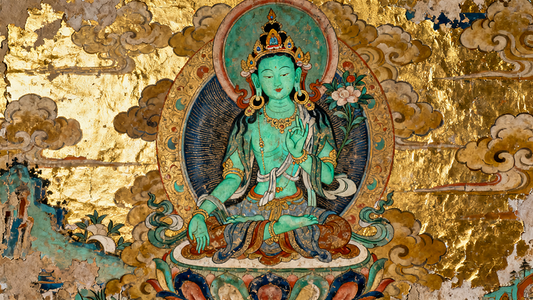
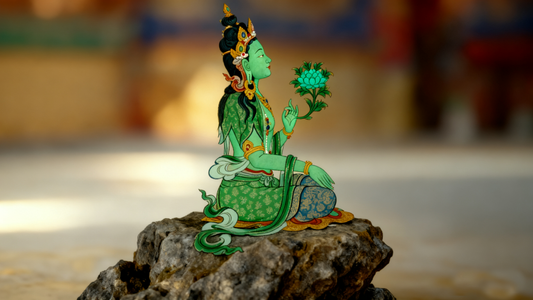
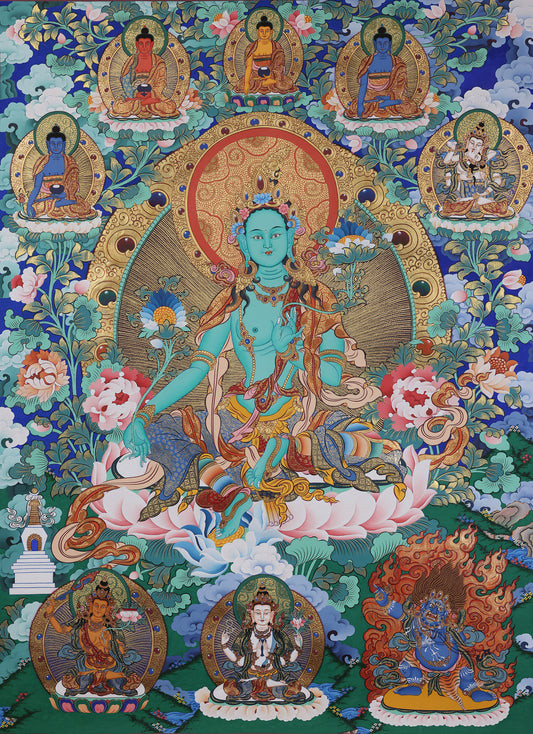
15. Appearance: Clad in emerald green, wearing a five-Buddha crown and adorned with heavenly garments and jewels. Her right leg extends down from the seat (symbolizing proactive deliverance), stepping on a lotus, while her left leg is crossed in a half-lotus posture. Her right hand forms the gesture of granting wishes (symbolizing fulfilling aspirations) and holds an utpala flower; her left hand forms the gesture of the Three Jewels and twists an utpala flower, with a kind and beautiful face.
16. Core Merits: Swiftly delivering beings from all urgent sufferings, blessing practitioners to eliminate obstacles and cultivate compassion. She is the most commonly practiced Tara deity in Tibetan Buddhism.
(2) White Tara: The Mother of Longevity and Purification
17. Identity: Manifested from the left eye tear of Guanyin, symbolizing "purification and longevity". Together with Green Tara, she is known as the "Two Jewels of Tara". Legend has it that she is the manifestation of Princess Wencheng.
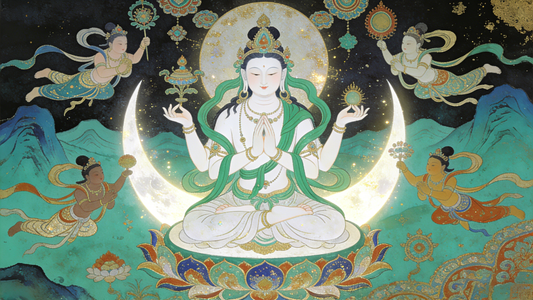
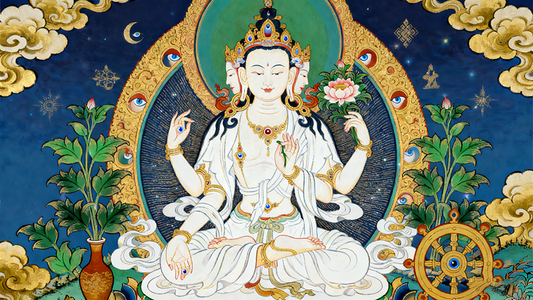
18. Appearance: As white as snow, with a bright and pure face. She has one eye on each of her eyes (three eyes in total) and one eye on each of her hands and feet (seven eyes in total), symbolizing "observing the suffering of all sentient beings". She holds a lotus with a longevity vase on it and forms the gesture of granting wishes.
19. Core Merits: Eliminating illnesses and prolonging life, purifying the karmic obstacles of body, speech, and mind, and bestowing peace and auspiciousness. She is the main object of prayer for the elderly and the sick.
(3) Other Important Taras
20. Tara of Abundant Treasures: With a yellow body, holding a treasure vase filled with jewels. She specializes in bestowing wealth and eliminating poverty, suitable for praying for smooth careers and abundant financial resources.
21.Healing Tara: With a green body, holding a glowing coconut (symbolizing healing). She is proficient in curing all illnesses, especially difficult and complicated diseases, and is a spiritual support for medical workers and patients.
22. Tara Who Delivers from Prison Calamities: With a red body, holding a vajra hook. She focuses on resolving prison disasters and legal disputes, protecting believers from punishment.
23. Demon-Subduing Tara: With a black body, three wrathful round eyes, and holding a phurba (vajra dagger). She specializes in subduing demonic obstacles and breaking evil spells, protecting practitioners from external evils.
3. Core Symbolism of Tara: The Dual Dimensions of Compassion and Deliverance
The symbolic significance of Tara goes far beyond being a "goddess"; she is the embodiment of the compassion ideology in Tibetan Buddhism:
24. "Immediate Response" Compassion: Unlike other deities that require long-term practice to connect with, Tara's core trait is "immediate deliverance" — as long as believers pray with sincerity, she can respond quickly and dispel suffering. This is why she is called the "immediate embodiment".
25. Awakening of "Female Power": In traditional religions, female deities often play auxiliary roles. However, as an independent female deity, Tara demonstrates the core idea that "compassion is power". Her existence proves the equal status of women in practice and deliverance.
26. Practice of "Afflictions Are Bodhi": Tara's deliverance is not about "eliminating the appearance of suffering" but guiding sentient beings to awaken amidst suffering. By praying to Tara, believers not only receive external protection but also cultivate inner compassion and wisdom, ultimately escaping the suffering of samsara at its root.

IV. The Practice of Tara Faith: From Mantras to Daily Life
For beginners, the faith in Tara is not an unreachable theological concept but a spiritual practice that can be integrated into daily life. Below are the most basic ways of practice:
1. Reciting Tara Mantras
Reciting Tara mantras is the most direct way to connect with Tara. The core one is the Green Tara Mantra: "Om Tare Tuttare Ture Soha" (Sanskrit pronunciation).
27.Meaning: This mantra encompasses all the merits of Tara. Reciting it once is equivalent to reciting all Tara sutras and mantras. It is simple and easy to remember, making it suitable for beginners.
28. Method: Recite it 108 times a day (a common number in Tibetan Buddhism), which can be counted with a prayer bead. While reciting, visualize the image of Green Tara, hold compassion in your heart, and pray for yourself and all sentient beings to be free from suffering.
2. Visualization and Worship
29. Visualization: During meditation, visualize Green Tara (or other Taras) standing on a lotus moon disc. Imagine her radiance shining upon you, transforming your pain and afflictions into black smoke, which is purified by Tara's light.
30. Worship: You can place a Tara thangka or statue at home, and offer fresh flowers, clean water, and butter lamps. No complicated rituals are required; just treat them with respect, symbolizing "offering compassion with a pure heart".
3. Practicing Compassion: The Core of Tara Faith
Tara's deliverance is not a "one-way bestowal" but a "two-way resonance" — only when believers practice compassion and help others can they truly connect with Tara's compassionate heart. Therefore, the essence of Tara faith is: "Taking Tara as a role model, delivering oneself and others in life."
V. Modern Perspective: The Universal Value of Tara Faith
In today's era filled with anxiety and uncertainty, the value of Tara faith has long transcended religious boundaries and become a universal spiritual sustenance:
31. Courage in the Face of Suffering: Tara's "deliverance from the eight calamities" symbolizes firmness and hope in the face of crises, reminding us that even in difficult situations, there is always the possibility of "being delivered".
32. Recognition of Female Power: As a female deity, Tara provides a spiritual role model for modern women — she proves that "tenderness and compassion are also a form of strength".
33. Inner Peace and Healing: The process of reciting mantras and visualizing Tara is essentially a form of meditation and mindfulness practice, which can help modern people relieve stress, purify their minds, and achieve inner peace.
Conclusion: Walking with Compassion, Encountering Tara
Who is Tara? She is the compassionate tear of Avalokiteśvara Bodhisattva, the great vow of Princess Wisdom Moon, the maternal figure in the hearts of Tibetan believers, and the "immediate embodiment" in the hearts of all who seek compassion and strength. She does not require us to recite complicated sutras or achieve advanced levels of practice; all she asks is for us to have a sincere heart, believe in the power of compassion, and practice kindness.
Whether it is a Tibetan pilgrim spinning prayer wheels or an office worker in the city; whether it is someone facing difficulties or someone pursuing spiritual growth — all can find their own comfort and direction in the faith of Tara. For the essence of Tara is "compassion" itself — it is everywhere, always ready to respond to every call.
May we all encounter Tara in compassion and become "Taras" in the lives of others.
Bring Tara Practice Into Your Sacred Space
Recommended pieces and collections
Schlagwörter:
Vorherige
Understand Green Tara in 3 Minutes: Who is the "Goddess of Compassion" in Tibetan Buddhism?
Nächste
Twenty-One Manifestations, Myriad Compassion: An In-Depth Interpretation of the Twenty-One Taras' Wisdom and Power