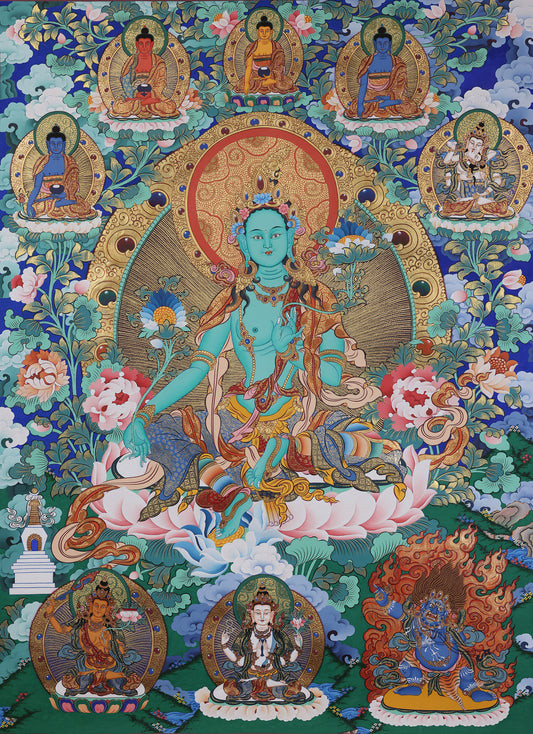
When a matte silver-gray thangka unfolds, what you see is not just a combination of colors and lines, but the millennium-old wealth philosophy and craft wisdom of Tibetan Buddhism—this is the hand-painted Tibetan silver thangka of Yellow Jambhala we’re exploring today.
I. Tibetan Esoteric "Wealth Protector Mandala": More Than a "Luck-For-Wealth" Spiritual Carrier
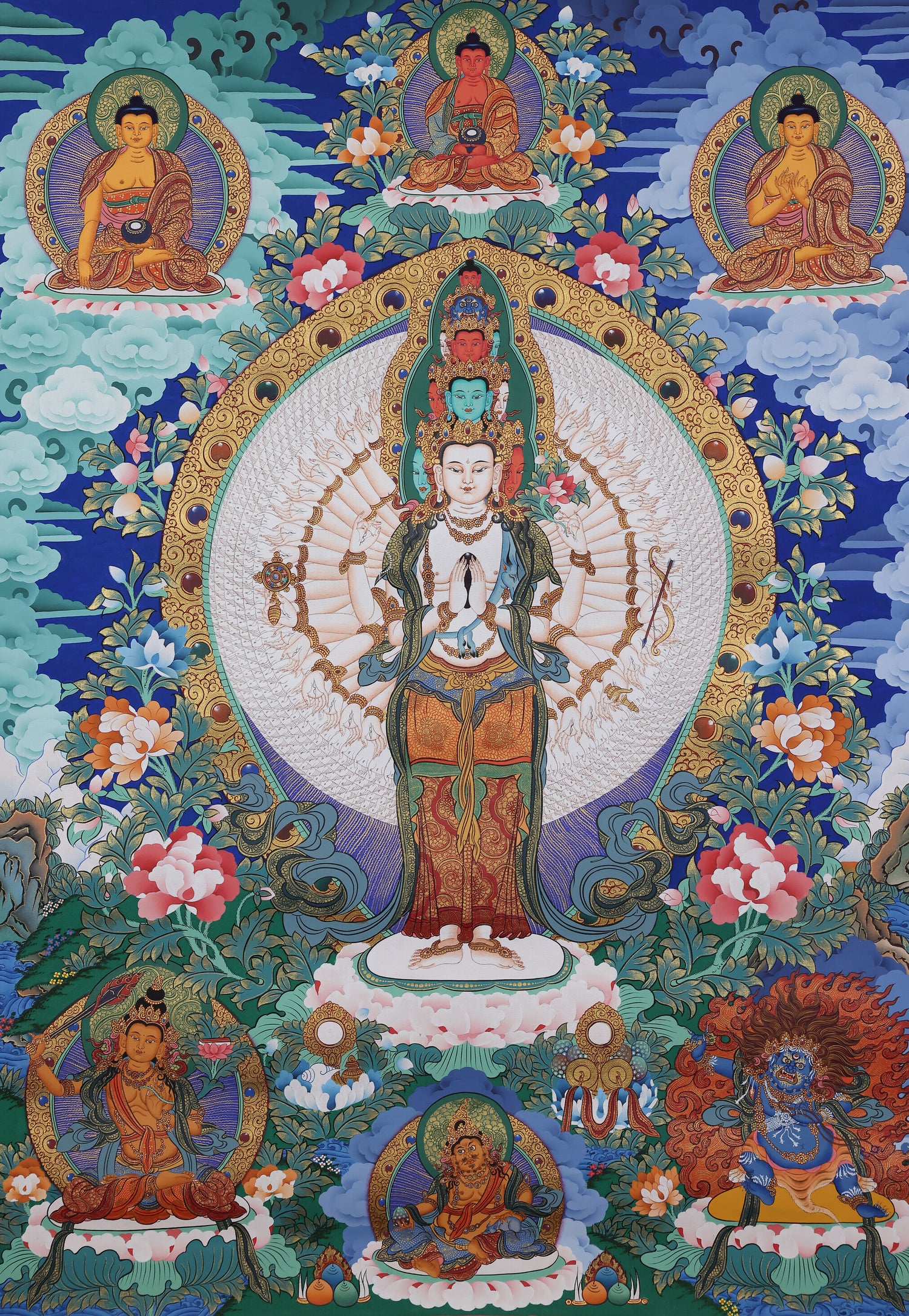
Many people’s first impression of a Yellow Jambhala thangka is "attracting wealth," but Tibetan Buddhism’s view of wealth goes far beyond that. This 45×60cm work centers on the "Wealth Protector Mandala" with Yellow Jambhala as the main deity: In the Tibetan esoteric system, Yellow Jambhala (Zambala in Tibetan) is the head of the Five Jambhalas, holding dual roles as a "Buddhist Dharma protector" and a "giver of spiritual/material provisions"—he guards not secular greed, but pure provisions that "free practitioners from poverty and enable them to practice generosity."
The entire composition follows strict mandala logic: The main deity at the center gathers core blessings, attendant deities positioned at the four corners assist in protection, and background cloud patterns and sacred vessels symbolize the "complete cycle of wealth energy." For Tibetan believers, enshrining this thangka means "using wealth as a tool to connect practice and daily life."
II. Main Deity: Yellow Jambhala—Every Detail Is a Code of Tibetan Esoteric Rituals
The Yellow Jambhala at the center of the painting is a standard "wrathful manifestation" in Tibetan esoteric rituals, with each feature carrying clear symbolism:
-
Form and Countenance: The "golden-yellow body" set against the silver thangka base corresponds to the "Earth" element in the five elements, symbolizing stable and abundant wealth; the three wide-open eyes represent the wisdom to "perceive the karmic causes of wealth across the three realms"; fangs and raised eyebrows are not "ferocity," but a deterrent to subdue "karmic obstacles of poverty"; the round, protruding belly is not a "sign of greed," but a concrete expression of compassion that "embraces all suffering beings."
-
Implements and Posture: The "Cintāmaṇi (wish-fulfilling jewel)" (partially visible in the right hand) symbolizes "fulfilling all virtuous wishes"; the "Nāga-mouse (Nüli)" held in the left arm spits jewels, implying that "wealth should be given outward rather than hoarded"; in the "Lalita Asana" (left leg curled, right foot resting on a conch), the conch is a symbol of "retrieving treasures from the sea"—Tibetan esotericism holds that wealth is the result of "using wisdom to understand karmic conditions."
-
Ornaments and Aura: The Five-Buddha Crown represents the wisdom blessings of the Five Dhyani Buddhas; the necklaces and bracelets symbolize the "majesty of virtue" in practice; the double-circle aura (inner layer: green and white for purity; outer layer: gold for merit) and multi-layered lotus throne emphasize that "wealth must be rooted in a pure mind, free from attachment."
III. Attendant Deities: The "Functional Team" of Wealth Protection
The four attendants surrounding the main deity are "auxiliary enforcers" in the Yellow Jambhala system, each with a clear protective focus:
-
Red Jambhala Manifestation (top left): (Red-hued, holding a lotus) Governs "relationship-based wealth," protecting business collaborations and interpersonal harmony;
-
Green Jambhala Manifestation (top right): (Green-tinted, holding a victory banner) Governs "career-based wealth," supporting career expansion and resource aggregation;
-
Dragon-Riding Protector (bottom left): Governs "wealth protection," with a dragon mount symbolizing "subduing karmic obstacles to wealth loss";
-
Black Jambhala Manifestation (bottom right): (Black-hued, holding a vase) Governs "emergency wealth," resolving sudden financial crises.
The "Kalaśa (auspicious bird)" at the top and the "treasure basin" at the bottom are additional auspicious symbols: The Kalaśa transmits "auspicious fortune," while the treasure basin symbolizes "the accumulation and rational distribution of wealth."
IV. Silver Thangka Base + Mineral Pigments: A "Living Fossil" of Millennia-Old Craftsmanship
Half the value of this thangka lies in its spirituality; the other half lies in its craftsmanship:
-
Silver Thangka Base: Unlike the opulence of gold thangkas, silver thangkas use "silver powder + natural glue" applied to cotton fabric, polished into a matte, fine texture—this aligns with the Tibetan esoteric aesthetic of "wealth protectors needing modesty and dignity" while allowing mineral pigments to adhere more stably; over time, the silver base develops a warm patina, a "texture bestowed by time."
-
Mineral/Earth Pigments: All pigments are derived from natural minerals (cinnabar, azurite, malachite) and earth materials (red earth, yellow earth), following the Tibetan intangible cultural heritage technique of "mineral pigment water-floating": Minerals are ground to a nanoscale (2-3μm), purified via water-floating, and mixed with glue—this is why thangka colors remain vibrant after centuries: the red of cinnabar, blue of azurite, and yellow of orpiment are "eternal colors gifted by nature."
V. Ü-Tsang School Style: Balancing Ritual Rigor and Artistic Beauty
This thangka belongs to the indigenous Tibetan Ü-Tsang school, blending ritual discipline and artistic expression:
- Compositionally, it strictly follows "mandala symmetry," with clear layers (main deity → attendants → background) in line with the Iconometric Canon;
- Lines are rendered in "iron-wire strokes," with subtle thickness variations precisely depicting garment folds and implement details;
- The matte silver base makes colors understated yet solemn, avoiding the "attachment cues" that excessive opulence might evoke;
- Background decorations (cloud patterns, lotus flowers) integrate Tibetan natural elements through "simplified realism," serving both the spiritual atmosphere and visual appeal.
Conclusion: More Than a Thangka—A "Lived-in Carrier" of Tibetan Esoteric Wisdom
This 45×60cm silver thangka of Yellow Jambhala epitomizes Tibetan Buddhism’s wisdom of "supporting practice with wealth": It is not a secular "luck charm," but a spiritual reminder that "wealth should serve practice and generosity"; meanwhile, the combination of silver thangka craftsmanship and mineral pigments makes it a "living sample" of millennium-old thangka techniques.
For Tibetans, it is a spiritual companion in the shrine; for culture enthusiasts, it is a dual treasure of Tibetan esoteric symbols and traditional craftsmanship—this is the timeless charm of thangkas.
#TibetanSilverYellowJambhalaThangka #TibetanBuddhistWealthPhilosophy #ThangkaCraftExplained #MineralPigmentThangka #ÜTsangSchool #TibetanEsotericMandala #YellowJambhalaRituals #HandPaintedThangka #TibetanIntangibleCulturalHeritage #ThangkaCulturalInterpretation