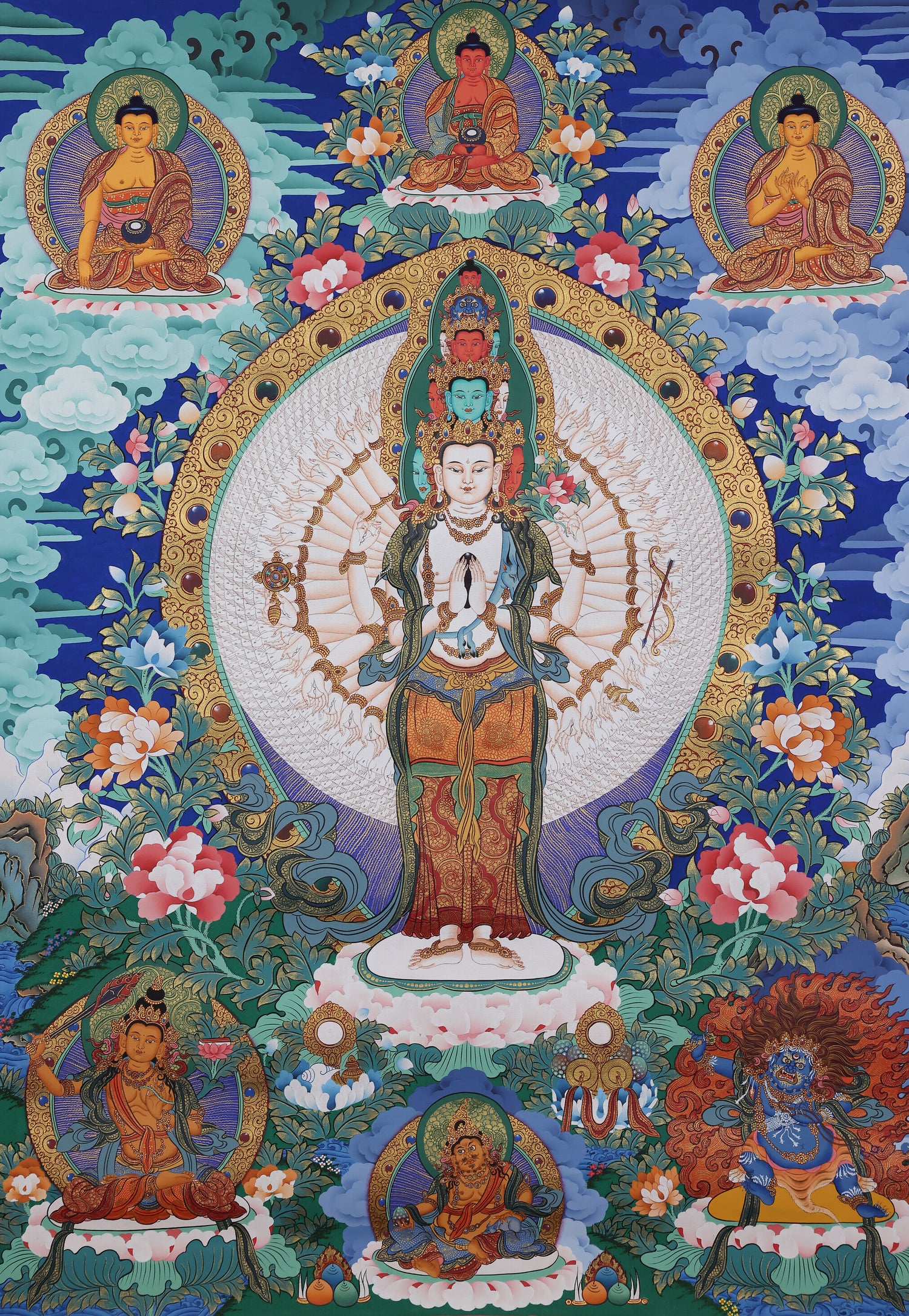
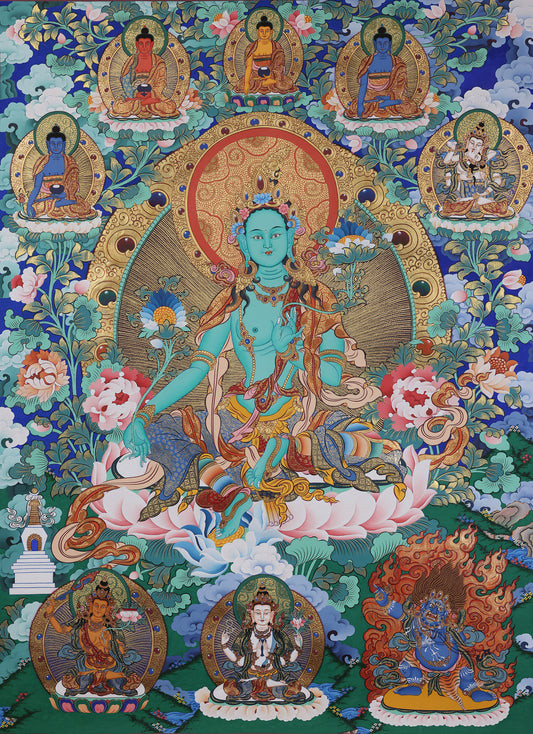
When a 45×60cm hand-painted color thangka from Nepal unfolds, the white Vairocana Buddha, red Amitabha Buddha, green Amoghasiddhi Buddha amid blue clouds, paired with the attendant Bodhisattva and protector below, are not just a feast for the eyes—they are a cultural code where Tibetan esoteric Buddhism and Newari art converge. This thangka, painted with mineral and earth pigments, is a contemporary masterpiece of Nepal’s Newari painting school and a visual vessel for the Tibetan esoteric “Five Dhyani Buddhas Mandala.” Today, we unlock its devotion and aesthetics through three dimensions: theme, iconography, and craftsmanship.
1. Theme: The Dharmic Order of the Five Dhyani Buddhas in the Vajra Realm (Tibetan Esoteric Buddhism)
At the heart of this thangka lies the cosmic logic of the Five Dhyani Buddhas Mandala of the Tibetan Esoteric Vajra Realm: Vairocana Buddha as the source of the Dharmakaya, unifying the four directional Buddhas to form a liberation system of “one Buddha manifesting five wisdoms.”
In the teachings of the Vajrasekhara Sutra Commentary, Vairocana Buddha (the “Buddha of Universal Radiance”) is the Dharmakaya Buddha representing the “wisdom of the Dharmadhatu’s essential nature.” The four directional Buddhas—Akshobhya (East), Ratnasambhava (South), Amitabha (West), and Amoghasiddhi (North)—are manifestations of his “five wisdoms”: corresponding to the “mirror-like wisdom, equality wisdom, discriminative wisdom, and all-accomplishing wisdom,” they purify the poisons of anger, pride, greed, and jealousy, and transform the five aggregates (form, feeling, perception, formation, consciousness).
The thangka’s layout is a tangible mandala: Vairocana Buddha sits at the center on a lotus throne (symbolizing “innate purity”), the four directional Buddhas are placed above, below, left, and right (aligning with spatial directions), retinue divinities surround them, and the background of blue clouds, pink peonies, and turquoise landscapes visualizes the “pure land”—adhering to the esoteric principle of “expressing Dharma through imagery” while continuing Nepal’s thangka tradition of “painting as mandala.”
2. Central Deity & Retinue Divinities: Symbolic Codes in Iconographic Rituals
Every deity’s form, color, and mudra (hand gesture) is a “symbolic language” of Tibetan esoteric Buddhism, and this thangka’s iconography strictly follows the rituals of the Iconometric Canon:
1. Central Deity: Four-Faced, Two-Armed Vairocana Buddha
The white deity at the core is the four-faced, two-armed Vairocana Buddha:
- His milky-white skin symbolizes “innate purity and freedom from defilement”; his four faces face the four directions (representing “universal illumination of the Dharmadhatu”), and he wears a Five-Buddha Crown (implying karmic connection to the four directional Buddhas);
- His hands form the Dharmachakra Mudra (gesture of turning the Dharma wheel), with a Dharma wheel resting in his palms (symbolizing “turning the Dharma wheel to liberate sentient beings”);
- He is dressed in Bodhisattva attire (a syncretic esoteric-exoteric iconographic feature) adorned with ornaments—this form embodies the Dharmakaya Buddha of “universal radiance and accomplishing all tasks” as described in the Vajra Pinnacle Sutra.
2. Four Directional Attendant Buddhas: Spatial Manifestations of the Five Wisdoms
The three Buddhas surrounding the central deity are the “four directional Buddhas” of the Vajra Realm:
-
Red Buddha Above: Amitabha Buddha (Lord of the Lotus Family), with vermilion skin and hands in the meditation mudra—symbolizing “discriminative wisdom,” purifying greed, and corresponding to the aggregate of perception; his pure land is Sukhavati (the Western Paradise);
-
Green Buddha on the Right: Amoghasiddhi Buddha (Lord of the Karma Family), with emerald skin and hands in the fearless mudra—symbolizing “all-accomplishing wisdom,” purifying jealousy, and corresponding to the aggregate of formation; his pure land is the “Pure Land of Victorious Actions”;
-
Blue/White Buddha on the Left: Akshobhya Buddha (Lord of the Vajra Family) or Ratnasambhava Buddha (Lord of the Jewel Family)—Akshobhya has cyan-blue skin (purifying anger), while Ratnasambhava has golden-yellow skin (purifying pride); together, they complete the retinue system of the “four directional Buddhas.”
3. Attendant Divinities: Dual Functions of Wisdom & Protection
The two divinities at the bottom of the thangka are Vairocana Buddha’s “close attendants”:
-
Orange Divinity on the Left: Manjushri (or Vajra 波罗蜜 Bodhisattva), with orange-yellow skin, holding a sword and scripture—symbolizing “wisdom cutting through afflictions,” a manifestation of Vairocana’s “wisdom of the Dharmadhatu’s essential nature,” and one of the “Four Paramita Bodhisattvas” of the Vajra Realm;
-
Blue Wrathful Divinity on the Right: Acala Vidyaraja (or Yamantaka), with deep blue skin surrounded by flames—Vairocana’s wrathful incarnation, tasked with “subduing demons and protecting the Dharma,” embodying the esoteric-exoteric balance of “peaceful + wrathful forms” in Nepalese thangkas.
3. Newari School Craftsmanship: Millennial Devotion in Mineral Pigments
This thangka is a hand-painted work of Nepal’s Newari School of Painting, whose craftsmanship is a dual practice of “devotion and skill”:
1. Canvas: From Linen to “Vessel of Divinity”
Using coarse linen as a base, a mixture of white clay and animal hide glue is applied, then air-dried and polished repeatedly with pebbles—this “canvas hardening process” is a Newari thangka tradition: it not only smooths the canvas to paper-like texture but also ensures pigment adhesion, laying the foundation for “fading resistance over millennia.”
2. Pigments: Gifts of the Earth & Minerals
All pigments are natural mineral and earth pigments, each color a “vessel of devotion”:
- White: Ground pearls and shells (taking months to grind to a water-suspending fineness);
- Red: Cinnabar and red coral (Amitabha’s skin tone, symbolizing “compassion”);
- Green: Turquoise and malachite (Amoghasiddhi’s skin tone, symbolizing “accomplishment”);
- Blue: Lapis lazuli (Akshobhya’s skin tone, symbolizing “immutability”);
- Gold: 24K gold leaf (for linework and halo decoration, symbolizing “perfection”).
Pigments undergo “grinding → glue mixing → layered shading”; no industrial ingredients are used—this “honoring divinity with nature” is a Newari painter’s heritage.
3. Painting: Ritual-First Creative Logic
Strictly following the process of “drafting (proportioning per the Iconometric Canon) → coloring (shading from light to dark) → linework (gold lines for garment patterns) → eye-opening (final step, symbolizing “bestowing divinity”),” a 45×60cm thangka takes 3–6 months to complete—for Newari painters, “painting a thangka” is not creation, but a practice of “dialoguing with the Buddha.”
4. Cross-Cultural Soul: Symbiosis in Himalayan Art
This thangka is more than a religious ritual object—it is a “symbiotic body” of Himalayan art:
It merges the iconometric proportions of Indian Pala art, the ritual system of Tibetan esotericism, and the color aesthetics of Nepal’s Newari school. The collision of high-saturation red, green, blue, and gold leaf luster aligns with the color codes of the Five Dhyani Buddhas while carrying the decorative flair of Newari art; the central deity’s peaceful form and the protector’s wrathful form express the Tibetan Buddhist spirit of “esoteric-exoteric balance.”
For Tibetan Buddhist practitioners, it is a “portable mandala”—contemplating the deities’ forms completes the practice of “transforming afflictions through the five wisdoms.” For art enthusiasts, it is a living heritage of the Newari school—every particle of mineral pigment is a symbiosis of devotion and aesthetics.
#Nepal Vairocana Thangka
#Newari School Thangka
#Tibetan Esoteric Five Dhyani Buddhas Mandala
#Hand-Painted Mineral Pigment Thangka
#45×60cm Color Thangka Analysis
#Vairocana Buddha Iconographic Symbolism
#Traditional Nepalese Thangka Craftsmanship
#Tibetan Buddhist Thangka Culture
#Himalayan Religious Art
#Five Dhyani Buddhas Retinue Divinities