White Tara: The Compassionate Mother of Longevity in Tibetan Buddhism – Decoding the Wisdom of a Millennium-Old Faith Through Thangka Art
wudimeng-Dec 24 2025-
0 comments
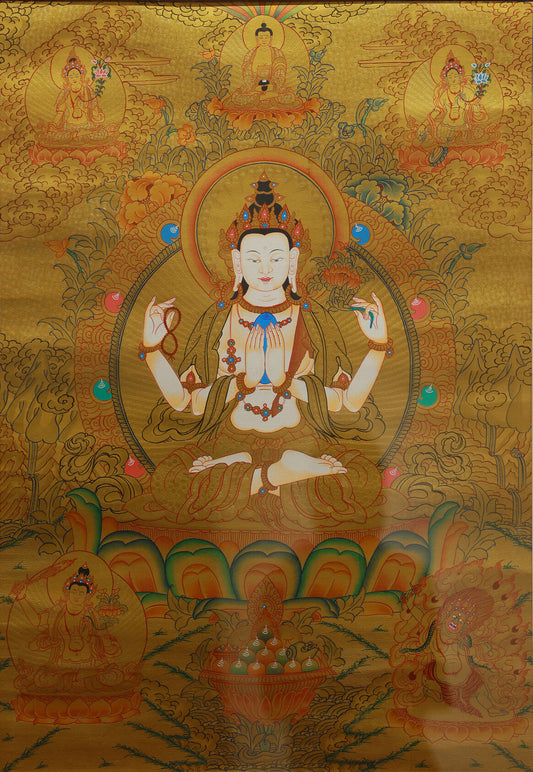
When a vivid Tibetan thangka unfolds before you: a white-robed goddess sits on a lotus throne, her eyes gently lowered, with an additional eye on her forehead, palms, and soles of her feet; her left hand cradles a blue lotus, while her right hand forms the gesture of granting wishes – this is White Tara, known in Tibetan Buddhism as the “Mother of Compassionate Wisdom and Lotus,” not a distant divine symbol, but the “most steady refuge” in Tibet’s thousand-year faith, the embodied compassion of Guanyin Bodhisattva, and a spiritual anchor for modern people navigating anxiety.
In the Tibetan Buddhist scripture The Origins of Tara, there is a timeless story of compassionate vows: when Avalokiteshvara (Guanyin) beheld sentient beings trapped in samsara, his compassion overflowed to the point of tears. A tear from his left eye fell to the earth and became White Tara; a tear from his right eye became Green Tara. The two bowed their palms and swore: “We shall share the work of liberating sentient beings; until samsara is empty, we shall not attain Buddhahood.”
This is no romantic myth, but a concrete expression of Buddhism’s “union of compassion and wisdom”:
-
White Tara’s “Source”: She is an extension of Guanyin’s “compassion,” not an independent deity. As the Tibetan text Tara’s Origins states, Tara is “born from the compassionate one, and the compassionate one is Guanyin”; her purpose is “complementary liberation” – when sentient beings need long-term protection rather than emergency rescue, White Tara appears as an embodiment of “longevity and purity.”
-
Historical Spiritual Roots: After the 11th-century master Atisha brought Buddhism to Tibet, he integrated White Tara’s teachings with Tibetan culture, making her a core practice deity in schools like Kadampa and Kagyu. The master Gampopa was once fated to die within three years due to karmic obstacles; after receiving White Tara’s empowerment, he lived decades longer. 历代 Karmapas (Gyalwang Karmas) have included White Tara in their daily practice to safeguard the Dharma.
This thangka is, in fact, a three-dimensional “White Tara doctrine manual,” where every color and symbol holds hidden meaning:
White Tara’s most iconic feature is her “seven eyes” – two on her face, plus one each on her forehead, palms, and soles. This is no artistic exaggeration, but a symbol:
- The forehead eye: Sees the root of sentient beings’ afflictions;
- The palm eyes: Protect sentient beings’ good intentions and actions;
- The sole eyes: Stabilize the foundation of sentient beings’ practice.
As Tibetan esoteric scriptures state: “Wherever the seven eyes gaze, no suffering goes unnoticed, no hardship goes unrelieved” – her compassion is not vague pity, but precise awareness that “knows and protects.”
-
White Form: Corresponding to “unstained light,” it symbolizes freedom from the defilement of afflictions, and aligns with her identity as the “Longevity Goddess” – white is associated with the moon in Tibetan culture, representing gentle, enduring vitality;
-
Lotus Moon Throne: The lotus symbolizes rising unsoiled from mud, the moon symbolizes coolness, and together they imply White Tara’s liberation is a wise protection that “abides in purity without clinging to suffering or joy.”
-
Left Hand Cradling an Utpala Lotus: The half-bloomed flower symbolizes “sentient beings yet to attain perfection”; White Tara uses the lotus as a vessel, meaning “nurturing sentient beings’ bodhicitta with virtuous Dharma”;
-
Right Hand in Varada Mudra (Gesture of Granting Wishes): Palm outward, fingers downward, representing “fulfilling sentient beings’ good wishes” – but this is not “granting every request,” but encouraging sentient beings to “make good vows and act virtuously” to free themselves from suffering through their own actions.
White Tara has never been far from Tibetan people’s lives: her image is worshipped for health at birth, her mantra is chanted for safety before travel, and her rituals are practiced for longevity in old age. Her practice system is a philosophy of “integrating compassion into life.”
The mantra “Om Tare Tuttare Ture Soha” may seem brief, but it contains a complete logic of liberation:
- “Om”: Encompasses the wisdom of all Buddhas;
- “Tare”: Guides sentient beings away from suffering;
- “Tuttare”: Emphasizes the resolve to liberate;
- “Ture”: Bestows peace and joy on sentient beings;
- “Soha”: Fulfills all good wishes.
Tibet has a saying: “Chanting the mantra one million times brings longevity and freedom from illness; chanting it ten million times fulfills all karmic aspirations.” But the true blessing is not “mantra magic,” but the process of “resonating with White Tara’s compassionate heart” during recitation – when you focus on the mantra, you are training your own compassion and concentration.
White Tara, along with Amitayus (Longevity Buddha) and Ushnishavijaya, is called the “Three Longevity Deities.” However, her “extending life” is not secular “eternal youth,” but:
-
Extending “time for practice”: Helping practitioners avoid “premature death” to complete altruistic work;
-
Extending “the life of the mind”: Using wisdom to transcend fear of aging and death, as Gampopa’s story reveals – the essence of his extended life was “breaking attachment to life and death through White Tara’s compassion.”
As modern people navigate the whirlwind of “involution” and anxiety, White Tara’s faith has transcended religion to become a universal spiritual guide:
Our anxiety often stems from “only seeing the surface of problems” – like only seeing life’s “suffering” without its root cause. White Tara’s seven eyes remind us:
- Use the “forehead eye” to examine your desires: Is anxiety rooted in unnecessary comparison?
- Use the “palm eye” to act: Instead of worrying about the future, do one small good thing in the present;
- Use the “sole eye” to ground yourself: Cultivate stable daily habits (like meditation or reading) as a “lotus throne” for your mind.
White Tara’s Varada Mudra is essentially the wisdom of “altruism first, then self-benefit.” When you show more understanding to a colleague or kindness to a stranger, you are practicing “White Tara’s compassion” – this kindness is not “sacrificing yourself,” but “connecting with the world through goodwill, so that you are ultimately surrounded by goodwill.”
White Tara’s “extending life” gives us time to complete “altruistic work.” In modern terms, this means “living a quality life”: whether focusing on work you love or accompanying family, you are “extending the length of your life’s meaning” – as Tibetan elders say: “White Tara does not give you life; she gives you the courage to live well.”
The White Tara in this thangka is not a lofty “goddess,” but the “potential for compassion” in each of us. Her seven eyes remind us to “see ourselves and others”; her Varada Mudra encourages us to “act, rather than wait for salvation.”
In this fast-paced era, perhaps we all need a “White Tara” – not to beg for blessings, but to use her image to awaken the compassion and wisdom in our own hearts. After all, the best liberation has always been “self-liberation.”
#WhiteTara #TibetanBuddhistCulture #ThangkaArt #GuanyinIncarnation #CompassionPractice #LongevityTeachings #SpiritualHealing #TibetanEsotericDeity #TraditionalCultureModernMeaning #SevenEyedBuddhaMother