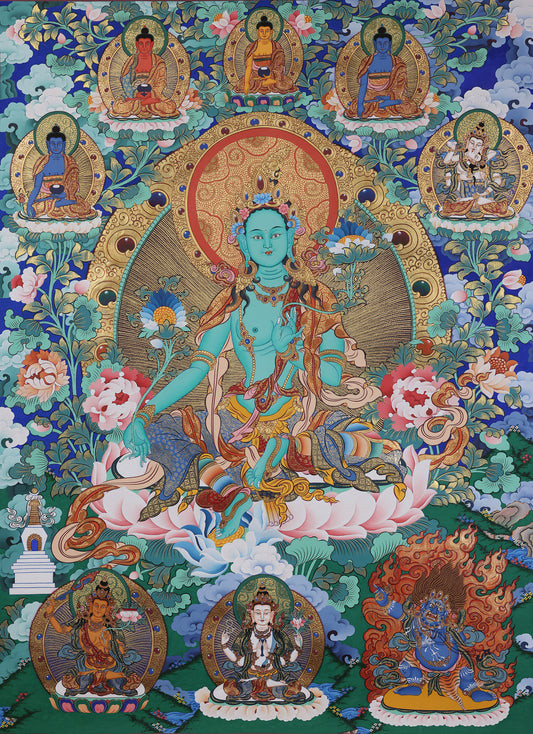
Hand-Painted Tibetan Buddhist Thangka: A Deep Exploration of Faith, Deity Iconography, and Sacred Craftsmanship through the Amitabha Pure Land Thangka

In Tibetan Buddhism, a thangka is never merely a painting. It is a sacred visual system that integrates cosmology, spiritual practice, and ritual art into a single living form. Among all thangka subjects, depictions of Amitabha Buddha and the Western Pure Land hold a particularly profound position, as they directly address humanity’s deepest spiritual concern—the liberation from suffering and rebirth.
This article centers on a hand-painted Tibetan Buddhist “Amitabha Buddha Pure Land Welcoming Thangka”, offering an in-depth analysis across five dimensions: thematic faith, principal deity symbolism, attendant deities, traditional painting techniques, and cultural significance. Through this lens, we can understand why such thangkas transcend religious boundaries and endure as living cultural heritage.
I. Thematic Foundation: A Visual Vessel for the Pure Land Faith
The core theme of this thangka is the “Amitabha Buddha Pure Land Welcoming Scene”, a visual embodiment of the Western Pure Land belief system within Tibetan Buddhism.
Amitabha Buddha—known in Tibetan as “Buddha of Infinite Light”—is revered as the lord of the Western Pure Land. His fundamental vow is to illuminate all beings with boundless light, guiding them beyond the cycle of samsara toward rebirth in a realm of purity and awakening. This faith is not solely concerned with the afterlife; it profoundly shapes how practitioners cultivate peace, clarity, and compassion in the present moment.
Unlike Shakyamuni Buddha, who manifests the Earth-touching Mudra in the human realm, Amitabha Buddha is traditionally depicted forming the Meditation Mudra while holding a begging bowl. This gesture symbolizes offering the nectar-like Dharma to sentient beings and welcoming them into the Pure Land. His red body color represents the vow of infinite light—transforming afflictions and karmic fire into luminous wisdom.
From a compositional perspective, the thangka follows the Tibetan Buddhist cosmology of the Three Realms and Five Directions:
-
The upper realm, adorned with red-gold lotus scrolls and auspicious clouds, represents the Realm of Eternal Tranquil Light.
-
The central realm, where Amitabha Buddha rests upon a lotus throne, symbolizes the Realm of True Reward and Perfect Adornment.
-
The lower realm, featuring attendant deities and ritual offerings, corresponds to the Realm Where Ordinary and Enlightened Beings Coexist.
Together, these layers form a spiritual narrative—a visual path from the mundane world to the Pure Land—serving both as an aid for daily meditation and as a contemplative focus for end-of-life Pure Land practice.
II. The Principal Deity: The Symbolic System of Red-Body Amitabha Buddha
At the center of the thangka stands Amitabha Buddha, rendered in strict accordance with the Iconometric Scriptures, following the 37:25 golden proportion. This ensures both doctrinal accuracy and visual harmony.
1. Body Color and Form
The Buddha’s body appears in a luminous crimson red, the most defining color associated with Amitabha in Tibetan Buddhism. Red symbolizes infinite light and the transformation of desire into wisdom. The flesh tone is built through layered applications of coral red and cinnabar mineral pigments, creating a sacred presence that feels both compassionate and transcendent.
2. Mudra and Sacred Attributes
Amitabha’s hands form the Meditation Mudra, holding a bowl filled with Amrita (nectar). This represents nourishing beings with the Dharma and sustaining their virtuous roots on the path toward rebirth in the Pure Land.
3. Robes, Halo, and Lotus Throne
The monastic robe draped over one shoulder is decorated with hand-applied gold lotus scroll patterns. Gold signifies the indestructibility of the Dharma, while lotus motifs symbolize purity beyond defilement.
The three-layer halo structure—body aura, head halo, and rainbow cloud aura—symbolizes Pure Land perfection, the continuity of Buddhist teachings, and the illumination of all realms.
The thousand-petaled red lotus throne reflects classical scriptural descriptions, representing liberation from suffering and the attainment of enlightenment.
III. Attendant Deities: A Functional System of Compassion and Wisdom
Amitabha Pure Land thangkas present not an isolated figure, but a complete spiritual support system.
Left Attendant: Mahāsthāmaprāpta Bodhisattva (Yellow Body)
Yellow represents growth, merit, and spiritual power. Mahāsthāmaprāpta is regarded as the embodiment of Amitabha’s strength, protecting practitioners from regression. Holding a lotus, he symbolizes the guidance of wisdom.
Right Attendant: Four-Armed Avalokiteśvara (Blue Body)
Blue signifies pacification and obstacle removal. Holding a nectar vase and prayer beads, this form of Avalokiteśvara embodies boundless compassion, cleansing karmic obscurations and guiding beings toward liberation. Together with Mahāsthāmaprāpta, they form a union of compassion and wisdom.
Lower Offerings
Treasure vases, white geese, and the Seven Precious Treasures represent abundance, purity, and the absence of scarcity in the Pure Land—where beings are nourished by virtue and delight in the sound of Dharma.
IV. Sacred Craftsmanship: The Union of Mineral Pigments and Spiritual Practice
This thangka belongs to the Regong (Rebgong) painting tradition, faithfully preserving all twelve traditional hand-painting processes. In Tibetan Buddhism, craftsmanship itself is a form of practice.
From canvas preparation and mineral pigment refinement to 24K gold detailing, ultra-fine line drawing, and the “three-shade, three-blend” facial technique, each step integrates devotion with skill.
The final step—the eye-opening ritual—symbolizes the awakening of enlightened awareness, transforming the artwork into a consecrated ritual object.
V. Cultural Significance: A Living Heritage of Faith and Art
This Amitabha Buddha thangka embodies a dual identity: a sacred ritual object and a cultural treasure.
Spiritually, it serves as a powerful aid for visualization and Pure Land contemplation. Artistically, it preserves the Regong tradition’s mastery of mineral pigments and hand craftsmanship, ensuring exceptional durability and long-term preservation.
In Tibetan Buddhist culture, a thangka is never static decoration—it is a living vessel of faith. Through mineral pigments as its medium and devotion as its essence, this Amitabha Pure Land thangka transforms the aspiration for rebirth into a tangible, contemplative form—standing as a profound example of the unity between spiritual belief and material culture.
#TibetanBuddhism
#TibetanThangka
#AmitabhaBuddha
#AmitabhaThangka
#PureLandBuddhism
#WesternPureLand
#HandPaintedThangka
#RegongThangka
#MineralPigmentArt
#GoldThangka
#IntangibleCulturalHeritage
#BuddhistArt
#BuddhistCulture
#SacredArt
#ReligiousArt
#MeditationPractice
#PureLandPractice
#VisualizationPractice
#TraditionalArt
#EasternArt
#SpiritualHeritage
#BuddhistAesthetics
Tags:
Previous
Vairocana Buddha in Tibetan Buddhism: Unpacking the Wisdom and Symbolism of the Dharmakaya Buddha Through a Color Thangka
Next
Hand-Painted Tibetan Golden Thangka: Yellow Jambhala’s Symbolism and Craftsmanship