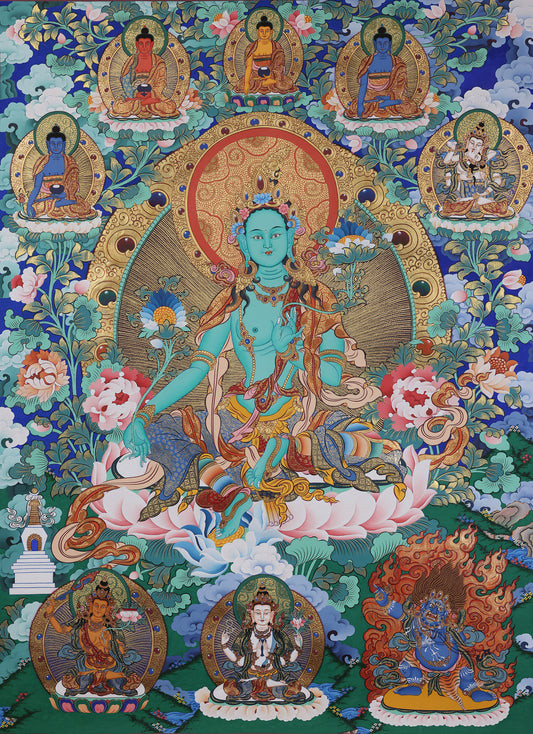
When a vivid Thangka unfolds before your eyes—with a central white-bodied Bodhisattva seated cross-legged on a lotus throne, a five-Buddha crown glinting against the golden halo behind him, right hand holding a vajra resting at his heart, left hand gently ringing a ghanta (bell); flanked by attendant deities and protectors in the four corners, their forms set against blue clouds and pink lotuses as if suffused with the pure sound of Dharma—this is Vajrasattva, revered as the "King of Repentance" in Tibetan Buddhism.
In the cosmology of Tibetan Buddhism, Vajrasattva is no ordinary Bodhisattva, but a "synthesis of all Buddhas" uniting the dharmakāya, sambhogakāya, and nirmāṇakāya. Every detail of this Thangka holds the esoteric meaning he has carried for millennia.
In Tibetan, "Vajrasattva" ( Dorje Sempa ) literally means "indestructible courageous mind." In Tibetan Buddhist doctrine, he holds three core identities:
According to scriptures like the Guhyasamāja Tantra, Vajrasattva is the dharmakāya manifestation of Samantabhadra Buddha—Samantabhadra represents the ultimate reality of "emptiness of all phenomena," while Vajrasattva is the dynamic expression of this reality that "gives birth to all Buddhas." As seen in the Thangka, his pure white form symbolizes "original purity free from all defilement," like an unblemished vajra, corresponding to the "seed of bodhicitta" inherent in all sentient beings.
In the lineage of Vajrayāna, Vairocana Buddha (the Cosmic Buddha) is the source of esoteric teachings, and Vajrasattva is the "first recipient and transmitter of these teachings." The Vairocana Sutra records that Vairocana taught the esoteric Dharma to Vajrasattva in the Vajra Realm Palace; Vajrasattva then passed the lineage to Nagarjuna Bodhisattva (as "Vajrapāṇi"), eventually bringing it to the human realm. This is why he is called the "second of the eight patriarchs of the Mantrayāna."
For ordinary beings, Vajrasattva’s most central role is the "deity of karmic purification." He made a great vow in his causal state: "If any sentient being commits the five heinous crimes or breaks samaya vows, as long as they hear my name and recite my mantra, all karmic obstacles shall be purified. Otherwise, I vow not to attain Buddhahood." Now that he has fully attained Buddhahood, this vow has become the "light of salvation" for sentient beings in the Degenerate Age.
Tibetan Thangka iconography is not mere art—it is "visual scripture." Every element of this Thangka corresponds to Vajrasattva’s "karmic purification function":
-
Pure white form: Represents "innate purity," metaphorizing that sentient beings’ karmic obstacles are only "temporary dust," and their inherent Buddha-nature is never defiled;
-
Five-Buddha crown: The five Buddhas (Vairocana, Akṣobhya, Ratnasambhava, Amitābha, Amoghasiddhi) on the crown symbolize "perfection of the five wisdoms"—the enlightened wisdom attainable through repentance;
-
Right hand holding a vajra (resting at the heart): The vajra is the implement that "crushes afflictions," placed at the heart to signify "destroying inner greed, anger, and delusion with right wisdom";
-
Left hand holding a ghanta (bell): The bell represents the "sound of prajñā (wisdom)," symbolizing "awakening deluded sentient beings with the wisdom of emptiness";
-
Lotus throne: The lotus grows from mud yet remains unstained, signifying "even heavy karmic obstacles can be purified from defilement."
The attendant deities in the four corners of the Thangka (e.g., the white-robed Bodhisattva in the upper left, the blue-bodied protector in the lower right) are in fact "branch manifestations of Vajrasattva’s merits":
- The Buddhas and Bodhisattvas above represent "the blessings of all Buddhas";
- The protectors below (e.g., the wrathful vajra figure) represent "the power to break obstacles."
The entire mandala symbolizes "centered on Vajrasattva, all sacred beings jointly support practitioners in purifying their karmic obstacles."
In Tibetan Buddhist practice, the core of Vajrasattva practice is the Hundred-Syllable Mantra (also called the "Vajrasattva Hundred-Syllable Mantra"), and the Thangka serves as the "object of visualization" during practice.
Consisting of 100 syllables (in Tibetan), the Hundred-Syllable Mantra is the "synthesis of Vajrasattva’s heart mantras." The Vajrasekhara Sutra states: "Reciting this mantra eradicates the five heinous crimes and broken vows, and grants the practitioner the Samādhi of the Indestructible Mind in this lifetime."
A core interpretation of the mantra (from Khenpo Tsultrim Lodrö):
"Oṃ Vajrasattva samaya" (Oṃ Vajrasattva, please guard the samaya of my body, speech, and mind);
"Tena tvatagate prahye" (Please abide in me, non-dual with me);
"Hūṃ" (The seed syllable, representing "perfection of the five wisdoms").
In Tibetan Buddhism, reciting the Hundred-Syllable Mantra is not "mechanical counting"—it must be paired with the "Four Powers":
-
Power of Reliance: Visualize Vajrasattva in the Thangka (external reliance) and arouse renunciation and bodhicitta (internal reliance);
-
Power of Regret: Generate sincere remorse for one’s karmic obstacles;
-
Power of Restraint: Vow "not to commit similar karmic acts again";
-
Power of Engagement: Focus on reciting the Hundred-Syllable Mantra, visualizing Vajrasattva’s white light merging into oneself to purify karmic obstacles.
According to the Supreme Empowerment King Tantra, properly reciting the mantra 100,000 times can completely purify the heavy karma of "breaking the root vows of Vajrayāna"; reciting 21 times daily prevents karmic obstacles from growing.
Padmasambhava prophesied: "In the Degenerate Age, false teachers are as numerous as Ganges sand, and sentient beings are burdened with heavy karmic obstacles—only the Dharma of Vajrasattva can deliver them." In modern times, the significance of this practice has become even more pronounced:
Whether it is the "five heinous crimes" in Mahāyāna, "breaking samaya vows" in Vajrayāna (e.g., betraying one’s guru, slandering the Dharma), or daily afflictions of greed, anger, and delusion, all can be purified through Vajrasattva practice. As Khenpo Yeshe Phuntsok notes: "Even reciting a single Vajrasattva heart mantra (Oṃ Vajrasattva Hūṃ) is a great protection for oneself."
Modern people are often entangled in anxiety and guilt, and Vajrasattva practice is essentially about "acceptance and transformation": by visualizing the white-bodied deity of "innate purity," one recognizes that "karmic obstacles are temporary, and purity is inherent," thus freeing oneself from self-negation—this is both religious practice and psychological healing.
Unlike some esoteric practices that require empowerment, Vajrasattva’s heart mantra and Hundred-Syllable Mantra are "universally transmitted": regardless of whether one is a Mahāyāna or Vajrayāna practitioner (even those without empowerment), as long as one practices with faith, they can receive blessings. This is why he is called the "universal deity" in Tibet.
When we gaze at this Thangka, we see not just a Bodhisattva image, but Tibetan Buddhism’s ultimate interpretation of "purity": karmic obstacles are not indelible stains, but temporary dust that can be transformed through "faith, repentance, and vows"; and Vajrasattva is the "support" for this transformation.
In today’s fast-paced world, we may not need to fixate on "reciting 100,000 times," but we can remember his core meaning: With an "indestructible bodhicitta like a vajra," accept your imperfect self, and maintain the awareness of "innate purity" in every thought and action.
This is the millennium-old compassion of Vajrasattva—he is not confined to the colors of the Thangka, but resides in every intention to "become better."
#Vajrasattva #TibetanBuddhism #ThangkaSymbolism #HundredSyllableMantra #KarmicPurification #SamantabhadraBuddha #EsotericLineage #Bodhicitta #LightOfTheDegenerateAge #TibetanDeity