Vairocana in Tibetan Thangka: The Symbolic Code of the Dharmakaya Buddha and Esoteric Buddhist Wisdom
I. Gazing at the Thangka: The Visual Narrative of Four-Armed Vairocana
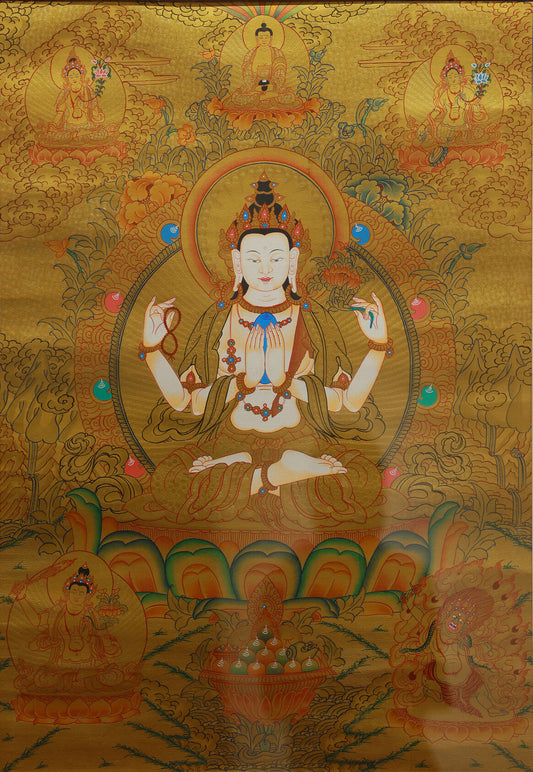
Every color and shape in this Thangka is a carrier of the wisdom of "expressing Dharma through form" in Tibetan Esotericism:
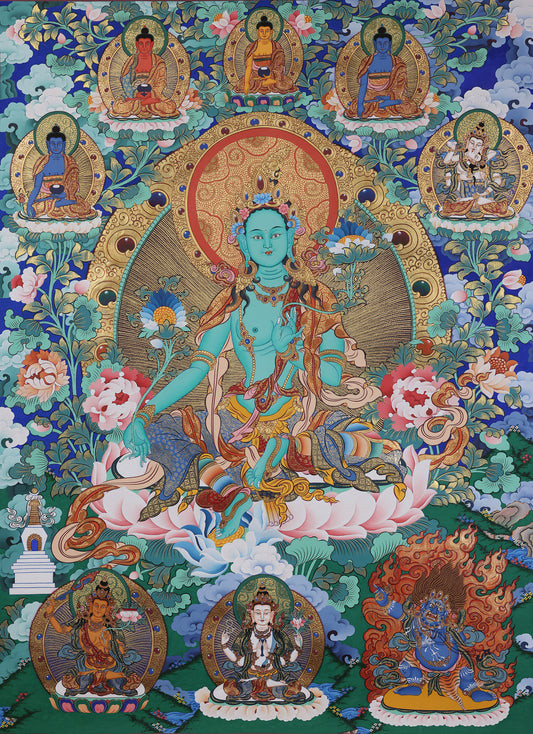
- Main Icon’s Form: Its body is as white as snowmelt from the Himalayas, symbolizing "the inherent purity of the Dharmadhatu"; the four arms unfold, with the hands in the Dharmakaya Mudra (left hand resting on the right, thumbs touching) at the chest, representing "the purity of the fundamental principle"; the upper right hand holds a crystal prayer bead (each bead connected to signify "endless compassion for universal salvation"); the upper left hand holds a blue lotus (its open petals symbolize "inherent wisdom, untainted by worldly dust").
- Retinues and Setting: Around the main icon, pink and white peonies wrap around green branches (representing "pure Dharma nature manifesting in vivid secularity"); the icons seated on clouds above are the other members of the Five Dhyani Buddhas (signifying "the Dharmakaya pervades all"); the blue protector below, wreathed in flames, represents "subduing afflictions and upholding the Dharma"; the clear waves and ritual vessels under the lotus throne embody "the concretization of the pure Buddha realm."
What Tibetan painters layer with mineral pigments is never just a "deity statue"—it is a visual translation of "the nature of the Dharmadhatu."
II. Vairocana in the Tibetan Context: The Essence of the Dharmakaya Buddha
In the Tibetan Buddhist system, Vairocana’s Sanskrit name "Vairocana" means "radiant light pervading all"—he is not a single "Buddha," but the Dharmakaya essence of all Buddhas, the personification of "ultimate truth."
Unlike Han Buddhism, which classifies him as "one of Sakyamuni’s three bodies," Tibetan Esotericism emphasizes his "transcendent, non-concrete" nature:
- As the central Buddha of the Vajradhatu Five Dhyani Buddhas, he corresponds to the "Dharmadhatu Wisdom"—an ultimate wisdom that dissolves all distinctions, not a knowledge accessible to thought, but the inherent state of "all phenomena sharing one origin, all sentient beings being Buddhas."
- In the Tibetan translation of the Commentary on the Vairocana Sutra, he is described as the "original Dharmakaya": manifesting in the mandala as the "blessing-receiving body," while pervading all worlds in the "self-realized supreme state," "with body, speech, and mind pervading the void, preaching the Vajra One Vehicle through the three esoteric gates."
III. Thangka Semiotics: Every Detail Is the Language of the Dharmakaya
Tibetan Esoteric Thangkas are never "decorative paintings"—every implement and mudra of Vairocana holds the core teachings of the tantras:
-
The Metaphor of Four Arms:
The rare four-armed manifestation in Tibetan Buddhism embodies the "union of compassion and wisdom"—two arms represent "fundamental principle and wisdom," the other two represent "compassion and salvation," corresponding to the three core tenets of the Sutra of the Vairocana Buddha: "Bodhicitta as the cause, great compassion as the root, skillful means as the culmination."
- Prayer Bead and Blue Lotus:
- Prayer Bead: In Tibetan Esoteric practice, holding Vairocana’s prayer bead during visualization is a method to "connect sentient beings with compassion, transforming afflictions into bodhi";
- Blue Lotus: Unlike worldly lotuses, the blue lotus in Thangkas often has "straight stems and upright petals," symbolizing "inherent wisdom, unobscured by afflictions."
-
Body Color and Lotus Throne:
The white body corresponds to "the inherent purity of the form aggregate," while the thousand-petaled lotus throne symbolizes "emerging from the mud of afflictions to abide in the pure land of Dharma nature"—Tibetan Esotericism holds that visualizing Vairocana’s lotus throne is visualizing "the awakening of one’s own Dharmakaya."
IV. Different Sectarian Voices: Nyingma and Gelug Interpretations of Vairocana
Different sects of Tibetan Buddhism interpret Vairocana with distinct emphases, but all point to the "Dharmakaya essence":
-
Nyingma School (Red Hat Sect):
Vairocana is seen as homologous to "Samantabhadra Buddha"—Samantabhadra is the "primordial Dharmakaya," while Vairocana is its "wisdom body manifest in the tantras." In the Nyingma "Dzogchen" practice, visualizing Vairocana is a shortcut to "directly accessing the inherent mind nature": "Vairocana’s light is the pure wisdom inherent in oneself."
-
Gelug School (Yellow Hat Sect):
Following Je Tsongkhapa’s teachings, Vairocana is strictly classified as the "center of the Vajradhatu Five Dhyani Buddhas," with rituals based on the Sutra of the Vairocana Buddha and Vajraśekhara Sutra. In Gelug monastery mandalas, Vairocana is fixed on the central moon disc, surrounded by the Four Close Bodhisattvas (Vajra, Ratna, Dharma, Karma 波罗蜜), corresponding to the cultivation sequence of "Dharmadhatu Wisdom giving rise to the four wisdoms."
V. Vairocana in Esoteric Rituals: From Visualization to Alignment
In Tibetan Esotericism, practicing Vairocana is never "worship"—it is "aligning with the Dharmakaya":
-
Scriptural Basis:
The Tibetan translations of the Sutra of the Vairocana Buddha (Garbhadhatu root sutra) and Vajraśekhara Sutra (Vajradhatu root sutra) are the core of Vairocana practice—the former expounds "inherent fundamental principle," the latter expounds "wisdom cultivation," together forming the Dharmakaya teachings of "non-duality of principle and wisdom."
- Basic Practice:
- Visualization: The practitioner first visualizes themselves transforming into Vairocana, with a white body, four arms, and identical form to the Thangka icon;
- Mantra Recitation: Chanting Vairocana’s heart mantra "Om Vajra Dhatu Vam," which means "merging into the Vajra Dharmadhatu";
- Mudra Formation: Forming the Dharmakaya Mudra or Wisdom Fist Mudra, aligning body, speech, and mind with Vairocana’s three esoteric gates.
Tibetan Esotericism holds that this practice is not "imitation," but "awakening one’s own inherent Dharmakaya"—Vairocana’s light has always resided in every sentient being’s heart.
VI. The Light of the Dharmakaya in Modern Times: Vairocana’s Spiritual Guidance
In the fast-paced modern life, Vairocana’s symbolism has long transcended religious rituals to become a spiritual guide:
- Purity: Its white form reminds people that "the mind is inherently pure, not to be trapped by worldly afflictions";
- Compassion-Wisdom Union: The prayer bead (compassion) and blue lotus (wisdom) serve as life principles: "treat others with kindness, handle affairs with clarity";
- Equality: The teaching that "radiant light pervades all" corresponds to the equal view that "regardless of wealth or status, all sentient beings have the potential to awaken."
When we gaze at this Thangka, we see not just an icon, but the reflection of "our own pure Dharma nature."
#VairocanaInTibetanBuddhism
#VairocanaThangkaSymbolism
#TibetanEsotericDharmakayaBuddha
#VairocanaTibetanInterpretation
#VairocanaEsotericDoctrine
#TibetanThangkaCulture
#VairocanaPracticeRituals
#VajradhatuFiveBuddhasTibetan
#NyingmaGelugVairocana
#VairocanaModernSpiritualGuidance
Tags:
Previous
Pure Hand-Painted Tibetan Thangka: The Symbolism and Craftsmanship of Manjushri Bodhisattva (Lion’s Roar Manjushri)
Next
Five-Wisdom Manjushri in Black-Gold Thangka: The Visual Code of Tibetan Buddhism’s Wisdom System