Vairocana Buddha in Tibetan Buddhism: Unpacking the Wisdom and Symbolism of the Dharmakaya Buddha Through a Color Thangka

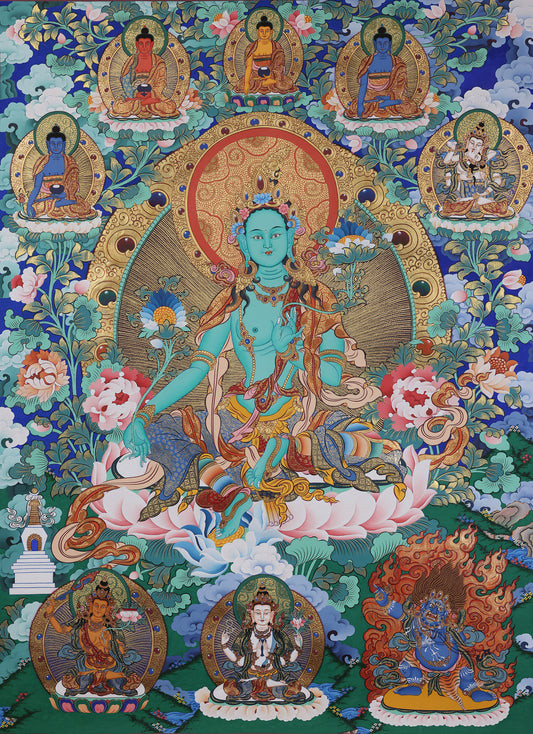
When a vivid, intricately detailed Tibetan color thangka unfolds before your eyes: a multi-headed Buddha sits at the center, adorned with ornaments, hands forming the Dharma Realm Samadhi Mudra while holding a Dharma wheel, surrounded by other Buddhas, bodhisattvas, and protectors amid lotus clouds and green mountains—what you see is Vairocana Buddha (Vairocana), the core Dharmakaya Buddha in Tibetan Buddhism.
This thangka is not just a work of art; it is a visual interpretation of the "essence of all dharmas" in Tibetan Vajrayana. Today, we use this icon as an anchor to unpack Vairocana’s religious positioning, iconographic metaphors, doctrinal significance, and cultural value in Tibetan Buddhism.
I. Vairocana in the Context of Tibetan Buddhism: The "Ontological" Status of the Dharmakaya Buddha
In the Tibetan Buddhist system (especially Vajrayana), Vairocana is not "a single Buddha"—but the essence of all dharmas, the Dharmakaya of all Buddhas. In Tibetan, he is called Langpa Langtse, meaning "pervading light," symbolizing that his Dharmakaya encompasses all worldly and transcendental dharmas.
As the central Buddha among the Five Wisdom Buddhas, Vairocana corresponds to the Dharmadhatu Wisdom: Akshobhya (East) represents Mirror-like Wisdom, Ratnasambhava (South) Equality Wisdom, Amitabha (West) Discriminating Wisdom, and Amoghasiddhi (North) Accomplishing Wisdom. Vairocana is the synthesis of these five wisdoms, the source of "Buddha-nature."
Unlike Mahayana Buddhism, which classifies Vairocana as one of the "Three Buddhas of Time," Tibetan Vajrayana defines him as the fundamental teacher of esoteric teachings: Core tantric scriptures like the Mahavairocana Sutra and Vajraśekhara Sutra all take Vairocana as the speaker. His trait of "omnipresent Dharmakaya" is the foundation of Tibetan Buddhism’s "attainment of Buddhahood in one lifetime"—practitioners do not "become Buddha" through cultivation, but awaken the inherent "Dharmakaya wisdom of Vairocana" via esoteric methods.
II. Vairocana in the Color Thangka: Every Detail Is a "Code of Wisdom"
This thangka strictly follows the Iconometric Canon of Buddhist Art, and every symbol carries religious metaphor. We analyze the central Buddha and his retinue below:
1. The Central Buddha: The Symbolism of Five Heads and the Dharma Realm Samadhi Mudra
- Body Color and Head Count: The Buddha’s body is white (symbolizing the pure, unstained essence of the Dharmakaya), with five heads—one main head at the front, and two on each side. This corresponds to the five wisdoms of the Five Wisdom Buddhas, representing Vairocana’s mastery of all Buddha-wisdoms and visualizing the "oneness of all dharmas."
- Mudra and Ritual Implements: His hands form the Dharma Realm Samadhi Mudra (left hand below, right hand above, thumbs touching, holding a Dharma wheel). This mudra symbolizes "equality of the Dharma realm," while the Dharma wheel represents the circulation and salvation of the Dharma—echoing the doctrine of "Vairocana’s pervasive light."
- Ornament Details: Adorned with green gilded ornaments and a Five-Wisdom Crown, he follows the Garbhadhatu iconographic norm of "bodhisattva attire," symbolizing the unity of the Dharmakaya Buddha’s "majesty and compassion."
2. The Retinue: Buddhas, Bodhisattvas, and Protectors as "Dharmakaya Retinue"
The retinue in the thangka is not randomly arranged; they are "manifestations" of Vairocana’s Dharmakaya wisdom:
- Three Buddhas Above: The red Buddha in the center is Amitabha (representing Discriminating Wisdom), the blue Buddha on the left is Bhaisajyaguru (corresponding to Akshobhya’s Mirror-like Wisdom), and the green Buddha on the right is Amoghasiddhi (representing Accomplishing Wisdom). These three are manifestations of Vairocana’s wisdom in different dimensions.
- Attendants Below: The orange figure on the left holding a sword is Manjushri (symbolizing "wisdom," Vairocana’s "wisdom retinue"), while the blue figure on the right wreathed in flames is a Vajra Guardian (symbolizing "subduing afflictions," the protector of Vairocana’s teachings).
- Environmental Elements: The blue background symbolizes "emptiness" (the omnipresence of the Dharmakaya), the lotus throne represents "the inherent pure Buddha-nature of all beings," and the green mountains and auspicious clouds are visual representations of "pure land" in the Tibetan context.
3. The Color Language of the Thangka: The "Symbol System" of Tibetan Art
This thangka is painted with mineral pigments such as cinnabar, lapis lazuli, and malachite—color choices are an "extension of doctrine":
- Blue: Symbolizes "emptiness," corresponding to the Dharmakaya essence of Vairocana.
- Red: Symbolizes "compassion," corresponding to Amitabha’s vows.
- Green: Symbolizes "growth," corresponding to Amoghasiddhi’s activities.
- Gold: Symbolizes "eternity," embellished on ornaments and the Dharma wheel to represent the "unchanging nature" of the Dharmakaya.
III. Doctrinal Significance of Vairocana: The Theoretical Foundation of "Attainment of Buddhahood in One Lifetime"
The core pursuit of Tibetan Vajrayana is "attainment of Buddhahood in one lifetime," and the foundation of this concept lies in Vairocana’s trait of "omnipresent Dharmakaya":
- "Vairocana" = "Buddha-Nature": Vairocana is not an "external deity" but the "pure mind" inherent in every sentient being. As the Commentary on the Mahavairocana Sutra states: "There is no distinction between mind, Buddha, and sentient beings." The practitioner’s goal is to "align with Vairocana’s Dharmakaya."
- The Hub of "Three Mysteries Correspondence": The "body mystery (mudra), speech mystery (mantra), and mind mystery (visualization)" in Tibetan esotericism all ultimately target Vairocana: Visualizing one’s form merging with Vairocana (body mystery), reciting the "Vairocana Heart Mantra" (speech mystery), and abiding in the Dharmadhatu Wisdom (mind mystery). Through "correspondence between one’s three mysteries and the Buddha’s three mysteries," one achieves "attainment of the Dharmakaya in this lifetime."
- The Core of the Mandala: In Tibetan Vajrayana mandalas, Vairocana sits at the center, while other Buddhas and bodhisattvas are "emanations" of his wisdom. When practitioners visualize the mandala, they "enter Vairocana’s Dharmakaya world."
IV. Practice Traditions of Vairocana in Tibetan Buddhism: Sectarian Differences and Ritual Practices
Across different Tibetan Buddhist schools, Vairocana practices have distinct emphases, but all center on "awakening inherent Dharmakaya wisdom":
1. Gelug Sect: Rigorous Vajradhatu Rituals
The Gelug Sect emphasizes Vajradhatu Mandala practice, focusing on Vairocana’s Dharmadhatu Wisdom:
- Practitioners must receive the "Vairocana Abhisheka" to qualify for practice.
- They visualize the Vajradhatu Vairocana (forming the Wisdom Fist Mudra, white body) and recite the seed syllable Vam.
- Rituals strictly follow the Vajraśekhara Sutra, emphasizing "gradual cultivation and realization," holding that afflictions must be purified step-by-step to align with Vairocana’s wisdom.
2. Nyingma Sect: Integration of Garbhadhatu and Dzogchen
The Nyingma Sect focuses more on integrating the Garbhadhatu Mandala with Dzogchen:
- It regards Vairocana as the "Primordial Buddha," holding that all sentient beings inherently possess Vairocana’s Dharmakaya wisdom.
- Practices center on "pointing directly to the nature of mind," visualizing the Garbhadhatu Vairocana (forming the Dharma Realm Samadhi Mudra, golden body) and integrating it with Dzogchen’s "natural abiding."
- Rituals are relatively flexible, emphasizing "faith and sudden realization," holding that "seeing one’s nature is seeing Vairocana."
3. Common Rituals: Mantra and Visualization
Regardless of sectarian differences, Tibetan practitioners commonly recite the "Vairocana Heart Mantra" (Om, Vajra, Tathagata, Vam) and visualize "merging one’s form with Vairocana"—the core of this practice is "recognizing that one’s own mind is Vairocana."
V. Vairocana in the Color Thangka: Religious Carrier and Cultural Heritage
This thangka is not just a religious symbol; it is a representative work of Tibetan thangka art, bearing dual value:
1. Religious Function: The "Object of Visualization" for Practitioners
The core function of a thangka is "aids to visualization": Practitioners gaze at Vairocana’s icon, "internalize" its form, and gradually achieve the state of "visualizing oneself as Vairocana." Religious rituals like chanting, hand purification before painting, and the final "eye-opening" ceremony endow it with "sacredness," making it a sacred object where "seeing the icon is seeing the Buddha."
2. Cultural Value: A "Living Carrier" of Intangible Cultural Heritage
Color thangka is a branch of Tibetan thangka, renowned for its long-lasting mineral pigments and rigorous adherence to the Iconometric Canon—it is an "encyclopedia" of Tibetan culture:
- Its iconographic symbol system is the key to understanding Tibetan Buddhist philosophy.
- Its painting techniques (e.g., gilding, dotting) are the essence of traditional Tibetan art.
- Today, Tibetan color thangka is not just a religious item but also an intangible cultural heritage, carrying the cultural memory of Tibetan Buddhism.
Vairocana’s significance in Tibetan Buddhism has never been "a deity to be worshipped"—but the "pure wisdom inherent in every person." This thangka translates the abstract "Dharmakaya" into a visible form, allowing practitioners to "contemplate the mind through the icon, and see the Buddha through the mind."
Tags:
Previous
The Wisdom of Wealth in Silver Thangka: The Millennium-Old Belief and Contemporary Enlightenment of Yellow Jambhala in Tibetan Buddhism
Next
Hand-Painted Tibetan Buddhist Thangka: A Deep Exploration of Faith, Deity Iconography, and Sacred Craftsmanship through the Amitabha Pure Land Thangka