Hand-Painted Tibetan Golden Thangka: Yellow Jambhala’s Symbolism and Craftsmanship

In Tibetan Buddhist culture, Thangka paintings are not only exquisite works of art but also sacred ritual objects. Among them, the Yellow Jambhala (Zangbala) Thangka is highly revered for its symbolism as a wealth-protecting deity and its meticulous hand-painted craftsmanship. This article explores the Yellow Jambhala golden Thangka from five perspectives: theme, main deity, attendant deities, painting techniques, and cultural value, providing an in-depth understanding of its religious and artistic significance.
1. Theme: A Faith Carrier of “Merit and Wealth Enhancement”
The core theme of this Thangka is the “Yellow Jambhala Wealth-Enhancing Depiction”, representing the visual ritual system of Tibetan Buddhist wealth-protecting deities. In Tibetan Buddhism, there are five types of Jambhala (yellow, white, red, black, green), with Yellow Jambhala regarded as the foremost. Its worship originates from the Jataka story in the Mahāprajñāpāramitā Sūtra, where Shakyamuni Buddha instructed the deity to protect monks and assist the poor.
This Thangka is more than a simple talisman for wealth; it serves as a medium for practitioners to use worldly prosperity to support the Dharma and cultivate merit. Its golden base color and wealth symbols are designed to reflect the Tibetan Buddhist principle: “use worldly merit to realize transcendent wisdom”, while also fulfilling the practical need for resources to support the Dharma.
Through its visual narrative, the Thangka communicates wealth augmentation and spiritual growth, emphasizing that prosperity and practice are inseparable. By meditating on the deity’s form and attributes, devotees cultivate generosity, ethical conduct, and wisdom.
2. Main Deity Analysis: Symbolism and Ritual Meaning of Yellow Jambhala
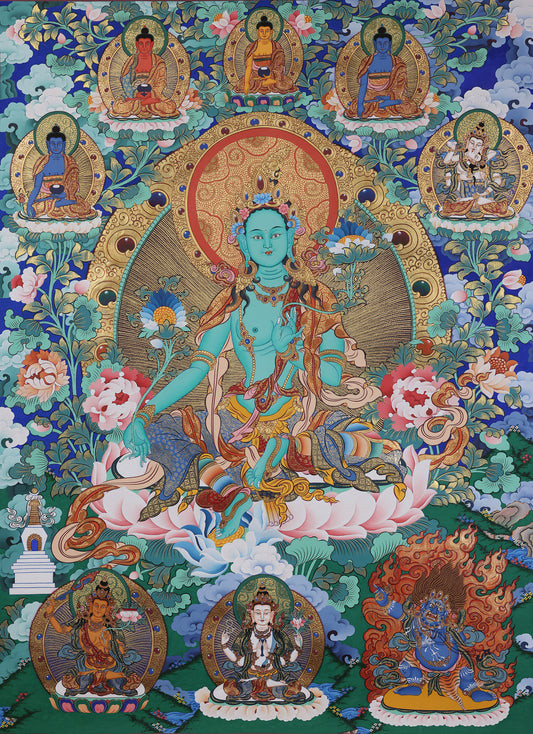
At the center of the painting is Yellow Jambhala (Zangla Sepo), depicted according to the 32 physical marks and 80 auspicious qualities prescribed in traditional iconometry. Every detail carries profound religious meaning.
-
Body Color: Bright yellow, symbolizing stability and growth of wealth. Pigments are mixed from orpiment and gold powder at a 7:3 ratio, creating a warm golden texture. Facial features include two long mustaches and a circle of short beard, representing the divine made approachable and worldly, showing Jambhala’s benevolent presence among humans.
-
Mudras and Attributes:
-
Right hand holds a Mani Jewel (Lazirza): signifies “the jewel’s light illuminating all directions, fulfilling all beings’ wishes.”
-
Left hand holds the Treasure Mouse (Nyüle): with jewels in its mouth, symbolizing endless treasure and generous giving.
-
Right foot steps on a conch (Dongka): represents “entering the ocean to obtain wealth and removing obstacles of poverty.”
-
-
Clothing and Ornaments:
-
Crown of the Five Buddhas: representing the wisdom of the Five Dhyani Buddhas.
-
Lapis lazuli necklaces and turquoise bracelets: lapis symbolizes cosmic wisdom; turquoise represents purity. Paired with gold, these convey the principle: “use wisdom to manage wealth, use purity to protect merit.”
-
-
Seated Posture: Vajra posture (half-lotus), a distinctive position of wealth-protecting deities, signifies adapting to worldly needs while guiding beings toward liberation.
The complete iconography demonstrates that Yellow Jambhala is not merely a symbol of material wealth, but a bridge between worldly prosperity and spiritual practice.
3. Attendant Deities: Functional Hierarchy and Symbolism
The layout follows the traditional “main deity – attendants – offerings” structure, where each layer conveys a specific function and symbolic meaning.
Upper Attendants: Manifestations of Yellow Jambhala
Small Yellow Jambhala figures on the upper left and right are emanations of the main deity, known as the Jambhala retinue in Tibetan ritual texts. They govern wealth in different directions, symbolizing the pervasive protection of merit throughout the three realms.
Lower Attendants and Offerings
-
Left red guardian: holds a vajra and steps on evil spirits, representing career protection and obstacle removal.
-
Right black guardian: performs the subduing mudra, bound with serpents, representing protection of acquired wealth.
-
Central offerings: the Seven Treasures (treasure vase, umbrella, banner, etc.) and a wealth bowl are depicted within the lotus pedestal, symbolizing endless resources of the pure land, standard in Tibetan wealth rituals.
This hierarchical system reflects the layered and functional sophistication of the Yellow Jambhala protection system, integrating visual richness with ritual significance.
4. Painting Techniques: Ultimate Fusion of Minerals and Gold
This Thangka belongs to the Regong (Rebkong) school golden Thangka tradition, one of the most costly and labor-intensive forms in Tibetan painting. Its 15-step process embodies the principle “material is faith.”
Canvas Preparation
-
Double-layer white cotton from Yushu, Qinghai, soaked for 3 years in aged yak bone glue (protein content ≥85%).
-
Stretched over sandalwood frame and polished with agate stone until translucent and smooth, ensuring gold leaf adhesion and century-long stability.
Gold Work
-
24K gold leaf hammered to 0.1μm thickness (1/700 of a hair).
-
Three-step technique: gilding, line gold painting, carving:
-
Gilding forms the base color
-
Line gold painting outlines the main deity
-
Carving lotus and vine motifs with agate knife (depth ≤0.05mm) for layered golden brilliance
-
-
Color Accents: lapis lazuli (blue), malachite (green), and cinnabar (red) are used for delicate shading, creating a cool blue and warm gold contrast.
Technique Highlights
-
Iron-wire lines outline the figures with precision 0.098mm (tolerance <0.005mm), embodying “fine as spider silk, strong as steel wire” characteristic of Regong painting.
-
Seven-layer face technique: gold powder base with successive layers of orpiment, coral red, and cinnabar, forming a majestic yet compassionate expression, requiring over 30 years of mastery.
-
Consecration: five Gelugpa monks perform seven-day retreat blessings, applying cinnabar “wisdom seal” between the deity’s eyebrows, transforming the painting from artwork to ritual instrument.
This integration of gold, minerals, and ritual makes the Thangka not only a visual masterpiece but also a functional sacred object.
5. Cultural Significance: From Wealth Symbol to Spiritual Medium
The value of the Yellow Jambhala golden Thangka goes far beyond decorative art:
-
Religious Aspect: Serves as a key ritual object for merchants and practitioners, used in opening ceremonies and daily practice. Devotees meditate on the deity and recite the Jambhala mantra, creating a closed loop of using wealth for generosity and accumulating merit toward enlightenment.
-
Artistic Aspect: Exemplifies the Regong school’s golden Thangka craftsmanship, with 12 grams of gold leaf (market value over $12,000) and mineral pigments with ≥99.95% purity, meeting the highest traditional standards.
In Tibetan Buddhist culture, the Yellow Jambhala Thangka is not a symbol of materialism, but a tool for converting worldly wealth into spiritual merit, perfectly reflecting the coexistence of worldly needs and spiritual pursuit.
Conclusion
The Yellow Jambhala golden Thangka is a fusion of faith, artistry, and craftsmanship. Whether used for meditation and ritual practice or as a cultural collectible, it possesses immense religious and aesthetic value. It allows viewers to experience both the blessing of wealth and merit and the spiritual power conveyed through mineral pigments and gold craftsmanship, making it a quintessential example of worldly prosperity harmoniously integrated with spiritual wisdom.
#TibetanThangka #YellowJambhala #GoldenThangka #HandPaintedThangka #TibetanBuddhism #WealthDeity #RegongArt #MineralPigmentArt #BuddhistArt #SpiritualArt #MeditationTools #CulturalHeritage #SacredArt #TibetanGoldArt #BuddhistRitual
Tags:
Previous
Hand-Painted Tibetan Buddhist Thangka: A Deep Exploration of Faith, Deity Iconography, and Sacred Craftsmanship through the Amitabha Pure Land Thangka
Next
Pure Hand-Painted Tibetan Thangka: The Symbolism and Craftsmanship of Manjushri Bodhisattva (Lion’s Roar Manjushri)