Black Gold Tibetan Thangka of Akashagarbha Bodhisattva A Dual Decoding of Sacred Symbolism and Masterful Craftsmanship
I. Theme and Principal Deity: A Cosmic Symbol of Perfect Wisdom and Merit
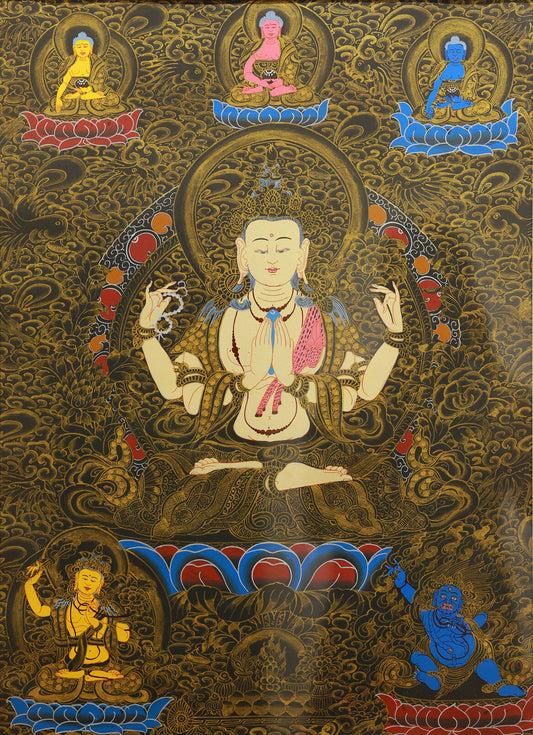
The core subject of this thangka is Akashagarbha Bodhisattva (Sanskrit: Ākāśagarbha), one of the Eight Great Bodhisattvas in Tibetan Buddhism. His name literally means “Treasury of Space”, symbolizing wisdom as vast as the void and merit as inexhaustible as a cosmic treasury. Within Esoteric Buddhism, Akashagarbha is the principal deity of the Akashagarbha Court in the Womb Realm Mandala and is revered as the foremost attendant of the Buddhas of the three times.
From an iconographic perspective, the identity of the principal deity is unmistakable:
-
Physical Form:
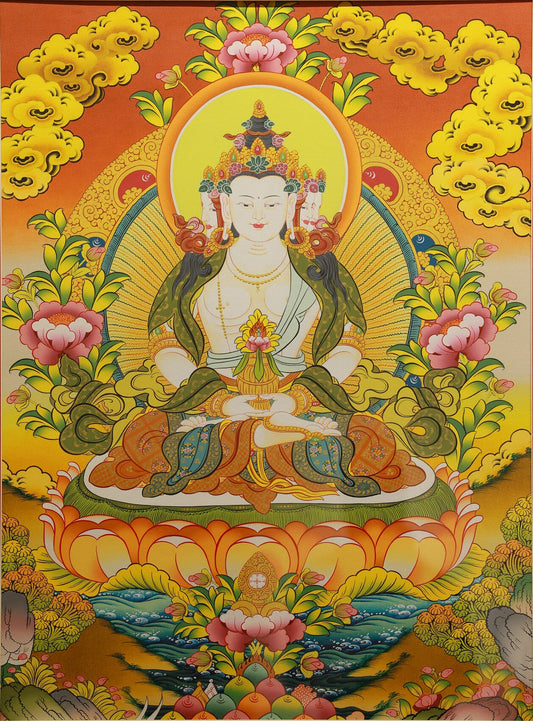
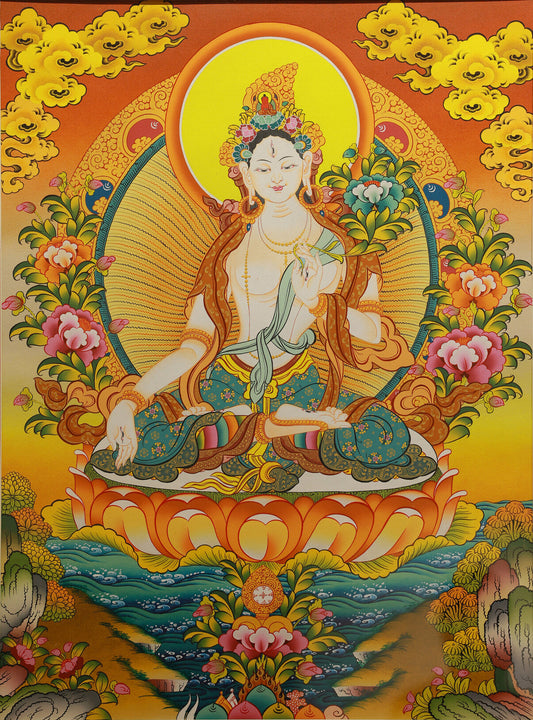
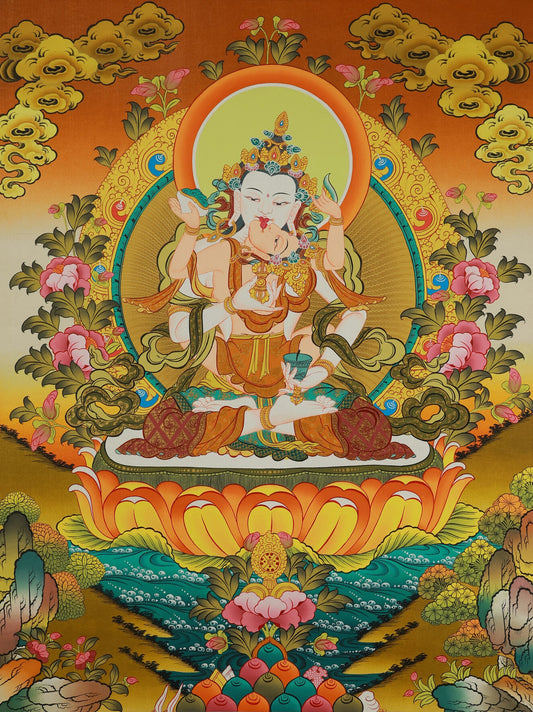
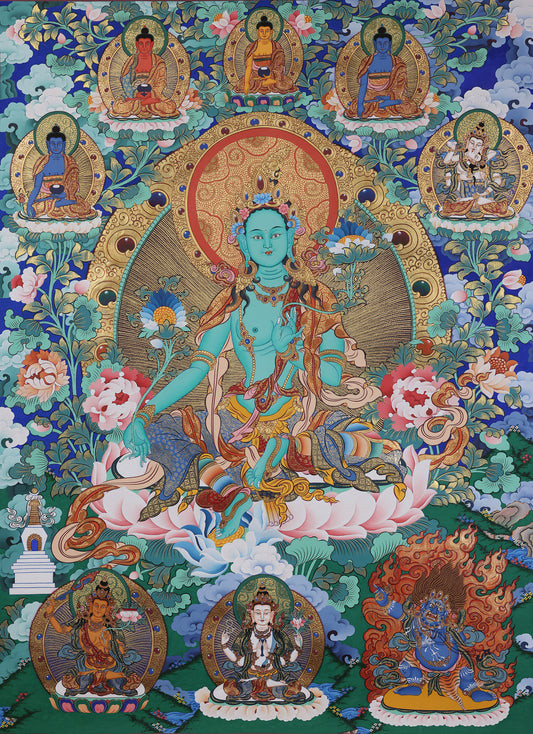
The Bodhisattva’s body is rendered in a warm golden hue, corresponding to the Ratna (Jewel) Family. He wears a Five-Buddha Crown, symbolizing the wisdom of the Five Dhyani Buddhas. The topknot is adorned with a wish-fulfilling jewel, representing Mount Sumeru as the cosmic axis. His elongated earlobes, jeweled ornaments, and celestial garments follow classical Tibetan descriptions of Akashagarbha as “majestic as Indra, king of the gods.” -
Attributes:
In his right hand, he holds a Sword of Wisdom, its blade encircled by flames, signifying the cutting away of ignorance and afflictions. His left hand forms the Granting Boon Mudra, associated with generosity and wish fulfillment, often linked symbolically to a lotus bearing a mani jewel. This iconographic feature clearly distinguishes Akashagarbha from Manjushri, who traditionally holds a scripture in his left hand. -
Posture:
The Bodhisattva is seated in full lotus posture (vajra posture) upon a multi-layered lotus throne. The lotus petals are delicately shaded in red, blue, and green, conforming to the Iconometric Scriptures, which prescribe that a Bodhisattva’s lotus throne must display eight primary petals. Symbolically, the lotus signifies transcendence above the mire of worldly defilements.
Within the Tibetan Buddhist belief system, Akashagarbha embodies three interrelated functions:
-
Lord of Wisdom, protecting memory, learning, and scholarship;
-
Lord of Merit and Wealth, granting abundance of spiritual and material resources;
-
Guardian of Moral Discipline, traditionally believed to assess practitioners’ observance of vows through dreams.
As such, this thangka functions not only as a devotional image but also as a spiritual talisman for the cultivation of both wisdom and merit.
II. Retinue Deities: A Protective System Concealed Within Ornamentation
This thangka adopts a single-deity composition, with no explicitly depicted retinue figures. Instead, protective forces are conveyed through symbolic ornamentation—a hallmark of Rebgong Black Thangka tradition:
-
Halo and Borders:
The golden halo surrounding the Bodhisattva intertwines vajra motifs with flame patterns, symbolizing the encircling presence of Vajra-family protectors. The decorative borders feature blue lotuses and pink peonies (often used in Tibetan thangka painting as substitutes for the “auspicious treasure flower”), representing the Eight Offering Goddesses who continuously present fragrant offerings to the enlightened being. -
Landscape Symbolism:
Beneath the lotus throne, swirling golden clouds and turquoise-green terrain subtly allude to the Nāga realm, members of the Eight Classes of Beings who protect the Dharma. Their forms remain concealed within mist and cloud, reflecting Vajrayana ritual principles wherein protectors appear and disappear according to karmic conditions. -
Color Symbolism:
The black background (nag thang) itself carries profound meaning, signifying the wrathful power and protective energy inherited from ancient Bon traditions. The layered gold lines, enhanced through subtle gradation, echo the radiance of the Five Buddha Wisdoms. This approach—representing deities through form rather than depiction—preserves visual solemnity while expressing the Vajrayana worldview that a single principal deity can encompass all phenomena.
III. Painting Technique: The Pinnacle of Rebgong Black Gold Thangka Artistry
This work belongs to the Rebgong Black Gold Thangka tradition (Nag Thang), one of the most refined schools within the Rebgong artistic heritage of Tongren, Qinghai. Its craftsmanship can be understood across three dimensions:
1. Preparation of the Black Ground
The black base is achieved through an extraordinarily meticulous process. Artists grind 99.9% pure natural graphite (locally known as “ink-jade powder”) to particles as fine as 5 microns, blending it with aged yak-hide glue that has been purified through prolonged immersion in clarified butter. This mixture is applied to treated cotton canvas—pre-soaked in wolfsbane extract for insect resistance—over more than 50 ultra-thin layers, each no thicker than 0.02 mm.
The result is a surface that appears matte black, yet smooth and glaze-like to the touch, combining the Bon tradition’s reverence for black with exceptional pigment stability. Laboratory testing indicates a color retention rate of over 96% after 50 years.
2. Gold Linework: The Artistic Rebirth of Pure Gold
The linework is executed using gold ink derived from 24K gold leaf, ground to an ultra-fine consistency of 0.098 mm. Artists employ specialized wolf-hair brushes tipped with as few as three hairs.
-
Primary Line Drawing:
Robe folds are rendered through a synthesis of Iron-Wire Line and Orchid-Leaf Line techniques. Double-gold outlining enhances the silk-like texture while adhering to iconometric rules requiring the exposure of seven key joint points. -
Decorative Detailing:
Vajra motifs within the halo are treated using the engraved-gold technique, where gold lines are incised with fine needles to create shadow and depth. This results in a luminous gradation effect known as the “Black Gold Layered Shading Method”, an innovation attributed to Rebgong master Deji and requiring nearly three times the labor of standard thangka production.
3. Mineral Pigments and Facial Rendering
-
Color System:
Mineral pigments such as lapis lazuli (azurite), cinnabar, and malachite are used sparingly on lotus petals and the crown. Each pigment undergoes a rigorous process of drying, steaming, and sedimentation to ensure century-long color permanence. -
Facial Rendering (Opening the Face):
The Bodhisattva’s visage is shaped through delicate ink outlines softened with gold powder shading. Crescent-shaped brows and lotus-petal eyes conform to the canonical Thirty-Two Marks of a Great Being, particularly the description “eyes like blue lotus leaves.” This restrained yet refined facial style is characteristic of the Wutun Upper Village School, renowned for its gold-based facial techniques.
IV. Cultural Significance: A Symbiosis of Faith and Art
This thangka embodies a profound convergence of religious devotion and artistic excellence:
-
Spiritual Dimension:
It visually manifests the Tibetan Buddhist ideal of integrating wisdom and compassion. Each attribute—the sword, the lotus, the posture—corresponds to specific contemplative practices within Vajrayana ritual systems. -
Artistic Dimension:
The stark contrast between black ground and gold lines reflects the philosophical dialectic of black as power and gold as illumination, achieving unity between material substance and aesthetic expression. -
Heritage Dimension:
As part of the UNESCO-recognized Rebgong Thangka tradition, the Black Gold Layered Shading Method is mastered by only a handful of officially recognized heritage bearers, such as Deji and Luozang Rejie. A single thangka of this caliber typically requires up to 18 months to complete, rendering it both culturally invaluable and inherently rare.
Conclusion
Centered on Akashagarbha Bodhisattva and expressed through the medium of Black Gold Thangka artistry, this work encapsulates the Tibetan Buddhist vision of the cosmos and the Rebgong tradition’s ethos of “conveying the Dharma through technique.” It is not merely a painting—it is the Dharma made visible.
#AkashagarbhaBodhisattva #BlackGoldThangka #TibetanBuddhistArt #RebgongThangka #HandPaintedThangka #VajrayanaArt #SacredArt #BodhisattvaThangka #TibetanSpiritualArt #MeditationArt #CollectibleThangka #BuddhistIconography #FineArtThangka
Tags:
Previous
Hand-Painted Tibetan Thangka Four-Faced Mahavairocana: A Cultural Decoding of Esoteric Wisdom, Sacred Iconography, and Traditional Craftsmanship
Next
White Tara Thangka: The Gaze of Compassion, The Guardian of Life