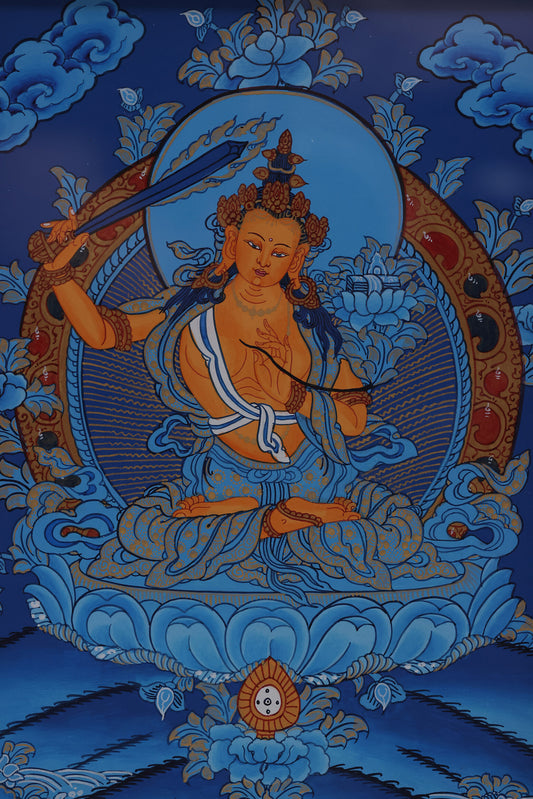
When a touch of deep blue mineral pigment blurs on the cotton cloth, and the sword blade outlined in gold foil glows with a warm luster, this 20×30cm Nepalese Blue Thangka becomes a tangible carrier of "wisdom" in Tibetan Buddhism—it enshrines Yellow Manjushri Buddha, the leader of the "Three Great Protectors" and the embodiment of the wisdom of the "Five Dhyani Buddhas" in Tibetan Buddhism. Beside the prayer wheels in Tibet and on the offering tables in Buddhist halls, the image of Manjushri Buddha has never been far away, and this Thangka is the key to opening the door to his world of belief and art.
In the belief system of Tibetan Buddhism, Manjushri Bodhisattva (referred to as Manjushri for short) is not a single divine symbol, but the personification of "great wisdom"—he is the "Dharma Prince" of the Buddha, the embodiment of "Prajna wisdom", and the spiritual reliance for all beings in Tibet to break free from "ignorance and afflictions".
Tibetan Buddhism divides Manjushri into the "Five Manjushris" (Yellow Manjushri, White Manjushri, Red Manjushri, Green Manjushri, Black Manjushri), with each body color corresponding to different wisdom attributes. Yellow Manjushri in this Thangka is one of the most common images among the "Five Manjushris": his golden body corresponds to Vairocana Buddha among the "Five Dhyani Buddhas", symbolizing the "Dharmadhatu wisdom"—the ultimate wisdom that can perceive the essence of the universe.
In the Tibetan practice tradition, Manjushri belief runs through from beginning to end: Master Tsongkhapa, the founder of the Gelugpa sect, is regarded as the incarnation of Yellow Manjushri; monks in the three major monasteries of Lhasa recite the Manjushri Nama Samgiti every day to pray for the growth of wisdom; even ordinary believers will enshrine Yellow Manjushri before exams or when making important decisions, hoping to break through confusion with wisdom. The universality of this belief has made Manjushri Buddha the "most down-to-earth wisdom totem" in Tibetan Buddhism.
Every detail of this Nepalese Blue Thangka conforms to the rituals of the Iconographic Measurement Sutra in Tibetan Buddhism and contains the symbolic logic of Manjushri belief.
The main deity has a soft golden body all over, which is the iconic body color of Yellow Manjushri—in the color system of Tibetan Buddhism, gold is not a symbol of "wealth", but the embodiment of "wisdom light": it represents the Dharmadhatu wisdom of Vairocana Buddha, and also implies that Manjushri Buddha's wisdom can "illuminate the darkness of ignorance".
The five topknots on his head are one of the core symbols of Manjushri's iconography: the five topknots correspond to the "Five Dhyani Buddhas" (Vairocana Buddha in the center, Akshobhya Buddha in the east, Ratnasambhava Buddha in the south, Amitabha Buddha in the west, Amoghasiddhi Buddha in the north), meaning that Manjushri's wisdom encompasses all the wisdom of the Five Dhyani Buddhas; the jewel decorations on the topknots symbolize "perfect and flawless wisdom".
The facial depiction integrates the style of the Newar school of Nepalese painting: the brow bones are plump, the outer corners of the eyes are slightly raised, and the lip lines are soft yet solemn—this "infant-like" iconography not only reflects the Bodhisattva's trait of "compassionately embracing all beings", but also conforms to the ritual of "holy beings must have pure appearances" in Tibetan Buddhism.
The Prajna Flaming Sword held high in the right hand is Manjushri's most recognizable ritual implement: the blade glows with a blue-black luster (a mixture of lapis lazuli and ink stone in mineral pigments), and the hilt is decorated with lotus patterns, symbolizing "cutting off the three poisons of greed, anger, and ignorance with the sword of wisdom"; the "flame patterns" on the blade imply that wisdom can "burn up ignorance and afflictions".
The left hand forms the "Dharma wheel mudra" and holds the stem of a blue lotus flower—on the lotus petals rests the Prajna Scripture Box, the "source symbol" of wisdom: the scripture box represents the Prajnaparamita Sutra, while the lotus symbolizes "wisdom emerging from the mud without being stained". The combination of sword and scripture is Tibetan Buddhism's dual definition of "wisdom": it not only requires "breaking foolishness", but also "spreading the Dharma".
The main deity sits cross-legged in the vajra posture on a double-layered lotus throne, with plump and overlapping lotus petals. The bottom is decorated with the Dharma wheel pattern, one of the "Eight Auspicious Symbols". In Tibetan Buddhism, the lotus throne is a symbol of the "pure land"—the Bodhisattva dwelling here represents his freedom from secular defilements; the Dharma wheel pattern also implies the "perpetual turning of the Dharma wheel" by the "Three Great Protectors" (Manjushri, Avalokiteshvara, Vajrapani), symbolizing the perfect integration of wisdom, compassion, and power.
This Thangka is a pure handcrafted work of the Nepalese Newar school. Its craftsmanship is not only a manifestation of art, but also a religious practice of "conveying the Dao through objects" in Tibetan Buddhism.
The painter selects traditional Nepalese white cotton cloth, which needs to go through three processes: "sizing and dyeing—polishing—gluing". First, the cloth is dyed with a mixture of saffron and glutinous rice paste, which not only increases the warmth of the canvas, but also conforms to religious rituals due to saffron's "pure attribute". Then, it is repeatedly polished with pumice stone until the cloth surface has no trace of texture. Finally, a mixed layer of ox bone glue and white clay is applied to ensure that the pigments can adhere firmly—this series of steps is the embodiment of the Tibetan Buddhist requirement that "Thangkas must be pure and undefiled".
The pigments used in Thangka are all natural mineral and earth pigments, and each color has its religious and artistic value:
-
Gold: Made by grinding gold foil mixed with bone glue, its warm luster is different from the harshness of chemical pigments, symbolizing the "eternity of wisdom";
-
Blue: Made of lapis lazuli powder, with 5-7 layers of layered dyeing to present the transition between light and dark—lapis lazuli represents "sky and emptiness" in Tibetan Buddhism, and the repeated dyeing process is not only a manifestation of artistic techniques, but also implies that "practice requires gradual progression";
-
White: Made of chalk from the Himalayas, its pure color symbolizes the "pure mind".
These mineral pigments have extremely strong stability, allowing the Thangka to retain its color for hundreds of years—for Tibetan Buddhism, this is not a demand for "durability", but a visual expression of "eternal belief".
The painting of Thangka strictly follows the rituals of Tibetan Buddhism:
-
Drafting: Using charcoal pencils to position according to the "geometric grid" of the Iconographic Measurement Sutra, the height of the main deity must be nine heads long, and the distance between the eyebrows and eyes, as well as the shoulder width ratio, all have precise values—this is not "rigidity", but to ensure the "solemnity" of the holy being's image, making believers feel reverence when they see it;
-
Coloring: First, the background color is applied, then the main deity's body, and finally the patterns are outlined with gold powder, following the order of "from outside to inside, from light to dark";
-
Facial Painting: As the final step, the painter must recite scriptures and purify his mind before painting the facial features—the deity's eyes need to be "slightly raised", which not only reflects the Bodhisattva's compassion of "gazing at all beings", but also conforms to the aesthetic of "eyes full of emotion" of the Newar school.
Extending from this Blue Thangka, the status of Manjushri Buddha in Tibetan Buddhism has long transcended the category of "gods" and become a "wisdom gene".
In Buddhist colleges in Tibet, monks need to temper their wisdom through "scripture debates"—the origin of scripture debates is the legend that Manjushri Buddha enlightened all beings with his "wisdom and eloquence". Among the folks, parents will let their children wear Manjushri Buddha amulets, hoping for their academic progress. Even all major sects of Tibetan Buddhism regard Manjushri as the "guardian of the sect's wisdom": the Gelugpa sect honors Tsongkhapa as the incarnation of Yellow Manjushri, and the Sakya sect takes Manjushri as the "root yidam".
The penetration of this belief has made Manjushri Buddha the "spiritual core" of Tibetan Buddhism—he is not an aloof god, but a "wisdom mentor" that all beings can rely on. Thangka, on the other hand, is the carrier for this mentor to "enter daily life": believers can enshrine this 20×30cm Blue Thangka with them, generate faith when turning prayer wheels and reciting scriptures, and integrate the belief in wisdom into daily life.
This Nepalese Blue Thangka is a condensation of Manjushri belief and art in Tibetan Buddhism: it carries the eternity of belief with the thickness of mineral pigments, conveys the connotation of wisdom with the symbols of iconography, and reflects the temperature of art with the craftsmanship of the Newar school. For Tibetan Buddhism, Thangka is never a "decorative item", but a "mobile Buddhist temple"—when believers gaze at this Blue Thangka, what they see is not only the image of Yellow Manjushri, but also the possibility of "wisdom awakening" in their own hearts.
#TibetanBuddhism #ManjushriBuddha #ThangkaArt #NepaleseBlueThangka #YellowManjushri