In the artistic system of Tibetan Buddhism, a Thangka is never merely a painting. It is a sacred visual vessel that integrates devotional practice, tantric ritual, and refined craftsmanship. Traditionally regarded as a bearer of the Buddha’s Body, Speech, and Mind, a Thangka functions simultaneously as an object of meditation, a ritual support, and a cultural legacy.
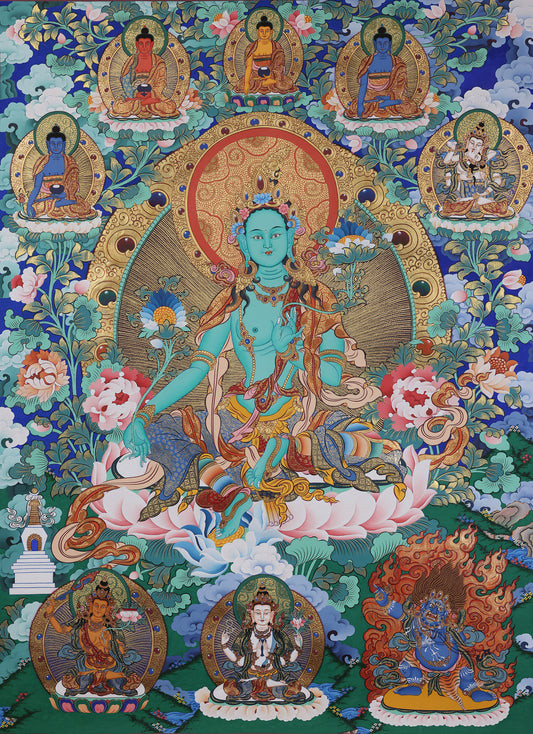
This hand-painted Green Tara Silver Thangka, created in the tradition of the Regong (Rebgong) school of Amdo Tibet, unites precise iconographic discipline with intricate silver-foil engraving. Through its doctrinal accuracy, symbolic richness, and rare materials, it embodies both deep spiritual significance and lasting artistic value.
I. Core Theme: The Embodiment of Avalokiteśvara’s Compassion and Wisdom
The central theme of this Thangka is “swift and fearless liberation through compassionate action.”
Green Tara (Sanskrit: Tārā), revered in Tibetan Buddhism as the “Holy Mother of Liberation,” is believed to have arisen from a tear of Avalokiteśvara (Chenrezig), the Bodhisattva of Compassion. She is regarded as the supreme emanation of the Twenty-One Taras, encompassing their collective virtues and enlightened activities. Green Tara represents the perfect union of compassion and wisdom in dynamic motion.
Unlike deities associated only with aspiration or contemplation, Green Tara is distinguished by her immediacy. She embodies the tantric principle of instant response to suffering, rising from meditative stillness to actively rescue beings from fear, danger, and inner obstacles.
Within Tibetan cultural history, Green Tara devotion is deeply interwoven with indigenous reverence for the feminine and maternal principle. Tibetan tradition often identifies Princess Wencheng as an earthly manifestation of Green Tara, granting her both divine salvific power and cultural motherhood. Centered upon Green Tara, this Thangka visually expresses the tantric progression from compassionate vow to enlightened action, reinforced by its attendant deities and enduring silver medium.
II. The Principal Deity: Iconography and Symbolic System of Green Tara
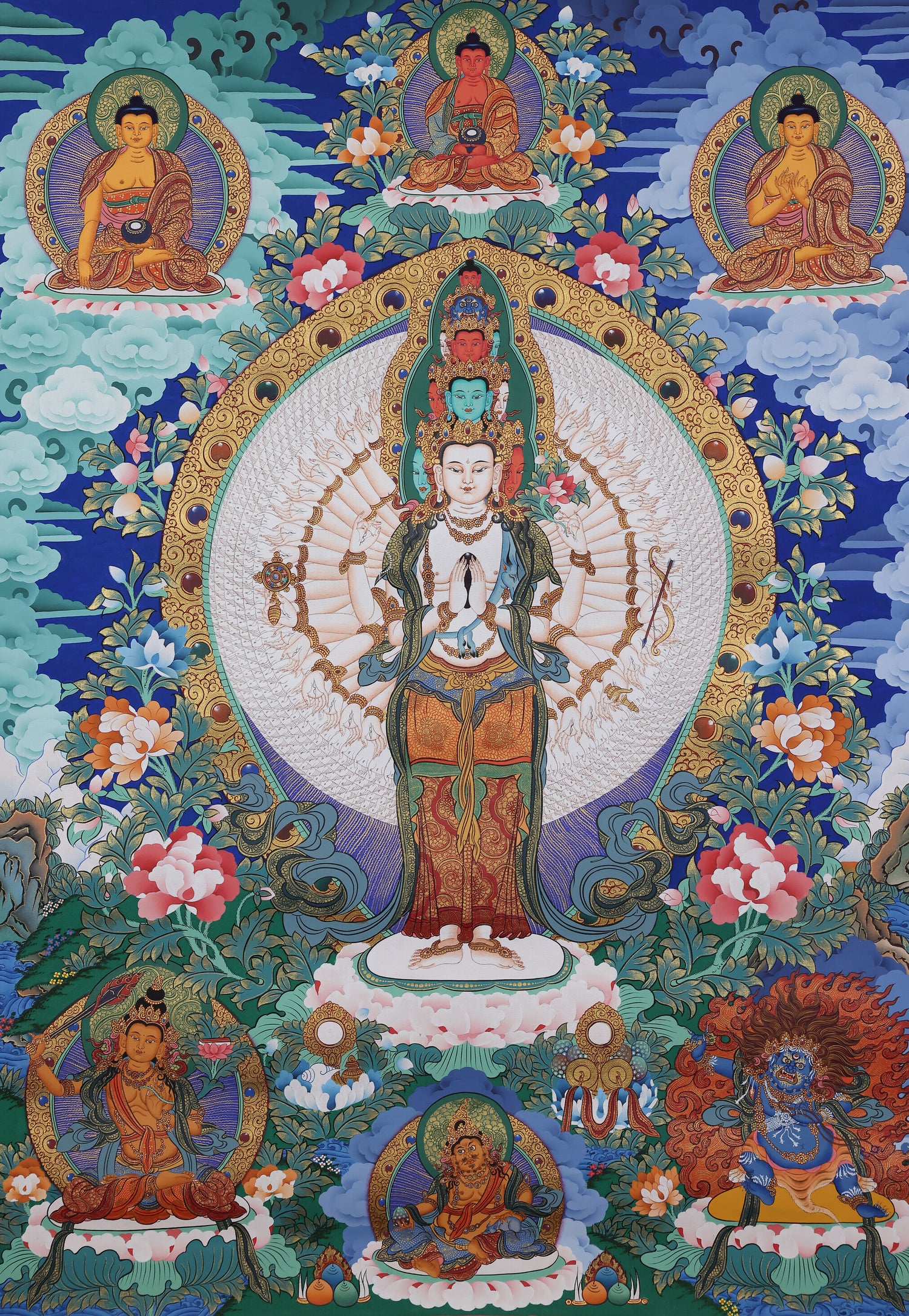
The central image of Green Tara strictly follows classical tantric iconometric texts, such as the Iconometric Treatises, ensuring doctrinal accuracy and spiritual integrity.
Form and Color
Green Tara’s luminous emerald-green body corresponds to the Activity (Karma) family of the Five Dhyani Buddhas, associated with Amoghasiddhi. This color signifies the power to remove obstacles, accomplish enlightened activities, and act swiftly for the benefit of beings. Her youthful appearance, traditionally depicted as a sixteen-year-old maiden, symbolizes the pure, undefiled nature of bodhicitta.
Posture and Mudrā
Her right leg extends forward upon a lotus throne, known as the “posture of readiness,” indicating her constant willingness to rise and act for sentient beings. The left leg remains in meditative repose, signifying unwavering inner realization.
Her right hand displays the gesture of supreme generosity, holding a blue utpala lotus that blooms at her shoulder—symbolizing fearless compassion and the fulfillment of wishes. Her left hand forms the Three Jewels mudrā, representing reliance on the Buddha, Dharma, and Sangha, while the union of thumb and ring finger signifies the inseparability of compassion and wisdom.
Ornaments and Halo
Green Tara wears the Five-Buddha crown, embodying the wisdoms of the five directions. Flowing silks, jeweled ornaments, and graceful scarves reflect the Regong school’s distinctive sense of rhythmic movement. Her halo features concentric rainbow motifs, while the body aura is delicately engraved in silver with scrolling lotus vines—evoking both sanctity and the Tibetan ideal of rainbow body realization.
III. Attendant Deities: Lineage and Protective Structure
A traditional Thangka presents not an isolated deity, but a complete spiritual cosmos sustained by lineage and protection.
Upper Deities
At the upper portion of the composition appear seated Buddhas, commonly identified as Amitābha and Amitāyus (Long Life Buddha). As Green Tara is an emanation of Avalokiteśvara, Amitābha represents her ultimate lineage source, while Amitāyus emphasizes her power to grant longevity and merit—uniting aspirations for present well-being and future liberation.
Lower Attendants
At the lower section, attendant female deities such as White Tara and Sarasvatī (or another Tara manifestation) are depicted.
White Tara, known for her seven eyes of omniscient compassion, governs longevity, healing, and pacification of suffering. Sarasvatī, often shown holding a stringed instrument, embodies wisdom, eloquence, and artistic inspiration, protecting scholars and practitioners alike. Their inclusion enriches the Thangka’s function as a multidimensional devotional support.
Symbolic Background
The background silver engravings—clouds, lotus scrolls, and flames—carry precise symbolic meanings. Clouds represent emptiness (śūnyatā), lotus vines symbolize the continuous growth of bodhicitta, and flames signify the burning away of ignorance and afflictions. Together, they construct a sacred narrative space rather than a decorative backdrop.
IV. Painting Technique: The Craftsmanship of Regong Silver Thangka
This Thangka belongs to the rare category of Regong silver-foil engraved Thangka, a pinnacle of Tibetan sacred art.
The canvas preparation alone requires repeated stretching, glue application, mineral priming, and polishing to achieve perfect smoothness and durability. Pure silver is hammered thousands of times into ultra-thin foil, then meticulously engraved using agate tools—each square centimeter requiring hundreds of precise incisions.
Natural mineral pigments such as malachite, cinnabar, and lapis lazuli are ground, layered, and bound with traditional animal glue in exact proportions. The cool radiance of silver interacts with the deep, stable tones of mineral pigments, producing a surface that changes subtly with light and endures for generations.
The final steps—gold outlining and the ceremonial “opening of the eyes”—are performed by senior masters on auspicious days, accompanied by mantra recitation, signifying the spiritual activation of the image.
V. Cultural Significance: Faith, Art, and Living Heritage
The value of this Green Tara Silver Thangka extends far beyond its visual beauty.
Spiritually, it functions as a portable shrine, supporting meditation, visualization, and devotional practice. Artistically, it represents the refined synthesis of strength and grace characteristic of Regong aesthetics. Culturally, it stands as a living testament to endangered traditional methods, as rare mineral pigments and master-apprentice transmission face increasing challenges.
For collectors, practitioners, and those seeking authentic sacred art with true lineage, this Green Tara Silver Thangka offers not only aesthetic refinement, but a profound and enduring connection to Tibetan Buddhist wisdom and compassion.
#TibetanThangka
#TibetanThangka
#SilverThangka
#HandPaintedThangka
#BodhisattvaArt
#SacredBuddhistArt
#TaraBuddhism
#BuddhistMeditationArt
#TraditionalThangka
#MineralPigmentArt
#BuddhistHeritage
#HimalayanArt
#BuddhistWallArt
#SpiritualHomeDecor
#MeditationRoomArt
#SacredArtCollection
#AuthenticThangka