Tibetan Thangka: Hand-Painted Yellow Jambhala Thangka (2025 Guide) – Symbolism, Deities & Traditional Artistry

$599.00 USD
Thangka Name: Yellow Jambhala Thangka
Size: 45cmX65cm
Origin: Nepal
Haz una pregunta

¡Date prisa! ¡Solo quedan [número] en stock!

Tiempos de entrega estimados: 12-26 días (Internacional), 3-6 días (Estados Unidos).

Devolución dentro de los 45 días posteriores a la compra. Los aranceles e impuestos no son reembolsables.

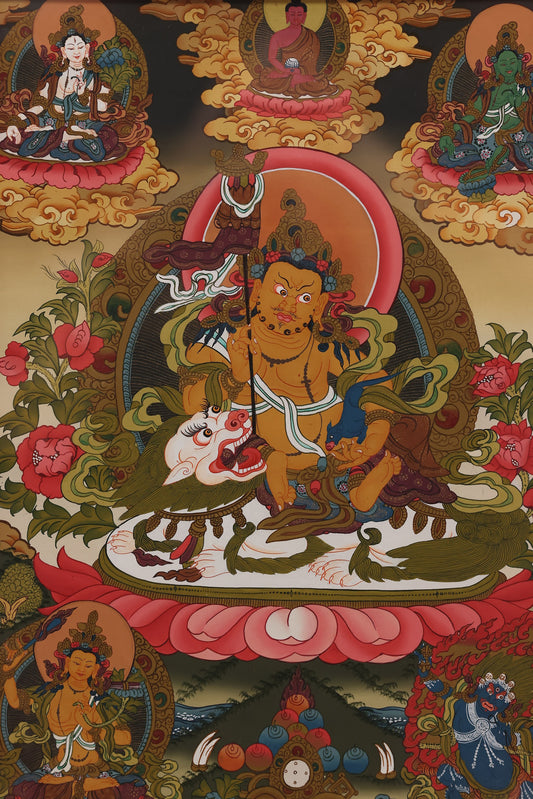
Yellow Jambhala wealth protection mandala thangka illustrating sacred order and material blessing
Tibetan Thangka: Hand-Painted Yellow Jambhala Thangka (2025 Guide) – Symbolism, Deities & Traditional Artistry
$599.00 USD
For practitioners of Tibetan Buddhism and collectors of spiritual art, a hand-painted Yellow Jambhala Thangka is far more than a decorative piece—it’s a sacred vessel of blessings, a masterpiece of centuries-old craftsmanship, and a bridge between material abundance and spiritual growth. In this 2025 guide, we dive into the symbolism, deity system, and traditional artistry of this revered Tibetan Buddhist thangka, perfect for those seeking to understand its cultural significance or add an authentic spiritual artifact to their collection.

What Is a Yellow Jambhala Thangka?

Originating from Tibet’s 14th-century Buddhist art traditions, the Yellow Jambhala Thangka centers on Zangla Serpo (Tibetan for “Yellow Wealth God”), the foremost of the Five Dhyani Buddhas of Wealth (White, Yellow, Red, Green, Black Jambhalas). Unlike commercial “fortune art,” this thangka embodies Tibetan Buddhism’s core tenet of “Dharma wealth”: it symbolizes not just material prosperity, but the abundance needed to pursue spiritual practice (e.g., funding retreats, supporting monastics) and alleviate suffering for others.
For modern practitioners and collectors, this thangka serves dual purposes: it’s a meditation aid (visualizing Yellow Jambhala cultivates generosity and removes poverty-related anxiety) and a heritage artifact—each piece is handcrafted by master Tibetan artists using techniques unchanged for 700 years.

The Main Deity: Yellow Jambhala (Zangla Serpo) – Symbolism & Iconography

At the heart of this thangka stands Yellow Jambhala, rendered in strict adherence to the Iconometry Sutras (Tibetan Buddhist artistic canons):
  • Physical Form: His golden-yellow skin represents the radiance of abundance; he wears a jewel-encrusted crown, pearl necklaces, and silk sashes—symbols of the “treasures of enlightenment” made accessible to devotees.
  • Key Symbols:
    • Right Hand: Holds a Cintāmaṇi (wish-fulfilling jewel), which emits flames to signify the transformative power of wealth (turning greed into generosity).
    • Left Arm: Embraces a Nāga (mythical serpent) or Marici (treasure-vomiting mongoose)—the mongoose’s open mouth spills jewels, a visual promise of “unending provision for virtuous deeds.”
  • Seat: He rests on a lotus throne (red petals, white base) — the lotus symbolizes rising above worldly attachment, even as one engages with material resources.
  • Aura: A circular mandorla (red-gold halo) surrounds him, lined with scrolling clouds and peonies (Tibetan symbols of joy and prosperity), framing him as a deity of both power and compassion.

Retinue Deities: The Supportive Pantheon of the Yellow Jambhala Thangka

A traditional Yellow Jambhala Thangka is never a solo portrait—it’s a microcosm of Tibetan Buddhist cosmology, with retinue deities that amplify the main deity’s blessings:
  1. Amitabha Buddha (Top Center):

    Positioned above Yellow Jambhala, this red-skinned Buddha is Jambhala’s “root guru” in Tibetan lore. His presence links material blessings to Buddha-nature: it reminds practitioners that wealth is a tool for awakening, not an end in itself.
  2. Other Four Jambhalas (Surrounding):
    • Green Jambhala (Top Right): Governs career and business success; his green skin represents growth.
    • White Jambhala (Top Left): Associated with healing and spiritual purity; his white hue symbolizes clarity.
    • Red Jambhala (Bottom Left): Supports harmonious relationships (critical for collaborative prosperity).
    • Black Jambhala (Bottom Right): Acts as a protector, removing obstacles (e.g., debt, bad luck) to abundance.
  3. Dharma Protectors (Bottom Edge):

    The blue-skinned deity at the bottom is a Dharmapāla (protector), tasked with safeguarding the thangka’s blessings and warding off negative energies that block prosperity.

Traditional Artistry: How a Hand-Painted Yellow Jambhala Thangka Is Made

This thangka is a product of the Menri School (Tibet’s most revered thangka tradition), requiring 3–6 months of work by a master artist. Every step honors Tibetan cultural heritage:
  1. Base Preparation:
    • The canvas is hand-woven cotton (sourced from Himalayan villages), boiled in tea and lime to stiffen it, then stretched over a wooden frame and coated with yak glue mixed with chalk (to create a smooth, paint-resistant surface).
  2. Natural Pigments:
    • Colors are derived from minerals, plants, and even gold:
      • Yellow: Ground 雄黄 (realgar, a Himalayan mineral)
      • Red: Cinnabar (朱砂)
      • Green: Crushed turquoise (from Tibetan mines)
      • Gold: 24K gold leaf, ground into powder and mixed with yak glue—artists use 玛瑙 (agate stones) to polish gold details, giving them a luminous sheen that lasts for centuries.
  3. Linework & Painting:
    • Artists sketch the composition with a bamboo brush (using the Iconometry Sutras to ensure precise proportions: e.g., Jambhala’s torso must be 3 “fingers” wide, his eyes 1 “finger” apart).
    • Layers of pigment are applied wet-on-wet to create soft gradients, then details (jewels, textiles) are added with fine brushes—some artists use a single hair for micro-details.
  4. Blessing Ritual:

    Before sale, the thangka is blessed by a Tibetan monk, who chants Jambhala mantras (e.g., “Om Vasudhāya Svāhā”) to infuse it with spiritual energy.

Why Choose a Hand-Painted Yellow Jambhala Thangka?

In an era of mass-produced spiritual art, this thangka stands out for three reasons:
  • Authenticity: It’s not a print—every brushstroke is unique, carrying the artist’s devotion and cultural heritage.
  • Spiritual Value: For practitioners, it’s a yantra (energetic tool) that deepens meditation on abundance and generosity.
  • Investment: Hand-painted Menri School thangkas appreciate in value (vintage pieces sell for $10,000+ at auctions) — they’re both a spiritual and financial asset.

How to Care for Your Yellow Jambhala Thangka

To preserve its color and blessings:
  • Hang it in a dry, dimly lit space (avoid direct sunlight, which fades natural pigments).
  • Dust it gently with a soft brush (never use water or chemicals).
  • If storing, roll it around a cotton cylinder (not wood) and wrap it in silk.
For those seeking to bring both abundance and spiritual depth into their lives, a hand-painted Yellow Jambhala Thangka is unparalleled. It’s a piece of Tibet’s soul, a reminder that true wealth is the freedom to live with compassion.
#YellowJambhalaThangka #TibetanBuddhistThangka #HandPaintedThangka #MenriSchoolThangka #FiveWealthGods #TibetanCulturalHeritage #NaturalMineralPigmentThangka #SpiritualArtCollection

Descubre el thangka budista tibetano perfecto que se adapta a tus deseos, estilo de vida y espacio. Cada thangka tiene un significado espiritual y trae bendiciones cuando se coloca correctamente.

1. Define tu intención

Riqueza y éxito → Dzambhala amarillo (deidad de la riqueza)

Compasión y Paz → Avalokiteshvara, Tara Verde

Sabiduría y aprendizaje → Manjushri

Salud y sanación → Buda de la Medicina

Longevidad y protección familiar → Tara Blanca

2. Elija por identidad

Emprendedores y dueños de negocios → Deidades de la riqueza para la prosperidad.

Estudiantes y eruditos → Deidades de la sabiduría para el enfoque y la claridad.

Sanadores y practicantes de yoga → Buda de la Medicina para la energía y el equilibrio.

Familias y amas de hogar → Tara Deidades para la armonía y la seguridad.

Coleccionistas y amantes del arte → Mandalas raros o Thangkas obras maestras.

3. Combina tu espacio

Santuario casero / Sala de meditación → Thangkas medianos (60–80 cm).

Oficina / Sala de negocios → Grandes Thangkas para prosperidad y autoridad.

Sala de estar / Estudio → Thangkas decorativas para la paz y la belleza.

4. Auténtica artesanía

Pintado a mano con pigmentos minerales naturales y lienzo fino, cada Thangka refleja el arte tibetano y su poder espiritual. Fuentes verificadas garantizan la calidad y el respeto por la tradición.

✨Elige tu Thangka con corazón: no es solo arte, sino una bendición para tu vida.

Cada persona tiene necesidades diferentes, y elegir el thangka adecuado puede brindar apoyo espiritual, protección, buena fortuna y bendiciones. A continuación, se presentan recomendaciones de thangkas para diferentes roles:

1. Emprendedores

  • Necesidades : Sabiduría, riqueza, salud, éxito profesional.
  • Thangkas recomendadas :
    Manjushri : Mejora la toma de decisiones y la sabiduría empresarial.
    Deidad de la riqueza : trae riqueza y prosperidad.
    Buda de la Medicina : Apoya la salud y reduce el estrés.
    Mahakala : protege el negocio de la competencia y los desafíos.

2. Individuos exitosos

  • Necesidades : Paz interior, armonía familiar, longevidad.
  • Thangkas recomendadas :
    Buda Amitabha : trae paz interior y tranquilidad.
    Avalokiteshvara (Guanyin) : Promueve la armonía y la felicidad familiar.
    Amitayus (Buda de larga vida) : ruega por la buena salud y una larga vida.
    Manjushri : continúa mejorando la sabiduría.

3. Amas de casa/Maridos

  • Necesidades : Armonía familiar, protección, salud.
  • Thangkas recomendadas :
    Avalokiteshvara : Aumenta la felicidad y la armonía familiar.
    Deidades protectoras : protegen a la familia de las perturbaciones externas.
    Tara Blanca : Bendice a la familia con salud.

4. Estudiantes y académicos

  • Necesidades : Sabiduría, concentración, éxito académico.
  • Thangkas recomendadas :
    Manjushri : aumenta el aprendizaje, la memoria y la sabiduría.
    Buda Sakyamuni : ayuda con la concentración y la práctica espiritual.
    Jixiang Tianmu : trae buena suerte académica y éxito en los exámenes.

5. Artistas y profesionales creativos

  • Necesidades : Inspiración, creatividad, logro artístico.
  • Thangkas recomendadas :
    Manjushri : Estimula el pensamiento creativo y la inspiración.
    Vajrapani : Ayuda a superar los bloqueos creativos.
    Maitreya : Aporta una actitud relajada y optimista, aliviando el estrés.

6. Viajeros y aventureros

  • Necesidades : Protección, buena suerte, éxito en las aventuras.
  • Thangkas recomendadas :
    Hayagriva : Proporciona una fuerte protección durante los viajes y elimina obstáculos.
    Mahakala : trae buena fortuna y protección, especialmente para los aventureros.
    Vajrasattva : Ayuda a superar las dificultades y los desafíos durante el viaje.

7. Personas mayores

  • Necesidades : Salud, longevidad, paz espiritual.
  • Thangkas recomendadas :
    Amitayus : Reza por una larga vida y buena salud.
    Buda de la Medicina : Promueve la curación y el bienestar físico.
    Avalokiteshvara : trae compasión y paz interior en los años posteriores.

8. Ejecutivos corporativos

  • Necesidades : Liderazgo, sabiduría, trabajo en equipo y éxito empresarial.
  • Thangkas recomendadas :
    Manjushri : Mejora las habilidades de liderazgo y la toma de decisiones.
    Deidad de la riqueza : trae éxito y prosperidad al negocio y al equipo.
    Avalokiteshvara : Promueve la armonía y el equilibrio dentro del equipo.

9. Entusiastas de la salud y el fitness

  • Necesidades : Buena salud, vitalidad, energía.
  • Thangkas recomendadas :
    Buda de la Medicina : Mejora la salud física y la vitalidad.
    Tara Blanca : Trae salud y rejuvenecimiento.
    Vajrasattva : Limpia los problemas de salud y aumenta la energía.

10. Políticos

  • Necesidades : Liderazgo, sabiduría, paz.
  • Thangkas recomendadas :
    Manjushri : Mejora las habilidades de liderazgo y la toma de decisiones.
    Buda Vairocana : Ayuda a mantener la paz interior y la sabiduría.
    Avalokiteshvara : promueve la paz social y la armonía familiar.

Para todos los pedidos que superen un valor de 100 USD, el envío se ofrece gratis.

Se aceptarán devoluciones hasta 10 días después de la recepción o el número de seguimiento del cliente para artículos sin usar. Como cliente, debe informarnos por correo electrónico antes de devolver el artículo.

De lo contrario, se aplicarán los gastos de envío estándar. Consulta nuestros Términos y Condiciones de Envío para más detalles.

Se aceptarán devoluciones hasta 10 días después de la recepción o el número de seguimiento del cliente para artículos sin usar. Como cliente, está obligado a informarnos por correo electrónico antes de devolver el artículo, únicamente en caso de:

– Recibí el artículo equivocado.
– El artículo no llegó como se esperaba (es decir, embalaje dañado).
– El artículo tenía defectos.
– Exceso de tiempo de entrega.
– El remitente no permite que se inspeccionen las mercancías antes del pago.

El/los producto(s) devuelto(s) debe(n) estar en su embalaje original, envuelto(s) de forma segura, sin daños ni uso. Esto significa que debe(n) estar embalado(s) de forma segura en una caja de cartón para su protección durante el transporte, posiblemente la misma caja utilizada para el envío.

Vistos recientemente

¡No lo olvides! Los productos que viste. ¡Añádelos al carrito ahora!

Combina bien con

Mejora tu selección con accesorios perfectamente combinados y productos complementarios.

La gente también compró

Aquí tienes algunos de nuestros productos más similares que la gente compra. Haz clic para descubrir las tendencias.