Nepalese Hand-Painted White Tara Thangka: Compassion and Millennium-Old Craft in Tibetan Buddhist Art

$499.00 USD
Thangka Name: Blue Tang White Tara
size: 20cm×30cm
origin: Nepal
Haz una pregunta

¡Date prisa! ¡Solo quedan [número] en stock!

Tiempos de entrega estimados: 12-26 días (Internacional), 3-6 días (Estados Unidos).

Devolución dentro de los 45 días posteriores a la compra. Los aranceles e impuestos no son reembolsables.

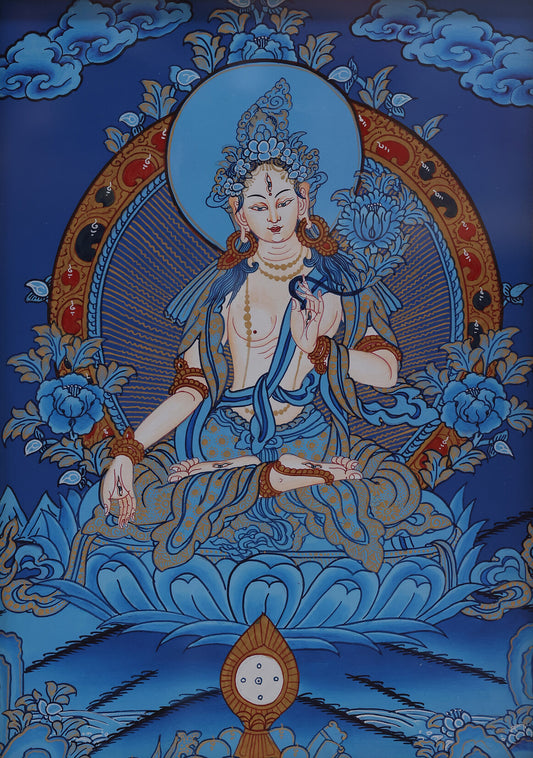
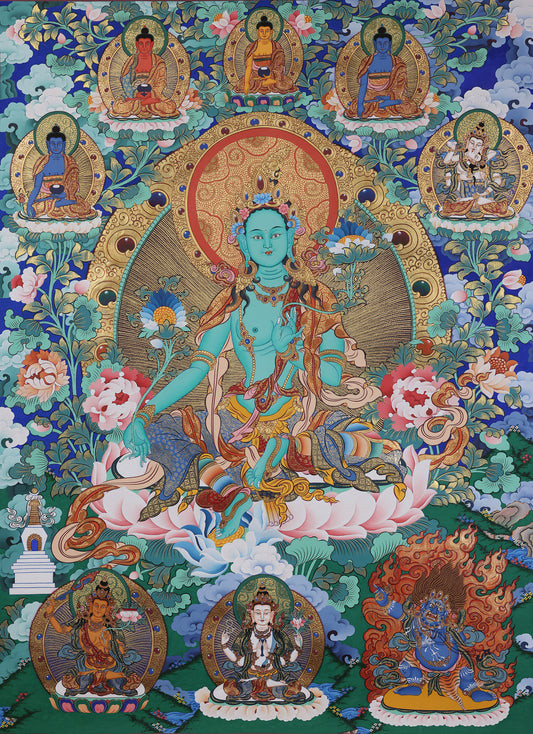
A hand-painted Blue Thangka depicting White Tara, the Tibetan Buddhist goddess of longevity, compassion, and healing energy.
Nepalese Hand-Painted White Tara Thangka: Compassion and Millennium-Old Craft in Tibetan Buddhist Art
$499.00 USD
When a 20×30cm hand-painted Nepalese thangka unfolds before your eyes, what you see is more than a layering of colors and lines—it is a materialized carrier of Tibetan Buddhist compassion, a living heritage of Nepal’s millennium-old craftsmanship, and a microcosm of the coexistence of "faith and aesthetics" in the Himalayan cultural sphere. Today, we unpack every detail of this White Tara-themed thangka through the lens of Tibetan Buddhism.

I. The Central Deity: White Tara—The "Mother of Compassion and Longevity" in Tibetan Buddhism

The core of this thangka is White Tara, one of the most widely venerated female deities in Tibetan Buddhism.
As an emanation of Avalokiteshvara’s compassionate heart, White Tara is known as the "Mother of All Buddhas" in Tibetan Buddhist tradition, embodying three virtues: pacifying afflictions, increasing merit, and fostering loving-kindness. She is particularly associated with life extension and the alleviation of suffering—this is why she is a central figure in the "Three Longevity Deities" (White Tara, Amitayus, and Ushnishavijaya).
In terms of iconography, this thangka strictly adheres to the Iconometric Sutras:
  • Form: Her skin is pure white (rendered with chalk or pearl powder mineral pigments), and she bears three eyes (one on the forehead, one in each eye socket), symbolizing "watching over all beings in the three realms." Her proportions follow the "seven-head height" standard, a marker of sacred dignity in Tibetan Buddhism.
  • Mudra and Implements: Her right hand forms the varada mudra (palm outward, fingers slightly spread), representing "bestowing ease." Her left hand holds an utpala (blue lotus), its stem extending to her shoulder—a symbol of "Bodhicitta untainted by samsara."
  • Lotus Seat and Aura: She sits on an eight-petaled white lotus (white lotus = purity). Behind her, a circular blue halo (head aura) and a radiating golden-rayed aura (body aura) are framed by "Seven Treasures" patterns. This aligns with the Nepalese thangka convention of "centralizing the deity" while metaphorically conveying "the illumination of Buddha’s light."

II. Implicit Attendants: Tibetan Cosmology in a Miniature Thangka

At 20×30cm, this is a "miniature thangka." Due to space constraints, it does not explicitly depict the other members of the Three Longevity Deities (Amitayus, Ushnishavijaya), but the artist uses symbolic devices to echo Tibetan Buddhism’s "three realms and five directions" cosmology:
  • The dharmachakra (wheel of dharma) pattern beneath the lotus seat symbolizes "Amitayus preaching the dharma," implying "blessings of the dharma body."
  • The blue cloud patterns and padma (lotus) motifs in the background correspond to the visual symbols of Ushnishavijaya’s pure land, representing "purifying karmic obstacles and extending life."
  • The three-layered composition (celestial clouds above, deity in the middle, wave patterns below) mirrors Tibetan Buddhism’s "three realms of samsara," with a cool-to-warm color gradient enhancing spatial order.

III. Millennium-Old Craft: Nature and Craftsmanship in Mineral Pigments

This thangka uses Nepal’s traditional "handmade mineral + earth pigment technique," with every step steeped in time:
  1. Canvas Preparation: Coarse cotton fabric is used as the base, coated 5–6 times with a mixture of cowhide glue and stone powder, then polished with pebbles until it "sounds like cowhide when tapped and feels like silk to the touch." This is a distinctive Nepalese process (Tibetan thangkas often use linen), ensuring pigment adhesion and century-long durability.
  2. Pigment Production:
    • Blue comes from Afghan lapis lazuli (ground to 5–20μm particles), white from chalk or pearl powder, and gold from 24K gold leaf ground into paste.
    • Red is derived from cinnabar ore, while yellow is a blend of realgar and turmeric (plant + earth).
    • Pigments are mixed with aged cowhide glue in a 3:1 ratio, then processed through pounding, grinding, filtering, and drying—resulting in saturated colors that "do not fade for over a century" (lapis lazuli pigments have a lightfastness of over 100 years, per Oxford University tests).
  3. Painting Process: First, the outline is sketched with charcoal according to the Iconometric Sutras to ensure precise proportions. Colors are applied from cool to warm: lapis lazuli blue (background) first, then the lotus seat, then the deity’s skin. Details are blended using the Newari "wheat-awn brush dotting method," with saliva used to dilute pigment paste for gradual transitions (e.g., the blue-gold gradient of the robes). A single miniature thangka can take dozens of hours to complete.

IV. Artistic Style: The Unique Aesthetic of the Nepalese Newari School

This thangka belongs to the Nepalese Newari School (a branch of the court school), with distinct stylistic differences from Tibetan thangkas:
  • Color Palette: Centered on blue, white, and gold (corresponding to Tibetan Buddhist symbols of "tranquility" and "compassion"), the colors are soft and unobtrusive—unlike the high-contrast palettes of Tibetan thangkas. Gold paste is matte-finished (gold powder + honey) to avoid a garish metallic sheen.
  • Lines and Form: Lines are straightforward and concise; robes use "curves + gold patterns" to convey elegance, unlike the intricate scrollwork of Tibetan thangkas. The face features the Newari school’s signature "infant-like appearance" (concentrated features, gentle expression), embodying the core of "compassion and purity."
  • Composition Rhythm: While adhering to the religious norm of "centralizing the deity," the composition avoids overcrowding through balanced ornamentation (e.g., padma beside the lotus seat). The negative space of the blue cloud background conveys "emptiness and elegance"—a departure from the Tibetan thangka tradition of "filling the frame as an act of reverence."

V. Cultural Value: The Dual Identity of a Miniature Thangka (Faith + Art)

This 20×30cm thangka is both a "portable protector" for Tibetan Buddhist practitioners (easy to carry and venerate; meditating on the deity’s three eyes grants wisdom blessings, while touching the thangka brings longevity protection) and a living carrier of Nepal’s intangible cultural heritage. Its "wheat-awn dotting" and "mineral pigment techniques" are unique creations of the Himalayan cultural sphere, blending "religious solemnity" and "artistic appeal."
From Tibetan Buddhist spiritual symbols to Nepal’s millennium-old craftsmanship, this miniature thangka carries humanity’s pursuit of "compassion and eternity" in a small frame. It is not just a work of art, but a cultural crystallization of the coexistence of nature, craftsmanship, and faith.

 #NepaleseThangka #WhiteTaraThangka #TibetanBuddhistArt #NewariSchool #MineralPigmentThangka #WhiteTaraBuddhistArt #TibetanBuddhismThangka
Descubre el thangka budista tibetano perfecto que se adapta a tus deseos, estilo de vida y espacio. Cada thangka tiene un significado espiritual y trae bendiciones cuando se coloca correctamente.

1. Define tu intención

Riqueza y éxito → Dzambhala amarillo (deidad de la riqueza)

Compasión y Paz → Avalokiteshvara, Tara Verde

Sabiduría y aprendizaje → Manjushri

Salud y sanación → Buda de la Medicina

Longevidad y protección familiar → Tara Blanca

2. Elija por identidad

Emprendedores y dueños de negocios → Deidades de la riqueza para la prosperidad.

Estudiantes y eruditos → Deidades de la sabiduría para el enfoque y la claridad.

Sanadores y practicantes de yoga → Buda de la Medicina para la energía y el equilibrio.

Familias y amas de hogar → Tara Deidades para la armonía y la seguridad.

Coleccionistas y amantes del arte → Mandalas raros o Thangkas obras maestras.

3. Combina tu espacio

Santuario casero / Sala de meditación → Thangkas medianos (60–80 cm).

Oficina / Sala de negocios → Grandes Thangkas para prosperidad y autoridad.

Sala de estar / Estudio → Thangkas decorativas para la paz y la belleza.

4. Auténtica artesanía

Pintado a mano con pigmentos minerales naturales y lienzo fino, cada Thangka refleja el arte tibetano y su poder espiritual. Fuentes verificadas garantizan la calidad y el respeto por la tradición.

✨Elige tu Thangka con corazón: no es solo arte, sino una bendición para tu vida.

Cada persona tiene necesidades diferentes, y elegir el thangka adecuado puede brindar apoyo espiritual, protección, buena fortuna y bendiciones. A continuación, se presentan recomendaciones de thangkas para diferentes roles:

1. Emprendedores

  • Necesidades : Sabiduría, riqueza, salud, éxito profesional.
  • Thangkas recomendadas :
    Manjushri : Mejora la toma de decisiones y la sabiduría empresarial.
    Deidad de la riqueza : trae riqueza y prosperidad.
    Buda de la Medicina : Apoya la salud y reduce el estrés.
    Mahakala : protege el negocio de la competencia y los desafíos.

2. Individuos exitosos

  • Necesidades : Paz interior, armonía familiar, longevidad.
  • Thangkas recomendadas :
    Buda Amitabha : trae paz interior y tranquilidad.
    Avalokiteshvara (Guanyin) : Promueve la armonía y la felicidad familiar.
    Amitayus (Buda de larga vida) : ruega por la buena salud y una larga vida.
    Manjushri : continúa mejorando la sabiduría.

3. Amas de casa/Maridos

  • Necesidades : Armonía familiar, protección, salud.
  • Thangkas recomendadas :
    Avalokiteshvara : Aumenta la felicidad y la armonía familiar.
    Deidades protectoras : protegen a la familia de las perturbaciones externas.
    Tara Blanca : Bendice a la familia con salud.

4. Estudiantes y académicos

  • Necesidades : Sabiduría, concentración, éxito académico.
  • Thangkas recomendadas :
    Manjushri : aumenta el aprendizaje, la memoria y la sabiduría.
    Buda Sakyamuni : ayuda con la concentración y la práctica espiritual.
    Jixiang Tianmu : trae buena suerte académica y éxito en los exámenes.

5. Artistas y profesionales creativos

  • Necesidades : Inspiración, creatividad, logro artístico.
  • Thangkas recomendadas :
    Manjushri : Estimula el pensamiento creativo y la inspiración.
    Vajrapani : Ayuda a superar los bloqueos creativos.
    Maitreya : Aporta una actitud relajada y optimista, aliviando el estrés.

6. Viajeros y aventureros

  • Necesidades : Protección, buena suerte, éxito en las aventuras.
  • Thangkas recomendadas :
    Hayagriva : Proporciona una fuerte protección durante los viajes y elimina obstáculos.
    Mahakala : trae buena fortuna y protección, especialmente para los aventureros.
    Vajrasattva : Ayuda a superar las dificultades y los desafíos durante el viaje.

7. Personas mayores

  • Necesidades : Salud, longevidad, paz espiritual.
  • Thangkas recomendadas :
    Amitayus : Reza por una larga vida y buena salud.
    Buda de la Medicina : Promueve la curación y el bienestar físico.
    Avalokiteshvara : trae compasión y paz interior en los años posteriores.

8. Ejecutivos corporativos

  • Necesidades : Liderazgo, sabiduría, trabajo en equipo y éxito empresarial.
  • Thangkas recomendadas :
    Manjushri : Mejora las habilidades de liderazgo y la toma de decisiones.
    Deidad de la riqueza : trae éxito y prosperidad al negocio y al equipo.
    Avalokiteshvara : Promueve la armonía y el equilibrio dentro del equipo.

9. Entusiastas de la salud y el fitness

  • Necesidades : Buena salud, vitalidad, energía.
  • Thangkas recomendadas :
    Buda de la Medicina : Mejora la salud física y la vitalidad.
    Tara Blanca : Trae salud y rejuvenecimiento.
    Vajrasattva : Limpia los problemas de salud y aumenta la energía.

10. Políticos

  • Necesidades : Liderazgo, sabiduría, paz.
  • Thangkas recomendadas :
    Manjushri : Mejora las habilidades de liderazgo y la toma de decisiones.
    Buda Vairocana : Ayuda a mantener la paz interior y la sabiduría.
    Avalokiteshvara : promueve la paz social y la armonía familiar.

Para todos los pedidos que superen un valor de 100 USD, el envío se ofrece gratis.

Se aceptarán devoluciones hasta 10 días después de la recepción o el número de seguimiento del cliente para artículos sin usar. Como cliente, debe informarnos por correo electrónico antes de devolver el artículo.

De lo contrario, se aplicarán los gastos de envío estándar. Consulta nuestros Términos y Condiciones de Envío para más detalles.

Se aceptarán devoluciones hasta 10 días después de la recepción o el número de seguimiento del cliente para artículos sin usar. Como cliente, está obligado a informarnos por correo electrónico antes de devolver el artículo, únicamente en caso de:

– Recibí el artículo equivocado.
– El artículo no llegó como se esperaba (es decir, embalaje dañado).
– El artículo tenía defectos.
– Exceso de tiempo de entrega.
– El remitente no permite que se inspeccionen las mercancías antes del pago.

El/los producto(s) devuelto(s) debe(n) estar en su embalaje original, envuelto(s) de forma segura, sin daños ni uso. Esto significa que debe(n) estar embalado(s) de forma segura en una caja de cartón para su protección durante el transporte, posiblemente la misma caja utilizada para el envío.

Vistos recientemente

¡No lo olvides! Los productos que viste. ¡Añádelos al carrito ahora!

Combina bien con

Mejora tu selección con accesorios perfectamente combinados y productos complementarios.

La gente también compró

Aquí tienes algunos de nuestros productos más similares que la gente compra. Haz clic para descubrir las tendencias.