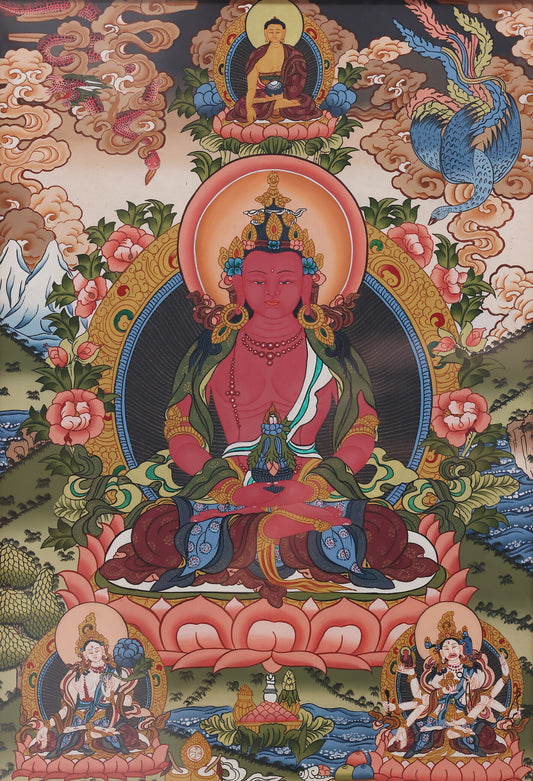
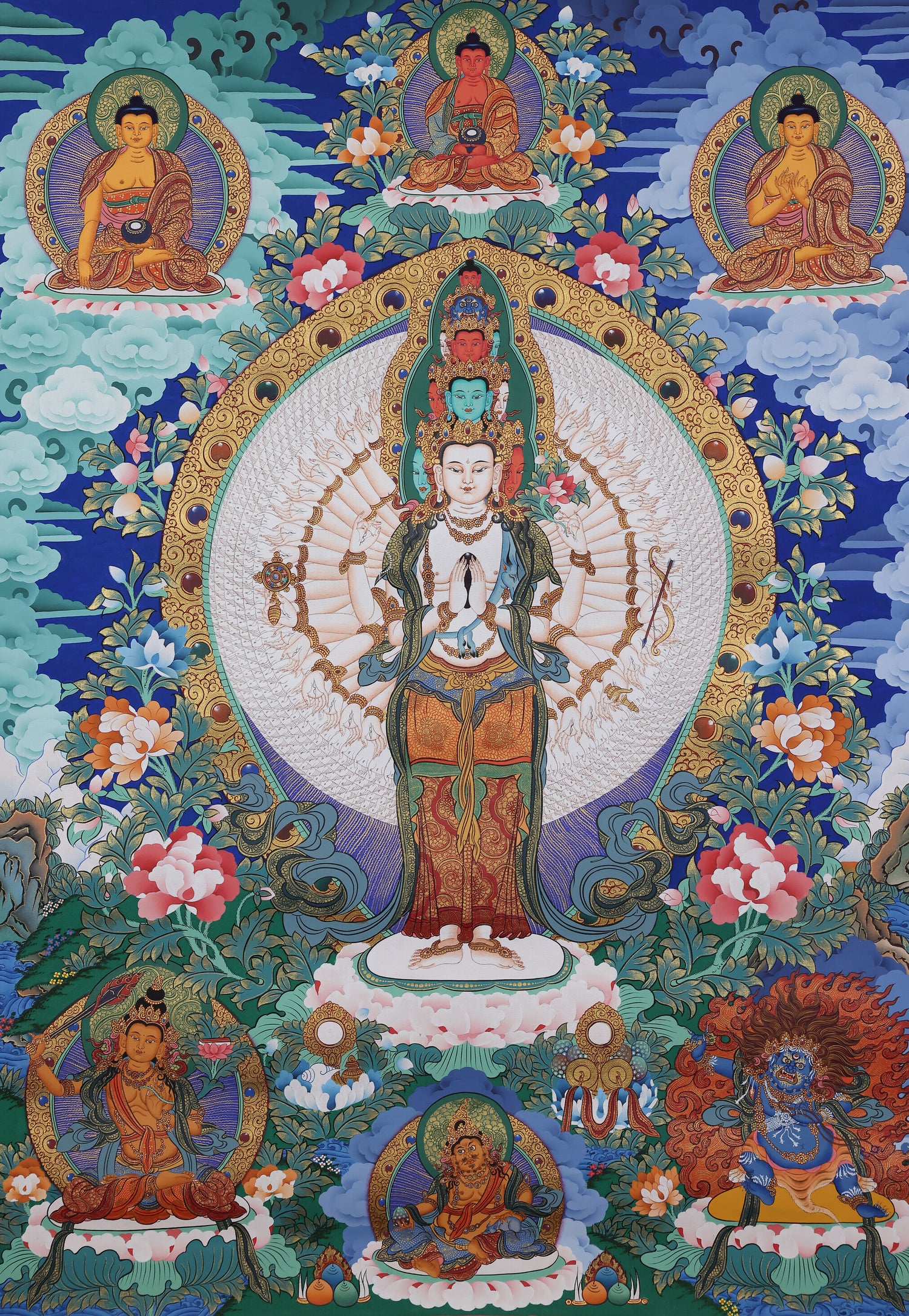
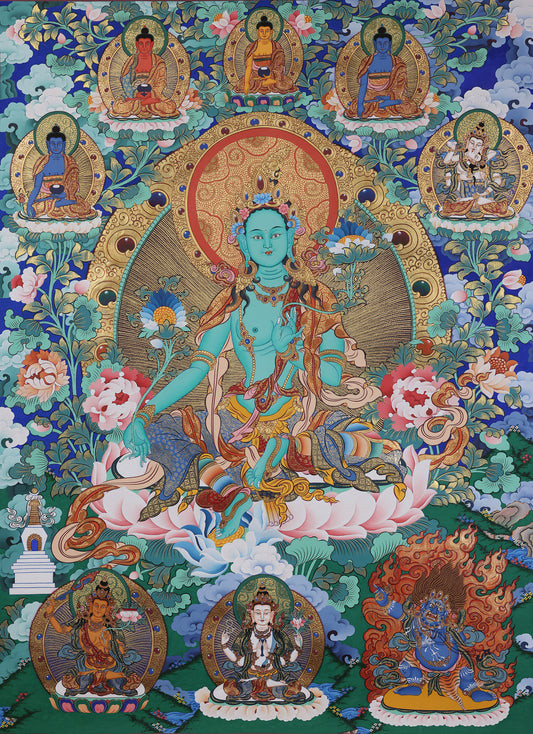
This meticulously hand-painted Thangka centers on the Tibetan Buddhist theme of “longevity and blessings”, representing a classic subject within the Nyingma and Gelug traditions. Crafted by the Mentang School, the work integrates precise iconography with natural highland materials, creating a sacred visual space governed by the central deity and protective attendants. Beyond a religious ritual object, it embodies the spiritual projection of Tibetan culture’s aspiration for life completeness, with every line and color carrying both worldly prayers and sacred devotion.
1. Core Theme: The Longevity Trikaya Mandala of Fulfillment
At the heart of this Thangka lies the “Longevity Buddha and Attendants’ Blessing Mandala”, a popular motif in Tibetan Buddhist art designed to eliminate obstacles, extend life, and increase merit. In Tibetan cultural context, longevity is more than lifespan—it represents freedom from illness, inner peace, and abundant merit and wisdom. This understanding resonates deeply with the highlanders’ reverence for resilience and their desire for stability amid harsh natural conditions.
The composition follows the Tibetan Mandala Cosmology: the central deity represents the core of the Dharma realm, while attendant deities occupy the four directions, symbolizing protection from all sides. The mountains, clouds, and background scenery link the mundane world with the sacred realm. Devotees engage with this Thangka through meditation and visualization, creating a spiritual connection between their life energy and the Buddha’s compassionate power, thus achieving the triple aspiration of obstacle removal, life extension, and merit accumulation. This theme reflects Tibet’s cultural essence of settling life through faith.
2. Central Deity: Symbolism and Spiritual Significance of the Longevity Buddha
The central figure is the Longevity Buddha (Tib. Tsepah), also known as the Buddha of Infinite Life and Wisdom. Its iconography strictly follows the Sutra of Measurement for Sacred Images, with every detail conveying tantric symbolic language:
-
Physical Attributes: Painted entirely in crimson, symbolizing vital warmth and abundant merit. In Tibetan color symbolism, red represents life energy and the flourishing of body and blood. The Buddha wears the Five Buddha Crown, symbolizing the wisdom of the five directions, and a bejeweled necklace, representing accumulated spiritual merit. These adornments are religious, not ornamental, guiding practitioners toward virtuous practices.
-
Posture and Attributes: Seated in the lotus position on a double lotus base, the Buddha holds a vase of longevity elixir in his hands, representing the continuous flow of blessings and purification. The lotus symbolizes liberation from cyclic existence, and the moon disk represents purity and serenity. Visualizing the elixir falling onto oneself invokes faith in cleansing karma and extending life.
-
Spiritual Meaning: Considered a manifestation of Amitabha Buddha, the Longevity Buddha embodies life energy. His serene expression conveys freedom from the fear of death, while the crimson body symbolizes vitality. For practitioners, this deity is both a giver of long life and a representation of life’s dignity, guiding believers to nourish mind and body through virtuous practices and attain completeness of merit and wisdom.
3. Attendant Deities: Protective Network and Ritual Logic
The surrounding deities form a comprehensive “longevity protective network”, with each deity positioned according to ritual logic to serve the theme of longevity:
-
Upper Deities: Shakyamuni Buddha or Amitayus presides above, representing the source of Dharma and confirming the authenticity of the longevity practice. Flanking bodhisattvas, such as Four-Armed Avalokiteshvara (compassion) and Manjushri (wisdom), form a dual function of compassion and wisdom, alleviating suffering and dissolving obstacles.
-
Side and Lower Attendants:
-
White Tara (Seven-Eyed): observes all suffering, alleviating illness and misfortune.
-
Vajra Yogini (Three Faces, Eight Arms): removes karmic obstacles and prevents premature death.
-
Yellow Jambhala (holding treasure mouse): provides wealth to sustain life.
-
Protector Deities (e.g., Mahakala): destroy forces hindering longevity.
This layout follows the ritual logic of “primary blessing by central deity, functional support by attendants”: the Longevity Buddha provides the root vitality, White Tara heals, Vajra Yogini clears obstacles, and Jambhala nurtures life, forming a holistic protective system that meets both existential and daily needs.
4. Painting Technique: Mentang School Craftsmanship and Faith
This Thangka exemplifies the Mentang School’s combination of ritual, natural materials, and handcrafting, where every step is an act of devotion:
Canvas Preparation
Handmade Tibetan cotton is coated with bone glue and chalk, repeatedly polished to form a firm, durable surface that resists pigment seepage for centuries. This step, known as “constructing a house for the Buddha”, is performed on auspicious days accompanied by prayer recitation.
Natural Pigments
-
Crimson Red: derived from Tibet’s cinnabar, purified over 49 days using the water-float method; fine powder for the face, coarser for robes.
-
Blue and Green: sourced from Ali lapis lazuli and Chamdo malachite; lightfastness ensures over 300 years of color retention.
-
Gold: 24K gold leaf mixed with trace bovine bile for adhesion; candlelight reveals dynamic color shifts, simulating radiant Buddha light.
Religious Technique
-
Linework: wolf hair brush, proportions strictly from the Sutra of Measurement; fine yet powerful lines embody grace within majesty.
-
Shading: multi-layered gradation allows garments to transition naturally, symbolizing life flow.
-
Composition: central mandala layout with hierarchical scaling for attendants, creating a “stars surrounding the moon” sacred effect.
Ritual Completion
Once painted, a living lama performs “opening of the eyes”, dotting the Buddha’s eyes with cinnabar and inscribing the Longevity Buddha mantra on the back, transforming the Thangka from art to a blessed ritual object.
Conclusion: Highland Philosophy of Life in a Thangka
This Longevity Buddha Thangka serves as both a tool for spiritual practice and a mirror of Tibetan highland culture. Crimson tones symbolize vital warmth, the elixir vase represents nourishing blessings, and the attendants create a protective spiritual network. Coupled with the Mentang School’s artistry, it reflects living in harmony with nature and faith.
Under the glow of butter lamps, the golden textures shimmer subtly, revealing not just a painting but a civilization’s devotion to life’s dignity and completeness. Every mineral pigment, every precise brushstroke, carries the essence of Tibetans’ pursuit of eternity within the limits of life.
#LongevityBuddha #TibetanThangka #BuddhistArt #HandPaintedThangka #TibetanBuddhistCulture #SpiritualDecor #MeditationArt #Blessings #LifeExtension #MentangSchool #ProtectiveDeities #SacredArt #Mindfulness #HomeAltar #BuddhistRitual