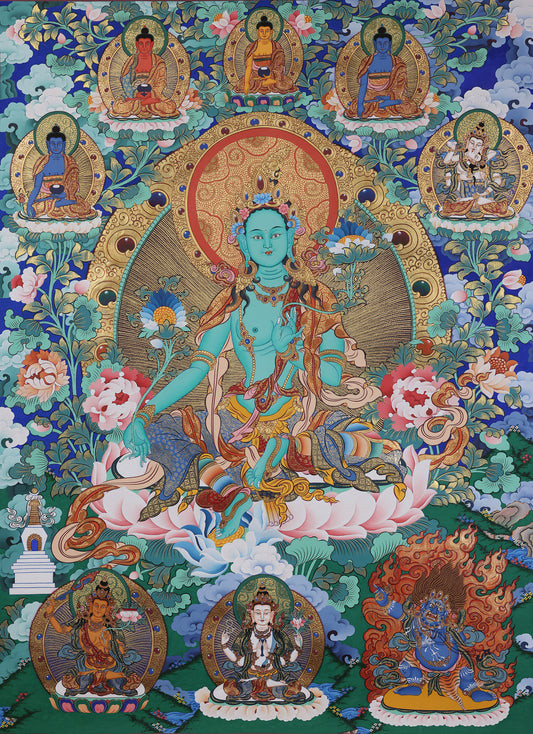
When a calm indigo hue spreads across the thangka canvas, and from the lapis lazuli ground, the seven-eyed goddess in celestial robes, seated on a lotus throne, casts soft light from her palms over the suffering of sentient beings in the three realms—this is White Tara (known as Drolma Karpo in Tibetan), the “Buddha-Mother of Longevity and Salvation,” as renowned as Green Tara in Tibetan Buddhism. In the Blue Thangka outlined by 24K gold by Rebkong artisans, she is not merely a religious symbol but the tangible embodiment of “compassion and hope” in the thousand-year-old faith of the Tibetan Plateau.
In Tibetan Buddhist scriptures, White Tara’s origin lies in a poignant tale of compassion: Eons ago, Avalokiteshvara Bodhisattva gazed down at the six realms with his sacred eyes, and upon seeing sentient beings still trapped in the ocean of samsara, his heart overflowed with sorrow—two tears fell from his eyes: the left tear became White Tara, and the right tear became Green Tara. The two Taras clasped their palms and declared: “We vow to abide in the world as female forms, aiding you in delivering all sentient beings.”
This is no accidental incarnation. In The Twenty-One Praises to the Noble Saviouress, White Tara is one of the core incarnations of the Twenty-One Taras, and together with Amitayus (the Buddha of Longevity) and Ushnisha Vijaya (the Buddha-Mother of Victory), she forms the “Three Deities of Longevity.” Her fundamental vow is to “attain Buddhahood in a female form and liberate sentient beings from samsara.” Unlike the majesty of male Buddhas and Bodhisattvas, White Tara manifests as a youthful celestial maiden—a testament to Tibetan Buddhism’s ultimate celebration of the “feminine power of compassion.” As Jungian scholars note, she is “the apex of the feminine archetype, the great mother goddess who embraces all opposites.”
The Blue Thangka before you is a rare category in Tibetan thangka art. Thangka backgrounds are never chosen arbitrarily: Black Thangkas depict protectors, Red Thangkas narrate the Buddha’s past lives, and Blue Thangkas, grounded in lapis lazuli, symbolize “the unshakable calm of the deep sea and sky”—they are reserved for principal deities who bestow auspiciousness and fearlessness, with White Tara as a prime example.
White Tara’s most iconic feature is the seven wisdom eyes adorning her form: one on her forehead (gazing at the ten directions of Buddha-lands), and one on each palm and sole (watching over sentient beings in the six realms). Gilded with gold leaf in the Blue Thangka, these eyes glisten like dewdrops on petals—soft yet imbued with the esoteric meaning of “unfailing salvation.” She can simultaneously perceive the spread of plague, the chains of prison, the engulfment of fire and water, and even the greed, anger, and delusion in sentient beings’ hearts.
-
Lotus Throne: She sits in the full lotus position on a white lotus moon disc—the lotus represents “purity untainted by mud,” and the moon disc symbolizes “coolness that soothes suffering.”
-
Mudras: Her right hand rests on her knee in the Varada Mudra (Gesture of Granting Wishes), palm outward as if holding nectar, signifying “fulfillment of all good aspirations.” Her left hand holds a white lotus to her chest; the stem wraps around her arm to her ear, and the three blooms (bud, half-open, fully open) correspond to “the completeness of the Three Jewels (Buddha, Dharma, Sangha).”
-
Adornments: Her celestial robes weave lapis lazuli blue with 24K gold, and her 璎珞 is strung with pearls. In Tibetan tradition, pearls are “crystallized teardrops,” echoing her origin from Avalokiteshvara’s tears.
Most people first encounter White Tara as the “Deity of Longevity”—Tibetan elders often enshrine her thangka to pray for health and long life. Yet her merits extend far beyond this; the Concise Sadhana of White Tara explicitly records three core benefits of sincere practice:
White Tara is called the “Tara Who Rescues from Eight Calamities,” capable of relieving suffering from lions, elephants, fire, water, snakes, imprisonment, thieves, and non-human beings. Tibetan folklore still tells the story of a young girl who chanted Tara’s name to subdue a mad elephant: in ancient India, a girl was seized by a wild elephant, and in desperation, she recited the mantra “Om Tare Tuttare Ture Soha”—the elephant suddenly calmed like a tamed sheep and gently placed her on a boulder.
In modern terms, the “Eight Calamities” have expanded to life’s struggles: the anxiety of unemployment (“poverty calamity”), the torment of illness (“pandemic calamity”), and the suspicion in relationships (“non-human calamity”)—all fall within her sphere of salvation.
White Tara’s white form itself symbolizes “the purity of wisdom.” Practitioners visualize her seven eyes emitting light, dispelling the “fog of consciousness”—Tibetan students often wear White Tara amulets to pray for wisdom and academic success. In esoteric practice, her mantra is regarded as a “sword that cuts through wrong views,” helping those attached to the “ego” gradually awaken to the “emptiness of all phenomena.”
For women, White Tara is the most approachable principal deity: those without children gain offspring, those in difficult labor receive protection, and those facing emotional distress find comfort. In Tibetan tradition, Princess Wencheng is regarded as an incarnation of White Tara—when she married into Tibet, she brought not only silk and scriptures but also the Tara spirit of “softness overcoming hardness.” Her statue is still enshrined in Lhasa’s Jokhang Temple today.
Tibetan Buddhist practice is never “imitation of form” but “connection of hearts.” White Tara’s practice centers on the unity of “visualization, mantra recitation, and dedication”:
-
Visualization: In a quiet room, visualize White Tara from the Blue Thangka abiding in the space before you. Her seven eyes emit white and red light, entering your own and others’ body, speech, and mind, transforming illness and afflictions into black qi that dissipates.
-
Mantra Recitation: Chant the heart mantra “Om Tare Tuttare Ture Soha”; for longevity, add “Om Tare Tuttare Ture Mama Ayur Vidyarana Vashin Kuru Soha”.
-
Dedication: After recitation, dedicate the merits with “May this merit adorn the Buddha-lands”—not for personal blessing alone, but for all sentient beings.
For modern people, there’s no need to fixate on “complete ritual”—muttering the mantra three times upon waking, offering a cup of water before the thangka, or recalling her seven eyes in hardship are all ways to connect with her. As Rebkong thangka artisans say: “White Tara does not care how many incense sticks you burn—only whether you hold others’ suffering in your heart.”
When we look up from urban exhaustion and see White Tara in this Blue Thangka, we suddenly understand: her compassion is never a “distant myth” but a moment of “willingness to see others’ suffering.”
She is the prayer of Tibetan herders during snowstorms, the breath of modern women facing workplace pressure, and every person who chooses “tenderness” in despair—because White Tara’s essence is never “supernatural power,” but the innate compassion of all sentient beings, blooming as an ever-lasting flower on the lapis lazuli background of the thangka.
#WhiteTara #TibetanBuddhism #ThangkaArt #CompassionGoddess #LongevityDeities #BlueThangka #BuddhistDeities #TibetanSpirituality #BuddhistPractice #TibetanCulture