Emerald Light Calms the Eight Perils: Green Tara in Tibetan Buddhism—Compassion and Deliverance Through Red Thangka Art
wudimeng-Dec 15 2025-
0 Kommentare
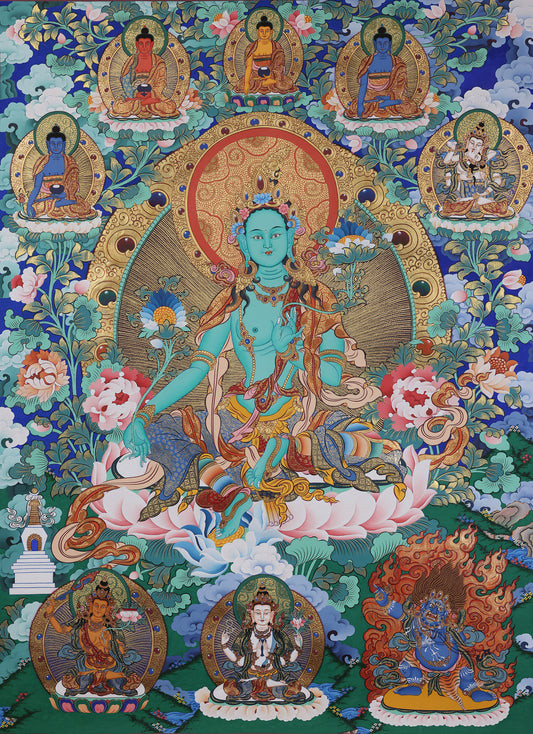
When an emerald-green figure unfolds against the crimson, gilded canvas of a thangka, what you see is the most vibrant female 本尊 (yidam) in Tibetan Buddhism: Green Tara. Seated on a lotus throne in the form of a sixteen-year-old maiden, her right foot lightly rests on a lotus (symbolizing "readiness to deliver") and her left hand holds an utpala flower (representing "union of compassion and wisdom"). This richly hued Red Thangka is the visual footnote to her millennium of compassion and power.
In the cosmology of Tibetan Buddhism, Green Tara’s birth is a moment when compassion takes tangible form. The Origin of Tara records: When Avalokiteśvara surveyed the six realms with his wisdom eye and saw sentient beings’ suffering unrelieved, he wept. A tear from his right eye fell and transformed into a lotus; when the lotus bloomed, Green Tara manifested to share his vow of deliverance—this is the "compassionate tear incarnates Tara" origin legend.
Another origin is rooted in the ancient Indian tale of "Princess Moon of Wisdom": The princess of the Radiant Kingdom vowed to attain Buddhahood in a female form, rejecting the advice to "transform into a male body to teach." She ultimately became Tara (Sanskrit for "deliverer"). This narrative aligns with Buddhism’s egalitarian view that "all sentient beings can attain Buddhahood" and provides a sacred archetype for female practitioners—Green Tara is not a "feminized Buddha," but an "enlightened one manifesting in female form."
In the 7th century, the first Tara statue brought to Tibet by Princess Bhrikuti (of Nepal) sowed the seeds of this devotion across the plateau. Tibetans further revered Princess Wencheng (of Tang China) as an incarnation of Green Tara: When Songtsen Gampo passed away, Princess Wencheng transformed into a sixteen-petaled green lotus and merged into an Avalokiteśvara statue. Since then, Green Tara has become a spiritual symbol of cultural exchange between Han and Tibetan peoples.
Every detail of this Red Thangka is a "visual scripture":
-
Form and Posture: Her entire body is emerald green, corresponding to the body color of Amoghasiddhi Buddha (symbolizing "accomplishment of all deeds"). Green also evokes spring and vitality, signifying new life amid suffering. Her left leg is crossed (representing "meditative wisdom"), while her right foot extends forward to rest on a lotus (symbolizing "readiness to rise and deliver")—this "half-lotus posture" embodies the compassionate stance of "stillness poised for action."
-
Mudra and Implements: Her right hand forms the varada mudra (palm outward), a promise of "granting protection and fulfilling wishes." Her left hand holds an utpala (blue lotus); the fruit, blooming flower, and bud on its stem correspond to the Buddhas of the past, present, and future, meaning "Tara encompasses the merits of all Buddhas across the three times."
-
Cultural Code of Red Thangka: Red Thangkas use cinnabar and ochre as a base, with gilded outlines—traditionally a auspicious art form in Tibet for "warding off evil and protecting the home." Green Tara’s presence against the red background is a metaphor for "emerald light piercing darkness"—using the power of compassion to dissolve karmic obstacles. The dharma wheel and treasure vase at the bottom of the thangka add meanings of "turning the dharma wheel" and "vase of fulfilled wishes."
In Tibetan Buddhism, Green Tara is called the "Tara Who Delivers From the Eight Perils"—she rescues from perils of lions, elephants, snakes, water, fire, imprisonment, thieves, and non-human beings. The Hymn to Green Tara expands her merits to the four karmas (pacifying, increasing, magnetizing, subjugating):
-
Pacifying Karma (Shanti): Eliminates illness, demonic obstacles, and plagues. The Nenang Lama once stated: "Diligent practice of Green Tara’s method averts all natural and man-made disasters, especially effective for warding off poison"—he attributed his three narrow escapes from poisoning to Tara’s practice.
-
Increasing Karma (Vridhi): Enhances wisdom, merit, and longevity. The Hundred Mantras for Purifying Karmic Obstacles notes that reciting her mantra grants "wealth, authority, and offspring"—this is not "worldly utility," but a skillful means to "support practice through positive conditions."
-
Magnetizing Karma (Mohana): Harmonizes relationships and resolves conflicts. Offering blessed food/drink to the wicked with a compassionate heart can "turn evil into kindness," embodying the wisdom of "transforming negative karma with gentle power."
-
Subjugating Karma (Abhichara): Dispels curses and black magic (requires guidance from a guru)—this is "subduing demons with compassion," not "defeating enemies with anger."
Modern practitioners also see her as a "spiritual guardian for women": She protects childbirth, eases emotional pain, and is even interpreted as an "awakened female archetype"—combining the tenderness of a mother with the courage of a deliverer.
Green Tara’s mantra, "Om Tare Tuttare Ture Svaha," is one of the most widely recited in Tibet; each syllable holds a code of deliverance:
-
Om: Encompasses the wisdom of the Buddha family, opening the source of blessings;
-
Tare: "Swift deliverance," seeing suffering with compassionate eyes;
-
Tuttare: "Deliverance from all fears," dispelling the eight perils and sixteen terrors;
-
Ture: "Transcending samsara," aiding sentient beings in realizing emptiness;
-
Svaha: Invoking the mantra’s power to merge with the dharma realm.
Practice requires "union of the three secrets": forming Tara’s mudra with the body, reciting the mantra with the mouth, and visualizing Green Tara’s emerald light pervading one’s being. This "visualization + mantra recitation" is not "superstition," but a way to subdue distracting thoughts through focus, anchoring the frequency of compassion in repetition.
A Tibetan proverb says: "Manjushri’s wisdom is quick; Tara’s blessings are swift"—many practitioners take "100,000 mantra recitations" as a foundational practice, and even ordinary people are believed to receive protection by sincerely chanting her name, even without formal rituals.
Today, Green Tara has transcended religious symbolism: In Tibet, she adorns thangkas in herders’ tents and is praised in monastery ceremonies; in cities, she is a spiritual totem for female healing and a "symbol of compassion" in cross-cultural dialogue.
Her value lies in the "equality embodied by her female form": While male yidams often manifest with "majesty," Green Tara conveys gentle power through her "maiden form"—proving that compassion is not weakness, and women are not "supporting characters in enlightenment," but core participants in the work of deliverance.
As this Red Thangka symbolizes: The crimson background is the afflictions of the world; the emerald figure is the compassion that pierces those afflictions; and the utpala flower always blooms between suffering and awakening.
#TibetanBuddhism #GreenTara #ThangkaArt #BuddhistCulture #FemaleSpirituality #CompassionateDeliverance