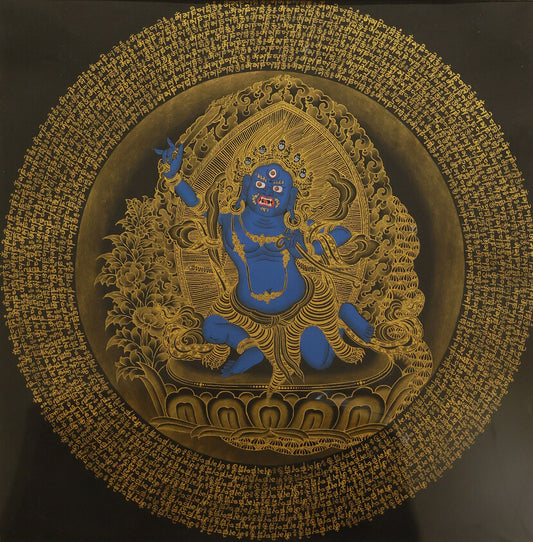
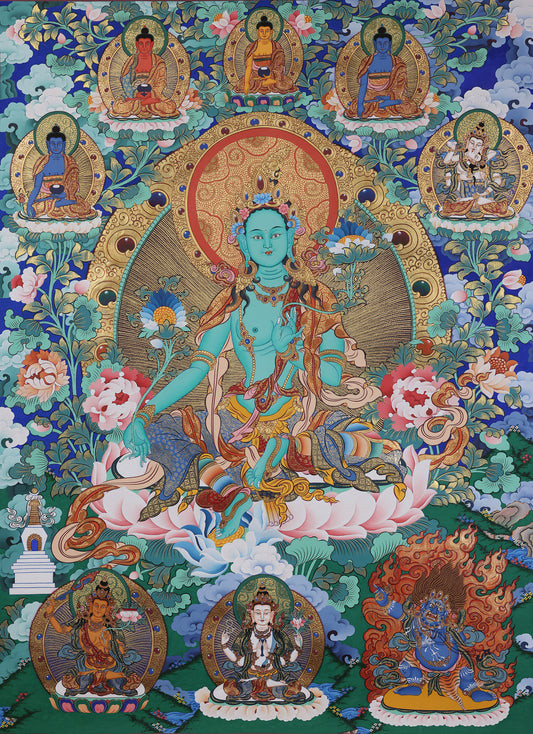
If you’re a Tibetan Buddhist art enthusiast or seeking a small worship artifact that balances spiritual empowerment and aesthetic value, this 50x50cm hand-painted Nepalese Thangka of Acalanatha and the Om Mani Padme Hum mantra is a quintessential masterpiece of Tibetan Vajrayana and Newari art fusion. It carries the Vajrayana logic of "subjugating afflictions and protecting virtuous roots" through the rich texture of mineral pigments, while condensing millennia of hand-painting traditions from the Himalayan region.
I. Core Theme: The Visual Loop of "Compassion and Wisdom United" in Tibetan Vajrayana
A Tibetan Vajrayana Thangka is not merely a "religious painting"—it is a functional field of spiritual empowerment. The core theme of this Thangka lies in the symbiosis of Acalanatha’s wrathful subjugating power and the Om Mani Padme Hum mantra’s compassionate protecting power:
-
Acalanatha’s "Breaking": As the foremost of the "Five Wisdom Kings" and the wrathful manifestation (krodha-rupa) of Vairocana Buddha, his core role is to dispel three obstacles: ego-clinging, external demons, and spiritual sloth. For practitioners, this is the critical force to "clear the path" of practice.
-
Om Mani Padme Hum’s "Establishing": The six-syllable mantra is the fundamental heart mantra of Avalokiteshvara (the Bodhisattva of Compassion). According to the Sutra of the Greatly Venerated Jewel Garland, this mantra embodies all of Avalokiteshvara’s compassionate merits, capable of accumulating virtuous roots and eradicating karmic obstacles—it is the most widely practiced mantra in Tibetan Buddhism.
-
The Logic of Unity: Acalanatha takes charge of "breaking" (severing afflictions), while the Om Mani Padme Hum mantra handles "establishing" (protecting virtuous roots). Together, they form a "break-and-establish" loop through the Thangka: the deity’s wrathful form is the embodiment of subjugation, and the surrounding mantra is the carrier of empowerment. This makes the Thangka ideal for practitioners seeking to strengthen concentration and overcome spiritual hindrances.
II. The Main Deity: Acalanatha’s Iconographic Rituals—Every Detail Is Vajrayana Language
The main deity of this Thangka is Acalanatha in the "serene-wrathful form," strictly adhering to the iconographic rules of the Iconometric Sutras. Every detail of his form carries symbolic meaning in Tibetan Vajrayana:
-
Body Color and Material: The deity’s deep blue body is painted with lapis lazuli mineral pigment. In Tibetan Buddhism, lapis lazuli is not just a "sacred color"—it symbolizes "subjugating anger and afflictions with pure blue." Its rich, natural mineral texture also aligns with the religious requirement that "the deity’s form be imperishable."
-
Facial Features and Adornments:
- Three-Eyed Configuration: The left eye sees past karmic obstacles, the right eye sees present afflictions, and the third eye (between the brows) sees future hindrances—symbolizing the wisdom to "perceive the root of afflictions across the three realms."
- Wrathful Eyes and Fangs: This is not mundane anger, but what Vajrayana calls "compassion manifesting as wrath"—a resolute stance that signals "zero tolerance for afflictions," an alternative expression of compassion.
- Five-Buddha Crown: Though simplified with gold lines, it conforms to Acalanatha’s status as one "empowered by the Five Dhyani Buddhas," marking his sacred identity.
-
Posture and Implements:
- Subjugation Squatting Posture: Unlike the cross-legged lotus position of the Buddha, this posture (one leg bent, one extended, weight grounded) emphasizes the "protector deity’s" agency, symbolizing "steadily subjugating all adverse conditions."
- Symbolism of Implements: The raised right hand (originally holding a wisdom sword, symbolizing severing the root of afflictions) and the inward-curled left hand (originally holding a lasso, symbolizing binding demons) use concise lines to capture the core function of Vajrayana iconography.
III. Retinue System: Om Mani Padme Hum—Vajrayana’s "Dharma Retinue"
Unlike large Thangkas with "tangible retinue attendants" (such as Acalanatha’s usual "Eight Boys"), this 50x50cm small Thangka adopts a unique design common in Nepalese folk Thangkas: the Om Mani Padme Hum mantra itself serves as the dharma retinue:
-
Meaning of the Dharma Retinue: In Tibetan Vajrayana, mantras are not mere text—they are the dharmakaya (truth body) manifestation of Buddhas and Bodhisattvas. In this Thangka, the Om Mani Padme Hum mantra (written in Tibetan script, a transliteration of Sanskrit) curves around the main deity, forming a 结界 (protective circle) where "the deity resides at the center, and the mantra provides protection." This symbolizes "Acalanatha’s wrathful power and Avalokiteshvara’s compassion forming an all-encompassing empowerment field linked by the mantra."
-
Artistic Balance: The soft, curved script of the mantra (in Newari style) balances the ferocity of the deity’s wrathful form. It aligns with Tibetan Buddhist recitation traditions while embodying the aesthetic logic that "wrathful power does not hinder gentleness."
IV. Techniques and Style: Newari Hand-Painting’s "Mineral Pigment Aesthetics"
The 50x50cm square size of this Thangka is standard for Nepalese home shrines. Its techniques and style are classic examples of Newari art:
-
Hand-Painting Process Steps:
-
Base Preparation: Linen and Tibetan paper are layered and mounted, then coated with bone glue and white ash (earth pigment) and polished repeatedly to create a "mirror-smooth" base—critical for mineral pigment adhesion and long-term preservation.
-
Line Drawing and Coloring: Charcoal is used to outline millimetric details (Newari linework is "as fine as silk"). The deity’s blue body is painted in 3–4 layers of lapis lazuli powder (polished after each layer dries). The gold sections use 24K gold leaf powder: the mantra is filled with flat gold and outlined with gold lines, while the lotus throne uses gradient gold gilding to create light and shadow layers.
-
Background and Consecration: A deep background is mixed with charcoal black and earth pigment to contrast with the gold and blue. Finally, Nepalese monks consecrate the Thangka, transforming it into a "sacred ritual implement."
-
Key Features of Newari Style:
- Symmetrical Composition: The central deity and surrounding mantra in the 50x50cm square embody the symbol of "perfection."
- Gold-Dominated Palette: Over 40% gold powder usage aligns with the Newari tradition of "majestic opulence" (influenced by Hindu temple decoration) and symbolizes "the all-pervading light of the Dharma."
- Sacred Materiality: The use of mineral and earth pigments not only ensures color longevity but also aligns with Tibetan Buddhism’s concept of "connecting to the dharma realm through natural substances."
Conclusion: The "Great Value" of a Small Thangka
This 50x50cm Acalanatha Om Mani Padme Hum Thangka is both a spiritual aid for Tibetan Vajrayana’s "Compassion and Wisdom United" practice and a miniature masterpiece of Nepalese Newari art. Through the richness of mineral pigments, the precision of hand-drawn lines, and the rigor of iconographic rules, it unites the roles of "religious ritual implement" and "Himalayan art treasure."
Would you like me to compile a guide on home worship and recitation practices for this Thangka?
#NepaleseThangka #AcalanathaThangka #OmManiPadmeHumThangka #TibetanVajrayanaArt #NewariHandPaintedThangka #MineralPigmentThangka #50x50cmThangkaAnalysis #HimalayanBuddhistArt #HandmadeNepaleseArt #VajrayanaThangka #HomeShrineThangka #LapisLazuliThangka #TraditionalBuddhistArt Tantric Deities Thangka