1. Theme and Positioning: The “All-Encompassing Compassion” of Four-Armed Avalokiteshvara
The central theme of this Thangka is the “Four-Armed Avalokiteshvara (Six-Syllable Mantra Avalokiteshvara) Iconography”, belonging to the Tibetan Buddhist Avalokiteshvara faith system as a ritual carrier of “all-encompassing compassion.”
In Tibetan Buddhism, the Four-Armed Avalokiteshvara is one of the Bodhisattva’s important manifestations. According to the Six-Syllable Mantra Tantra, “Avalokiteshvara manifests four arms to represent the four immeasurable minds and subjugates all sentient beings through the six-syllable mantra.”
This Thangka uses a black-gold background with a colorful deity figure, adhering to the Tibetan belief that Avalokiteshvara is the spiritual protector of the snow land. It carries the dual functions of “dissolving afflictions through compassion” and “guiding beings through the power of mantra.” Practitioners can visualize the deity while reciting the six-syllable mantra for daily practice or to aid in the process of death, making it a core ritual instrument.
2. Main Deity Analysis: The Symbolic System of Four-Armed Avalokiteshvara
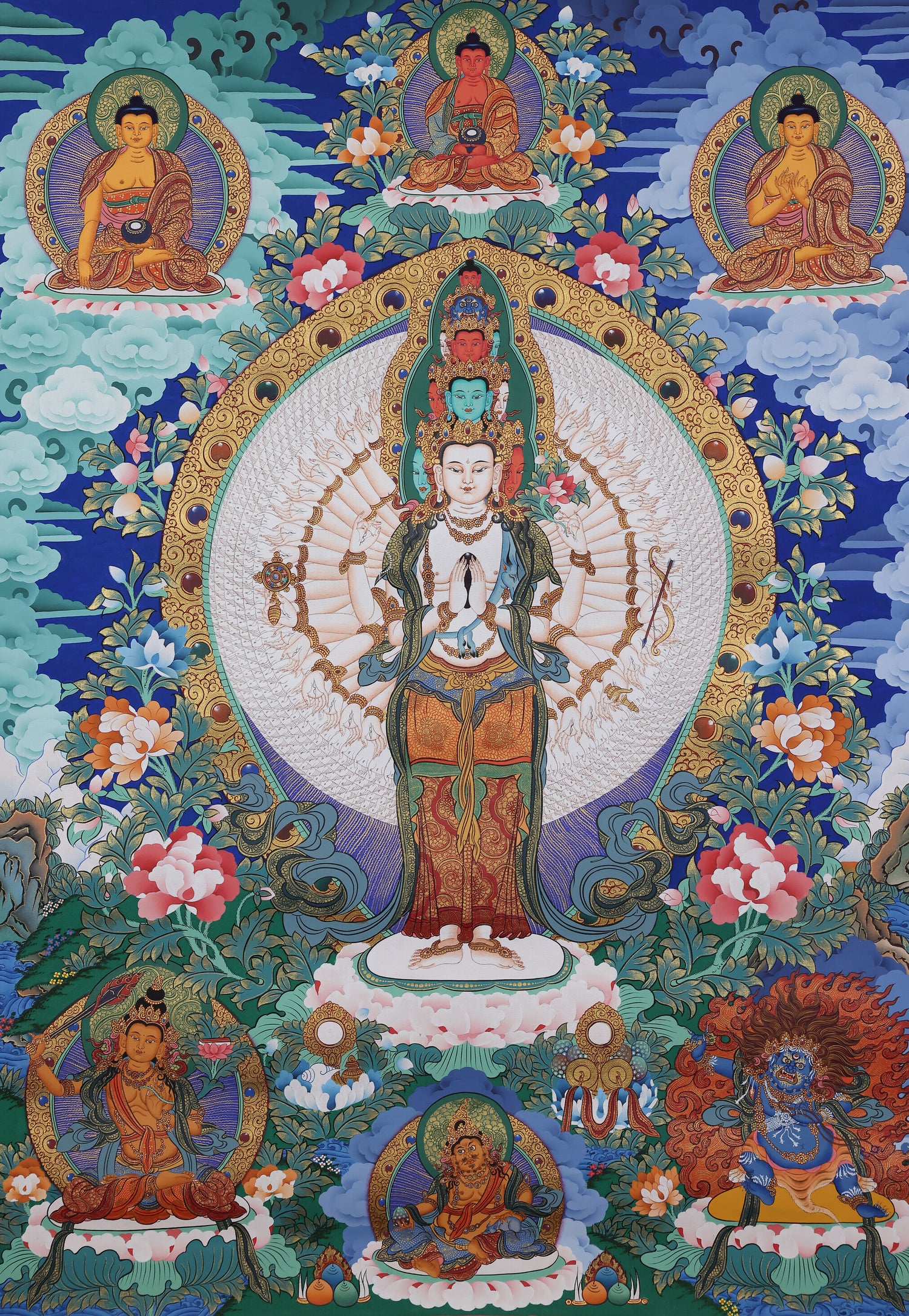
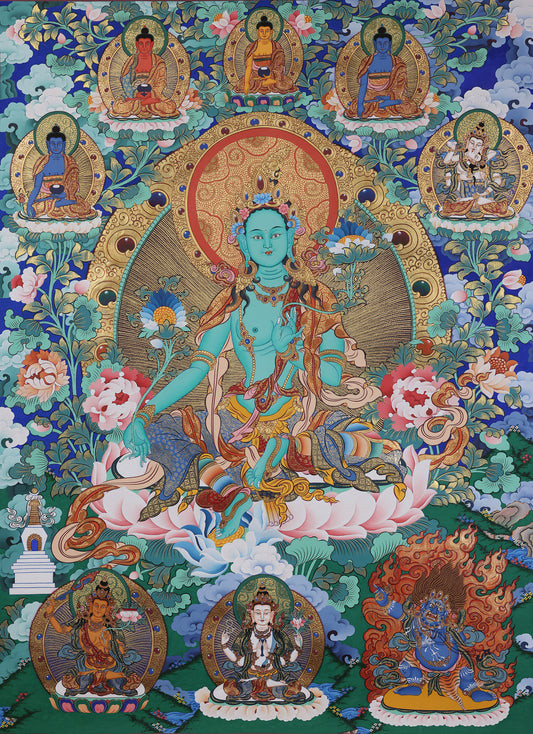
The central figure is Four-Armed Avalokiteshvara (Tibetan: Chimey Chenpo), meticulously following the Bodhisattva proportions specified in the Iconometric Sutra. Every detail carries ritual significance representing “all-encompassing compassion.”
Body and Facial Features
The body is milky white, symbolizing “pure compassion.” The skin tone is blended from pearl powder and white clay at a 3:1 ratio, creating a warm and translucent effect. The red dot on the forehead (urna) represents “the compassionate eye illuminating all beings,” consistent with the Universal Gate of Avalokiteshvara scripture, which states, “Avalokiteshvara observes the ten directions, manifesting according to the beings’ conditions.”
The facial expression is gentle and composed, with slightly downcast eyes and a faint smile. The downcast gaze signifies “observing the afflictions of beings,” while the subtle uplift of the lips embodies the manifestation of “wisdom dissolving suffering,” symbolizing the union of compassion and wisdom.
Mudras and Attributes
The four arms are distinct in function:
-
Central hands: Held in the anjali mudra (prayer gesture), holding a wish-fulfilling jewel (inlaid with lapis lazuli), symbolizing “union with sentient beings’ minds” and the fulfillment of virtuous wishes.
-
Right hand: Performs the abhaya mudra (fearlessness gesture) and holds a mala decorated with Bodhi seeds, representing “removal of fear” and cultivating merit through the six-syllable mantra.
-
Left hand: Performs the varada mudra (granting wish gesture) and holds a lotus flower (pink-white shaded), symbolizing “bestowing blessings and purity of mind.”
Attire and Ornamentation
The deity wears a jeweled crown (top inlaid with red coral) and three strings of necklaces: the neck adornments with amber, hand adornments with turquoise. The crown represents the Bodhisattva fruition of Avalokiteshvara, coral and amber symbolize worldly merit, and turquoise represents transcendental wisdom.
Posture and Lotus Seat
Seated in full lotus on a thousand-petal white lotus seat (blue and red-tipped petals), symbolizing “compassion unsullied by defilements.” The full lotus posture signifies the correct meditation posture of Buddhas and Bodhisattvas.
3. Attendants and Symbolic Context: Five Dhyani Buddhas and Protector Deities
The upper and lower attendants reflect the three-tiered ritual structure of “main deity – intrinsic deity – protector deity.”
Upper Attendants: Five Dhyani Buddhas
At the top of the composition are three representative Dhyani Buddhas:
-
Left (yellow): Vairocana, representing “Dharmadhatu Wisdom”
-
Center (red): Amitabha, representing “Discriminative Observation Wisdom”
-
Right (blue): Akshobhya, representing wisdom encompassing all directions
Surrounding the main deity, these Dhyani Buddhas symbolize Avalokiteshvara’s compassion embracing the wisdom of all directions.
Lower Attendants: Protector Deities and Ritual Implements
-
Left protector (yellow): Holds a wisdom sword, serving as Avalokiteshvara’s protector for removing obstacles to wisdom.
-
Right protector (blue): Performs the subjugation mudra, safeguarding the practitioner’s accumulated merits.
-
Central ritual implements: Seven treasures and Dharma wheels embedded in the lotus motif symbolize the complete offerings of Avalokiteshvara’s dharma path.
4. Painting Craftsmanship: The Black-Gold Thangka Technique
This piece belongs to the Rebgong school’s black-gold Thangka tradition, among the highest-cost and most technically demanding types of Tibetan Thangka. Its 16 key steps demonstrate the principle that “materials embody faith.”
Canvas Preparation
Triple-layered linen from Tongren, Qinghai, is soaked for 5 years in yak bone glue (boiled four times, filtered three times). Stretched on sandalwood frames, polished repeatedly with agate until the canvas is “light-transmissive and smooth like porcelain,” ensuring gold leaf and mineral pigments adhere perfectly.
Black-Gold Background
-
Base color: Lamp soot ink mixed with bone glue (4:1), applied in 8 layers to create a matte black base (“Avalokiteshvara Black”).
-
Gold lines: Combination of incised and painted gold. Background floral patterns are incised, main deity’s robes are drawn with 24K gold powder mixed with ox bile for adhesion. Incision depth controlled at 0.06mm for relief without flaking.
-
Mineral pigment accents: Only high-purity red coral, lapis lazuli, and orpiment are used:
-
Red coral for the drapery and lotus petals (ground to 10 μm)
-
Lapis lazuli for the wish-fulfilling jewel and halo, contrasting with gold lines
-
Orpiment for the upper deities, highlighting wisdom radiance
Technical Features
-
Linework: Iron-line technique outlines the main figure with precision 0.08mm (±0.003mm), meeting Rebgong standards.
-
Face painting: Nine-layer technique with pearl powder, white clay, orpiment, and coral red, forming a compassionate expression. Requires over 20 years of master-level Rebgong experience.
-
Consecration: Three Nyingma lamas perform 10 days of retreat and consecrate the Thangka, applying vermillion “wisdom seal” on the deity’s brow, transforming it from art into ritual instrument.
5. Cultural Value: From Symbol of Compassion to Ritual Tool
The black-gold Thangka is valuable for its combination of ritual significance and artistic rarity.
Religious Dimension: Practitioners visualize the four-armed Avalokiteshvara and recite the six-syllable mantra to increase compassion and eliminate karmic obstacles. It is particularly suited for cultivating compassion, overcoming obstacles, and guiding sentient beings.
Artistic Dimension: A representative masterpiece of Rebgong black-gold Thangka. Uses approximately 15 grams of gold leaf (market value over $1,800), and mineral pigments with purity ≥ 99.9%, meeting the “special-grade Thangka” standard in traditional Tibetan craft guidelines.
In Tibetan Buddhism, the Four-Armed Avalokiteshvara Thangka is never merely decorative. The black background represents sentient beings’ afflictions and ignorance, gold lines signify Avalokiteshvara’s luminous compassion, and the visualization transforms the six-syllable mantra’s power into a tangible, meditative focus. It embodies the Tibetan cultural principle of harmonizing spiritual pursuit with practical needs.
#TibetanThangka #FourArmedAvalokiteshvara #BlackGoldThangka #HandPaintedThangka #RebgongArt #BuddhistArt #Avalokiteshvara #CompassionMantra #TibetanBuddhism #SpiritualArt #MeditationTool #SacredArt #BodhisattvaArt #SixSyllableMantra #CollectibleThangka