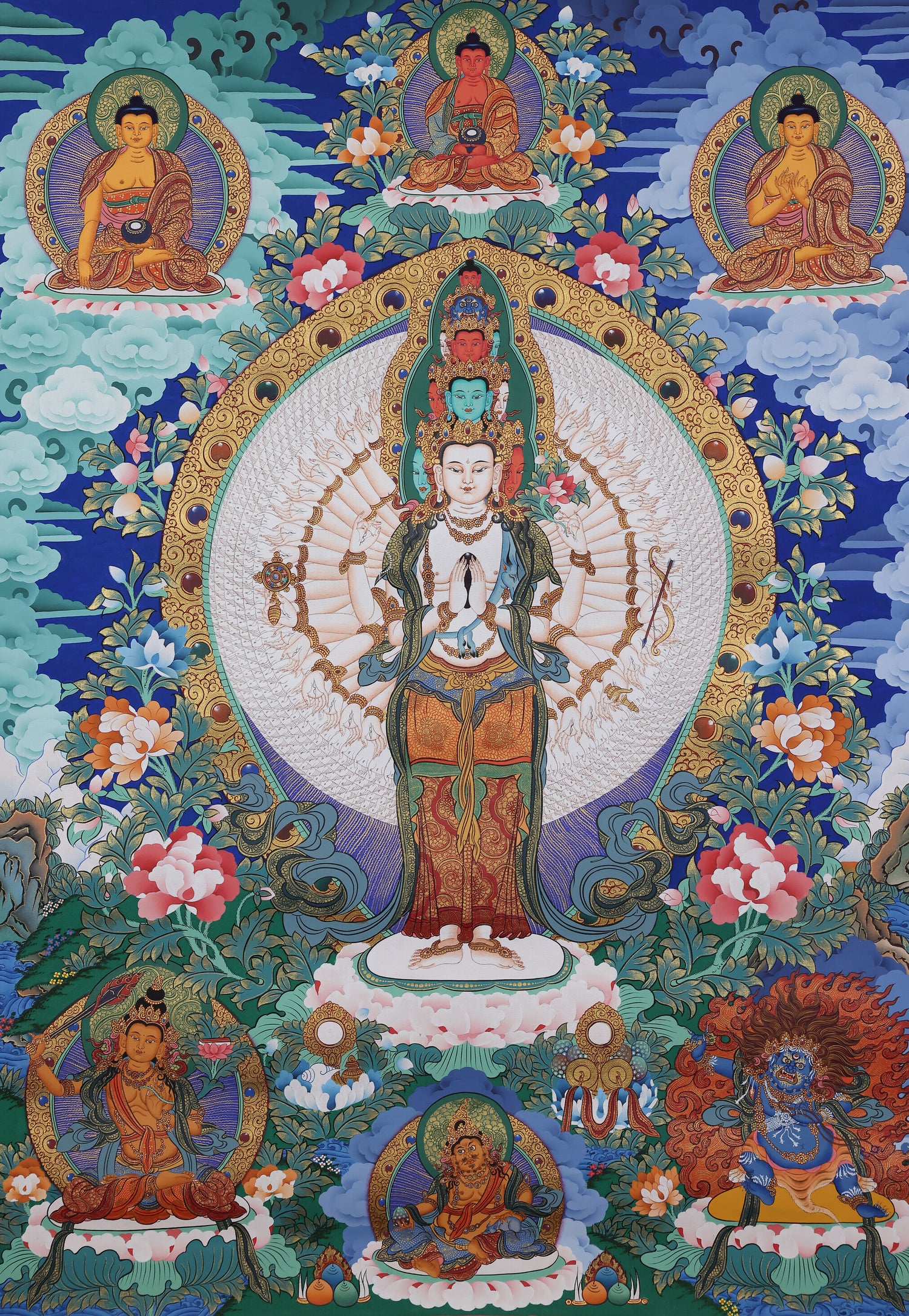
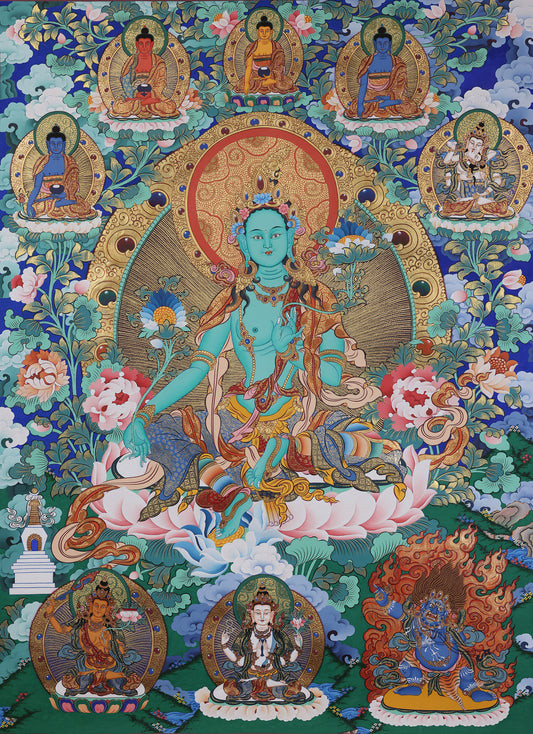
When the "pure wealth" belief of Tibetan Buddhism meets the millennium-old hand-painting skills of Nepalese Newari artists, this 45x64cm hand-painted color thangka is born: the Five-Direction Jambhalas Thangka centered on Yellow Jambhala. Made with natural mineral and earth pigments, this work is not only a worship object for Tibetan Buddhist believers to pray for material abundance, but also a vivid epitome of the symbiosis of "religious spirit + traditional craftsmanship" in the Himalayan cultural circle.
1. Tibetan Buddhism’s "Five-Direction Jambhalas" Thangka: More Than a Vessel for Wealth Aspirations
In the Tibetan Buddhist system, the "Five-Direction Jambhalas" (referred to as "Langse Ngawang" in Tibetan) are not just symbols of secular wealth; their core belief is "using pure wealth as a support for practice" – praying for material abundance while avoiding the affliction of greed.
The "Five-Direction Jambhalas" combination in this thangka centers on the central Yellow Jambhala, paired with four attendant Jambhalas (White Jambhala of the East, Red Jambhala of the South, Green Jambhala of the West, and Black Jambhala of the North), corresponding to the five elements (earth, water, fire, wind, space), each governing a distinct dimension of wealth needs:
- Central Yellow Jambhala: Oversees all wealth karma, serving as the core of the Five-Direction Jambhalas;
- White Jambhala of the East: Guards "pure wealth" to prevent greed brought by material gain;
- Red Jambhala of the South: Enhances personal connections and incidental blessings, expanding karmic resources;
- Green Jambhala of the West: Supports career stability and ensures continuous financial resources;
- Black Jambhala of the North: Removes obstacles to wealth and purifies negative karma.
This combination not only aligns with the iconographic protocol of "central deity overseeing attendants" in Tibetan Buddhism, but also conveys the belief logic that "complete wealth requires balancing foundation, purity, connections, career, and freedom from obstacles."
2. Central Deity: Yellow Jambhala – Religious Symbolism in Iconographic Details
As the core of the thangka, Yellow Jambhala’s iconography strictly adheres to the Tibetan Buddhist Iconographic Measurement Sutra, with each detail carrying religious metaphors:
-
Form and Demeanor: The body is a rich golden yellow (painted with mineral pigment ground from natural realgar), corresponding to the "earth element" and symbolizing the stable foundation of wealth. The facial expression is a "wrathful-compassionate visage" – raised brow ridges, wide-open eyes, conveying both the deterrence against evils and greed that hinder wealth, and the compassion to protect believers. The short facial beard and blue lotus crown mark its dual identity as a "worldly protector + transcendent sacred being."
-
Attire and Adornments: The upper body is bare, adorned with three layers of 璎珞 (a small neck 璎珞,a chest bead strand, and a long strand hanging to the abdomen). The jewelry patterns are outlined with fine brushwork, with golden, red, and green gradients highlighting abundance. The lower body wears a cinnabar-red monk’s skirt, edged with green and gold scrollwork patterns – this "half-secular, half-monastic" attire fits the Jambhala’s role as a "worldly protector" and uses red to symbolize thriving fortune.
-
Posture and Implements: It adopts the Half-Lotus Pose (one leg curled on the lotus seat, the other hanging down), symbolizing "abiding in the pure dharma realm (lotus seat) while responding to worldly aspirations." The left hand holds the "Treasure-Vomiting Rat" (called "Nüli" in Tibetan), which holds a jewel in its mouth, symbolizing "endless treasures flowing continuously." The right hand holds a "Wish-Fulfilling Branch," representing "all desires fulfilled and wealth never lacking."
-
Aura and Lotus Seat: The head aura is an orange-yellow halo (symbolizing the light of wisdom), and the body aura features a black background with golden scrollwork (deterrence + enduring blessings). The double-layered pink lotus seat (upper petals in full bloom, lower petals folded) symbolizes "pure blessings arising from worldly afflictions"; the pink hue, mixed from cinnabar and chalk, is soft and fade-resistant for centuries.
3. Attendant Deities: Blessing Dimensions and Iconographic Features of the Four Jambhalas
The four attendant Jambhalas at the thangka’s corners are key supplements to the "five-direction wealth system," with each iconography corresponding to a clear blessing function:
-
Red Jambhala (Top Left): Body is vermilion (cinnabar pigment), corresponding to the "fire element," governing "personal connections and incidental wealth." With a wrathful visage, seated in Full Lotus Pose on a lotus seat, holding a treasure vase (containing nectar and jewels), it is suitable for businesspeople or those needing to expand their network.
-
Green Jambhala (Top Right): Body is emerald green (malachite pigment), corresponding to the "wind element," governing "career wealth." With a gentle-wrathful visage, seated in Half-Lotus Pose, holding the Treasure-Vomiting Rat, it is a core worship object for business and industry practitioners.
-
White Jambhala (Bottom Left): Body is milky white (chalk pigment), corresponding to the "water element," governing "pure wealth." Riding a snow lion (to dispel poverty and affliction), holding a victory banner (symbolizing stable wealth), it guards believers’ mental purity.
-
Black Jambhala (Bottom Right): Body is dark blue (mixed from azurite and charcoal), corresponding to the "space element," governing "obstacle removal." With a fierce wrathful visage, seated in a playful pose on a demon-subduing mat, holding a treasure vase, it clears evils, greed, and anger that hinder wealth.
4. Nepalese Newari Thangka: Centuries of Heritage in Mineral Pigments and Traditional Craftsmanship
This thangka’s craftsmanship is a typical example of Nepalese Newari thangkas, combining ritual standardization with unique artistry:
-
Extreme Use of Natural Mineral Pigments: Raw materials include realgar (yellow), cinnabar (red), malachite (green), azurite (blue), chalk (white), and charcoal (black). These undergo multiple processes: grinding → mixing with cow bone glue → settling. Each color layer is dyed 3-5 times repeatedly, ensuring rich saturation and fade resistance for centuries.
-
Decorative Traits of Newari Style: Unlike Tibetan thangkas, Newari style emphasizes "decorative layers" – fine lines outline the deities’ contours and jewelry patterns, with soft and neat curves for clothing folds; golden-brown scroll cloud patterns (symbolizing enduring blessings) in the background, a pile of colorful jewels (echoing the Jambhala theme) at the bottom, and flattened landscapes (blue-white gradient snow peaks, flowing water) enrich the visual hierarchy.
-
Rigorous Traditional Production Steps:
- Canvas: Nepalese cotton is stretched on a frame, coated with a base of "cow bone glue + chalk," and sanded 4 times repeatedly until smooth;
- Sketching: Charcoal pencils define proportions according to the Tibetan Buddhist Iconographic Measurement Sutra (central deity is 9 head-heights, attendants are 2/3 the size of the central figure);
- Coloring: First lay the base color, then paint patterns, and finally outline details;
- Face-Painting: The final step involves holding one’s breath to outline the eyes and eyebrows, ensuring the demeanor aligns with ritual protocols.
This 45x64cm Yellow Jambhala Central Deity Five-Direction Jambhalas Thangka is both a visual expression of Tibetan Buddhism’s "pure wealth" belief and a living testament to Nepalese Newari traditional craftsmanship – beyond worship, it serves as a cultural carrier connecting religious spirit and traditional art.
#YellowJambhalaCentralDeityFiveDirectionJambhalasThangka #NepaleseHandPaintedThangka #NewariThangkaCraftsmanship #TibetanBuddhistJambhalaThangkaAnalysis
#MineralPigmentTraditionalThangka #45x64cmHandPaintedThangkaCulture
#SmallMediumHandPaintedThangka #AuthenticNepaleseThangka #JambhalaThangkaSymbolism
#TibetanBuddhistIconographyArt #TraditionalHimalayanThangka