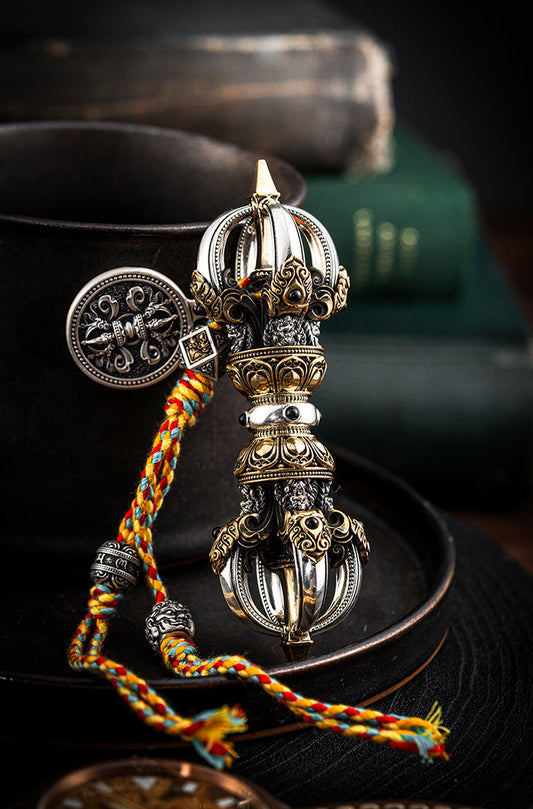
When the gilded cylinder twists gently with a wrist’s motion, the warm texture of the sandalwood handle meets the palm, and the tiny bell chimes like snow falling from an eave—this “mani wheel” in Tibetan hands, from the temple halls of the Tibetan Plateau to the counters of urban Tibetan teahouses, has always carried the most simple practice philosophy of Tibetan Buddhism in a quiet manner: To spin is to chant; daily life is the spiritual path.
In the belief system of Tibetan Buddhism, the prayer wheel (called “mani wheel” in Tibetan) is far more than an ordinary decorative object—it is a “portable scripture scroll” and a “flowing carrier of merit”.
The Guan Yin Bodhisattva Dharma Door, a classic Tibetan Buddhist text, clearly states: “Whoever spins a prayer wheel is equivalent to reciting all the scriptures inside it once; if spun with a pure heart, the merit is comparable to reciting the mantra tens of millions of times.” This doctrine makes the prayer wheel a tangible embodiment of Tibetan Buddhism’s concept of “universal salvation”—for illiterate herders, infirm elders, or even children, there is no need to chant obscure Sanskrit mantras; a simple clockwise twist of the cylinder completes a practice.
At the core of the prayer wheel is the scroll of scriptures coiled inside. The most common is the six-syllable mantra “Om Mani Padme Hum” (the heart mantra of Guan Yin Bodhisattva), while some wheels contain excerpts from the Tripitaka or the heart mantra of Guru Rinpoche. Tibetan Buddhism holds that after scriptures are “consecrated” by high monks, the wheel gains “spirituality”: each spin when moving is a wish conveyed to Buddhas and Bodhisattvas, capable of dispelling past karmic obstacles and praying for current blessings (such as health, peace, and a bountiful harvest).
In Tibetan areas, you often encounter scenes like this: on the morning kora path, an elder walks slowly with a small prayer wheel, the “rustle” of the spinning cylinder interweaving with the soft chime of the wheel’s pendant bell, sunlight brushing the butter scent in his wrinkles—this is not a deliberate ritual, but faith kneaded into the daily rhythm of every breath.
The wisdom of Tibetan Buddhism lies in grounding faith in reality. The popularization of the prayer wheel embodies this wisdom: it is not a “sacred object” enshrined on an altar, but a “daily necessity” in Tibetans’ pockets, bags, and fingertips.
Tibetan herders have long followed water and grass, unable to chant scriptures at temples daily, but the prayer wheel keeps their “practice uninterrupted”: they hang small wheels at their waists while herding, twisting them in the gaps between milking; they hold them in their hands during long journeys, the spinning sound of the wheel a steady companion amid the rhythm of wheels rolling over grasslands.
Even in cities, many young Tibetans carry a palm-sized prayer wheel—during meeting breaks or subway commutes, a light twist of the fingertips becomes a moment of spiritual anchoring. This “fragmented practice” aligns precisely with Tibetan Buddhism’s idea that “a single pure thought is a spiritual path.”
The pendant bell at the end of the prayer wheel handle is not mere decoration. Tibetan Buddhism believes bells can “disperse evil and awaken good intentions”; psychologically, the steady rhythm of the spinning wheel (usually 7-8 rotations per minute), paired with the crisp bell tone, helps people quickly escape restlessness:
“When I followed Grandma to do kora as a child, she always said, ‘When the bell rings, troubles drift away.’ Later, working in a big city, when I’m stressed, I spin the wheel and listen to the bell—it’s like I can smell the butter tea from home.” A Tibetan girl living in Chengdu describes the prayer wheel’s “healing power” this way.
In Tibetan areas, the prayer wheel is a “family heirloom.” Elders pass down their used wheels to younger generations, the patina on the cylinder holding the blessings of several lifetimes: when a child is born, parents place new scriptures in the wheel to pray for their safe growth; before an elder passes away, they hand the wheel to their children, instructing, “Spin it well—it will stay with you.”
This inheritance is not just the transfer of an object, but a relay of faith—when a young person’s fingertips touch the handle their elders once held, it is like grasping the warmth and stability of an entire family.
The prayer wheel you see (gilded/oxidized silver cylinder + sandalwood handle) merges Tibetan craftsmanship with religious symbols. Every detail holds the cultural code of Tibetan Buddhism:
In Tibetan Buddhism, “offering treasures” is a way to accumulate merit, so prayer wheels are often made of materials like gilded metal, pure silver, and brass:
- Gilding symbolizes “the radiance of Buddha’s light,” representing reverence for Buddhas and Bodhisattvas;
- The matte texture of oxidized silver echoes Tibetan Buddhism’s concept of “simple practice”;
- The warmth of the sandalwood handle is a “link between the secular and the sacred”—the wood comes from nature, and holding it feels like touching the grass and trees of the plateau.
The carvings on the cylinder are no random decorations:
-
Six-syllable mantra: The Sanskrit inscriptions of “Om Mani Padme Hum” are the core of the wheel’s “spirituality,” each stroke calibrated by high monks;
-
Auspicious patterns: The common “Four Harmonious Friends” (elephant, monkey, rabbit, bird) represent “harmonious coexistence,” while the lotus symbolizes a “pure heart untainted by the mire”;
-
Dharma wheel motif: The Dharma wheel at the cylinder’s edge symbolizes Buddhism’s “turning the Dharma wheel to save all beings,” echoing the prayer wheel’s meaning of “spinning as preaching.”
The prayer wheel’s “automatic rotation” design also holds ingenuity: the built-in bearing in the handle allows the wheel to spin continuously by inertia—much like Tibetan Buddhism’s view of practice: “A good thought is the start, but sustained good intentions are merit.” A light twist lets the wheel spin for several turns, just as “a single pure thought lingers on.”
Today, the prayer wheel has long spread beyond Tibetan areas, becoming a window for many to understand Tibetan Buddhism. Yet its value is never as an “exotic ornament,” but a way of life that “returns faith to daily routines”—
Placing a prayer wheel on your desk, twisting it when tired from work, creates a “breathing gap” in the fast pace; gifting a wheel to a friend conveys not a “religious symbol,” but the gentle wish that “may you be at peace.”
Tibetan Buddhism teaches: “The merit of a prayer wheel does not lie in how thick the gilding is, but in the heart with which it is spun.” This is perhaps the prayer wheel’s most touching quality: it reminds us that practice need not be in remote temples, but in every gentle spin of the fingertips, holding onto inner purity and kindness.
When the prayer wheel’s bell chimes in the wind, and the scriptures twist with the cylinder—this is not a mysterious ritual, but Tibetans stitching faith into the seams of life, a gentle practice every ordinary person can touch.
#TibetanBuddhism#PrayerWheel#ManiWheel#TibetanSpirituality#SpiritualPractice#BuddhistArt#TibetanCulture#EverydaySpirituality