Tibetan Buddhist Four-Armed Avalokiteshvara Gold Thangka: In-Depth Analysis of Compassion, Deity System, and Gold Thangka Craftsmanship

Tibetan Buddhist Thangka painting is an essential carrier of religious culture in Tibet, serving both as a vessel of faith and a masterpiece of artistic craftsmanship. Among these, the Four-Armed Avalokiteshvara Gold Thangka stands out for its profound symbol of compassion, intricate deity system, and exquisite gold Thangka techniques. This article provides a comprehensive analysis of the Four-Armed Avalokiteshvara Gold Thangka from five dimensions: thematic essence, central deity iconography, attendant deities, painting craftsmanship, and cultural value.
1. Thematic Essence: The “All-Encompassing Compassion” of Four-Armed Avalokiteshvara
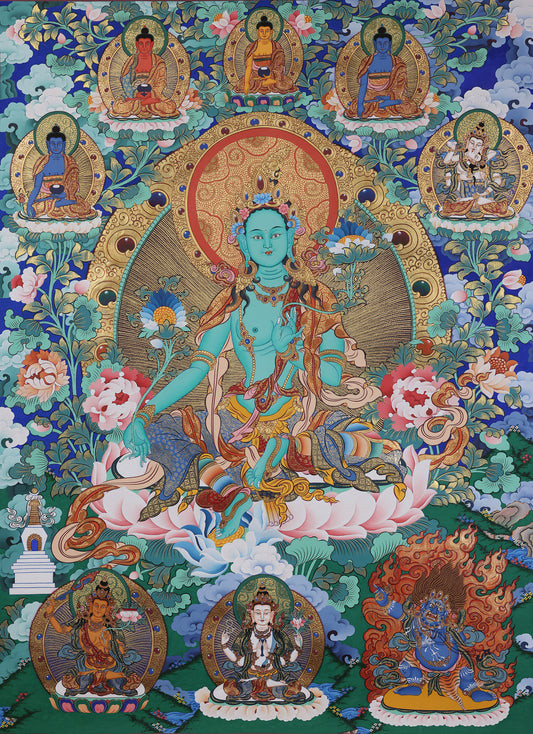
The central theme of this Thangka is Four-Armed Avalokiteshvara (Tibetan: Shazhu Ba), the ultimate symbol of compassion in Tibetan Buddhism. It also represents the fusion of Han and Tibetan Buddhist cultures. Originally one of the six Avalokiteshvaras in Indian Vajrayana Buddhism, it was introduced to Tibet and became a principal deity in major schools such as Gelug and Kagyu, regarded as an incarnation of Avalokiteshvara. The Four-Armed Avalokiteshvara embodies the core teaching of relieving all sentient beings from suffering and manifests compassion that reaches all directions.
This Thangka is rendered in Gold Thangka (Gong Tang) style, using gold leaf or gold powder as the base. In Tibetan Buddhism, gold symbolizes light, perfection, and indestructibility. Painting a Gold Thangka itself is considered an act of utmost reverence toward Avalokiteshvara’s compassion, while also implying that the deity’s mercy radiates like golden light, unobstructed and all-encompassing. The golden shimmer not only enhances visual impact but also enriches its spiritual and collectible value.
2. Central Deity: Iconography and Symbolic Meaning of Four-Armed Avalokiteshvara
At the heart of the Thangka is the Four-Armed Avalokiteshvara, painted strictly according to the ritual proportions described in the Sutra on the Measurement of Divine Images (Zao Xiang Du Li Jing). Every detail carries profound doctrinal significance.
Physical Attributes
The deity is depicted in milky white, symbolizing purity and compassion, with four arms representing “compassion extending to all directions”:
-
Primary pair of arms: Held in front of the chest in prayer mudra, holding a cintamani jewel. The gesture represents the union of wisdom and compassion, and the jewel symbolizes the fulfillment of all beings’ virtuous wishes.
-
Secondary pair of arms: Right hand holds crystal mala beads, signifying constant dedication to saving sentient beings; left hand holds a blue lotus (often supporting a sutra scroll), representing pure compassion that remains unstained despite worldly defilements.
Attire and Ornamentation
Avalokiteshvara wears a Five-Buddha Crown, symbolizing the wisdom of the five directions. The deity is draped in flowing celestial robes, adorned with necklaces, bracelets, and armlets. These luxurious ornaments are not worldly displays of wealth, but represent the deity’s “perfect appearance” that attracts sentient beings to the Dharma through joy and devotion.
Posture and Lotus Throne
The deity sits in full lotus posture on a thousand-petaled lotus base. The lotus represents transcendence from worldly afflictions, and the thousand petals symbolize compassion reaching all beings—an emblem of Avalokiteshvara’s boundless mercy.
3. Attendant Deities: The Compassionate Divine Network
The attendant deities are arranged in a central radiating pattern, forming a complete hierarchy from celestial teachers to worldly protectors, reinforcing the theme of Avalokiteshvara’s compassionate salvation.
Upper Attendants
Above the central deity, the miniature manifestation shows Shakyamuni Buddha in the center, seated in lotus posture with the earth-touching mudra, symbolizing that Avalokiteshvara’s compassion stems from Buddha’s teachings.
Flanking him are Manjushri and Vajrapani (or Green Tara/White Tara):
-
Manjushri holds a lotus, representing wisdom assisting compassion.
-
Vajrapani holds a vajra, symbolizing the power that protects compassion.
Together, they form a trinity of compassion, wisdom, and power, implying that Avalokiteshvara’s mercy is guided by wisdom and safeguarded by strength.
Lower Attendants
Below the central deity, left side features offering Bodhisattvas, holding ritual offerings that symbolize devotees’ respect and prayers. The right side depicts worldly protectors (e.g., Hayagriva or Mahakala), powerful yet respectful, signifying protection of Avalokiteshvara’s teachings and practitioners. This layout demonstrates both the all-embracing compassion of Avalokiteshvara and the worldly safety ensured for practitioners.
Symbolic Implements
At the bottom, a cintamani offering plate symbolizes Avalokiteshvara’s ability to fulfill all virtuous desires. Surrounding clouds and flowers represent auspiciousness and purity, reinforcing the theme of compassion leading to perfection.
4. Painting Craftsmanship: Material Faith and Traditional Techniques in Gold Thangka
Gold Thangka is one of the most complex and revered forms in Tibetan Thangka painting, reflecting a deep connection between material and faith.
Base and Gold Materials
The base consists of double-layer pure cotton cloth, meticulously prepared through pounding, bleaching, and stretching to ensure smoothness and durability.
The gold layer is the heart of the painting: 24K gold leaf or gold powder mixed with gelatin is applied over the entire surface. The application must be performed in an absolutely clean environment, with the artist ritually purified and incense burning. The gold is then polished with agate stones, creating a mirror-like sheen, symbolizing Avalokiteshvara’s radiant compassion.
Techniques and Details
-
Line Drawing: Wolf-hair brushes are used to draw precise lines, delicate yet firm. Avalokiteshvara’s clothing is rendered in “floating cloud lines,” reflecting robe delicacy and flowing compassion; facial lines follow the Measurement of Divine Images standard, with less than 0.2mm deviation.
-
Color Application: Low-saturation mineral pigments (light blue, pale green, cinnabar red) are used only to highlight attire and ornaments, emphasizing the gold base while keeping the deity as the focal point.
-
Decorative Patterns: Clouds and vine scrolls form continuous motifs; auspicious eight treasures (dharma wheel, vase, etc.) are embedded in the background, symbolizing infinite compassion and perfection.
Stylistic Origin
This Thangka belongs to the Ü-Tsang Gold Thangka School in Tibet, characterized by gold base with light colors, fine lines, and strict ritual adherence. Predominantly practiced in Gelug monasteries such as Drepung and Sera, this style is executed by rigorously trained artists who chant Avalokiteshvara mantras with every stroke, combining artistic mastery and spiritual empowerment.
5. Cultural Value and Religious Significance
The Four-Armed Avalokiteshvara Gold Thangka is both an art treasure and a faith vehicle. As art, it exemplifies the pinnacle of Tibetan gold Thangka craft: reflective gold surfaces, meticulous lines, and restrained coloration create a visual effect that is solemn yet compassionate. As a spiritual instrument, it serves as the central medium for devotees to pray for and resonate with Avalokiteshvara’s compassion, providing inner peace and worldly protection.
This “art as practice” quality is the hallmark of Tibetan Thangka, distinguishing it from secular art: it is not merely for appreciation but functions as a bridge between sentient beings and divine compassion, embodying both spiritual and artistic value.
Conclusion
The Four-Armed Avalokiteshvara Gold Thangka embodies profound Buddhist faith, an intricate deity network, and exceptional craftsmanship. It is a microcosm of Tibetan culture and art. Whether used for religious devotion, spiritual practice, or art collection, its value is irreplaceable. Through viewing and meditating on this Thangka, one can feel the radiant compassion of Avalokiteshvara and appreciate the principle of “art as spiritual practice” intrinsic to Tibetan Thangka tradition.
#TibetanBuddhism #Avalokiteshvara #FourArmedAvalokiteshvara #GoldThangka #TibetanArt #BuddhistArt #ThangkaPainting #SpiritualArt #Bodhisattva #TibetanCulture #ReligiousArt #CompassionPractice #ThangkaCollection #HandPaintedThangka #MeditationArt
Tags:
Previous
The Mandala in Tibetan Buddhism: A Microcosmic Mirror of the Universe, a Sacred Temple for Spiritual Practice
Next
Kalachakra Mandala Thangka in Tibetan Buddhism: A Three-Dimensional Interpretation of Cosmology, Deity System, and Sacred Craftsmanship