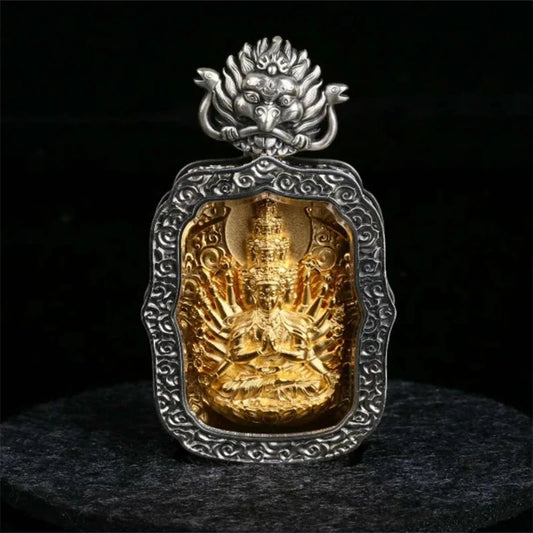
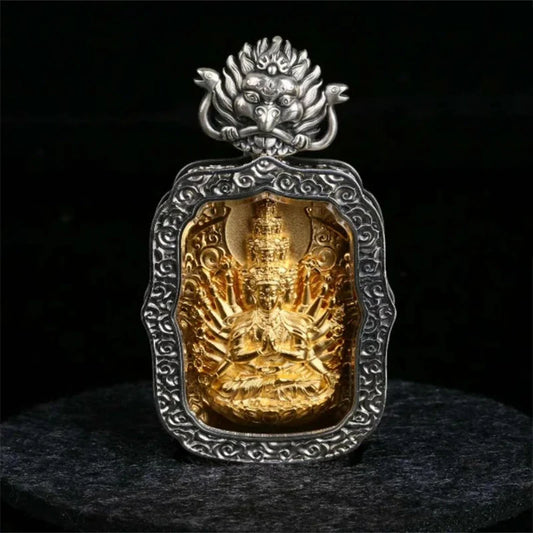
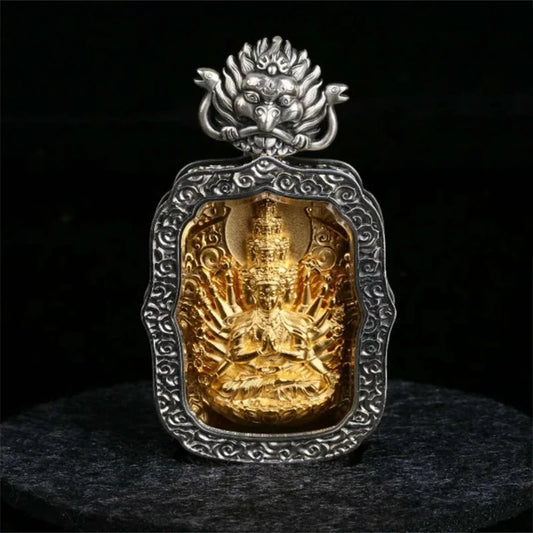
In Tibetan Buddhist narratives, the birth of Thousand-Armed Avalokiteshvara is not a myth, but the inevitable collision of vows and suffering.
According to the Sutra of the Great Compassionate Heart Dharani, Avalokiteshvara once vowed, “I will attain Buddhahood only after freeing all sentient beings from suffering.” Yet upon seeing sentient beings in samsara as countless as Ganges sands, they were overwhelmed by sorrow—so profound was their vow that their body shattered into a thousand pieces. Amitabha Buddha, moved by compassion, reassembled the fragments into the eleven-faced, thousand-armed, thousand-eyed form:
- The eleven faces symbolize the “ten stages of a Bodhisattva” and the spirit of the “ten perfections”; the Amitabha face at the top marks Avalokiteshvara as the successor to the Western Pure Land.
- The thousand arms transform into “thousand wheel-turning kings,” protecting beings with infinite skillful means.
- The thousand eyes in each palm are the wisdom incarnations of the “thousand Buddhas of the fortunate eon,” observing all worldly joys and sorrows.
Tibet localized this belief further: legend holds that Avalokiteshvara incarnated as a monkey who mated with a rakshasi to give birth to the Tibetan people; Songtsen Gampo was regarded as an Avalokiteshvara incarnation, with Princess Wencheng and Princess Bhrikuti as White and Green Tara. Thus, Thousand-Armed Avalokiteshvara became the “Protector of the Snowlands,” its images omnipresent in Tibetan temples, monasteries, and even cliff caves.
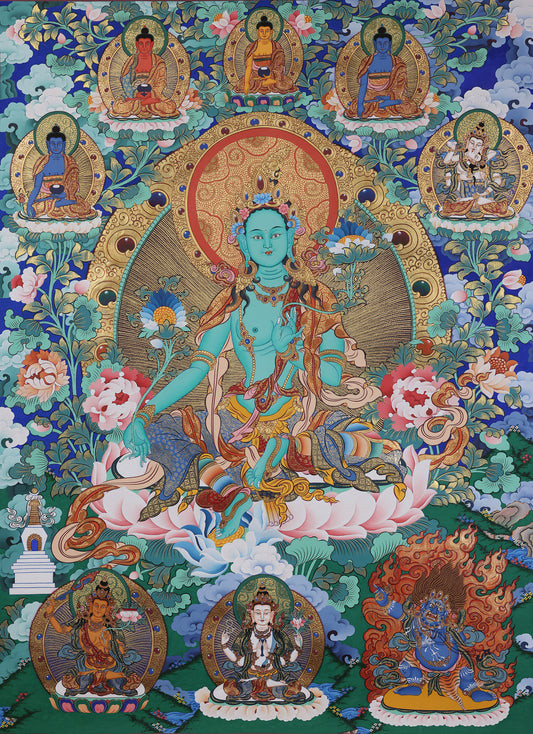
The Thangka before us is a classic example of the Tibetan “royal-style” Thousand-Armed Avalokiteshvara—it is not a mere artistic creation, but a strict adherence to the Iconometric Canon, with every detail carrying doctrinal meaning:
The eleven faces stacked on Avalokiteshvara’s head display distinct hues and expressions, from bottom to top:
-
Three white faces: Symbolize “pacifying karma,” using compassion to dispel sentient beings’ karmic obstacles.
-
Three yellow faces: Symbolize “increasing karma,” enhancing fortune, status, and longevity.
-
Two red faces: Symbolize “subjugating karma,” using majesty to tame sentient beings’ afflictions.
-
Two cyan wrathful faces: Symbolize “vanquishing karma,” using vajra power to destroy demonic hindrances.
-
The Amitabha face at the top: Represents the “Buddha family,” the ultimate perfection of compassion and wisdom.
This sequence, shifting from gentle to fierce, aligns with Tibetan Buddhism’s logic of “first attracting with desires, then leading to Buddhist wisdom.”
In the Thangka, Avalokiteshvara’s thousand arms are symbolized by a circular halo (actual statues often use 42 arms, each corresponding to 25 states of sentient beings—42×25=1,000). Each hand holds a unique ritual object:
-
Lotus: Represents purity, guiding beings out of suffering.
-
Holy water vase: Contains nectar to purify sentient beings’ physical and mental afflictions.
-
Bow and arrow: Subdue the three poisons (greed, anger, delusion) and cut the roots of suffering.
-
Dharma wheel: Turns the wheel of Dharma, enabling beings to hear the right path.
The thousand eyes in the palms are both symbols of “observing the world in full” and a reflection of Tibet’s belief that “Avalokiteshvara hears cries and rescues.” Devotees believe that chanting the Om Mani Padme Hum mantra will make Avalokiteshvara’s thousand eyes see their suffering, and thousand arms protect them instantly.
This Thangka uses a deep cyan background (in Tibetan Thangka, cyan represents the sky, symbolizing emptiness and purity), paired with golden halos and pink lotuses. It follows the traditional color palette of the Menri school while incorporating the delicacy of Han Chinese fine brushwork:
- The background—auspicious clouds, peonies (symbolizing perfection), and landscapes (representing “crossing the sea of suffering”)—blends religious imagery with natural vitality.
- The layout (main deity centered, attendants above and below) follows the classic Tibetan Thangka structure of “heaven-main deity-earth,” embodying the cosmology of “unity of the three realms.”
Notably, the mineral pigments (turquoise, cinnabar, gold leaf) used in Thangkas not only preserve colors for millennia but also express reverence for Avalokiteshvara through “precious materials”—in Tibet, painting a Thangka is itself a form of practice.
In Tibetan Buddhism, Thousand-Armed Avalokiteshvara is not just an object of worship, but a core Yidam (meditational deity) for practice.
According to the Vajra Peak Yoga Ritual Sutra for Practicing Thousand-Armed, Thousand-Eyed Avalokiteshvara, practicing the Thousand-Armed Avalokiteshvara Dharma requires:
-
Receiving Precepts and Initiation: Obtain the Bodhicitta precepts from a guru and receive initiation into the mandala.
-
Altar Setup: Arrange an altar in a pure space, enshrine the Thousand-Armed Avalokiteshvara image, and offer incense, flowers, and lamps.
-
Visualization and Mantra Recitation: Visualize oneself merging with Avalokiteshvara, chant the Great Compassion Mantra or Om Mani Padme Hum, and cultivate the “four immeasurables” (loving-kindness, compassion, joy, equanimity).
Tibetan devotees’ daily lives are deeply intertwined with Thousand-Armed Avalokiteshvara: prayer wheels are carved with Om Mani Padme Hum, mani stones are inscribed with the mantra, and even during daily work, devotees often chant the Avalokiteshvara mantra. To them, Thousand-Armed Avalokiteshvara is not a distant deity, but a “constant companion of compassion.”
Though Han and Tibetan Thousand-Armed Avalokiteshvara share roots in the Great Compassion Dharani Sutra, their iconography and worship show distinct differences:
-
Iconographic Differences: Han Thousand-Armed Avalokiteshvara is often depicted as the female “Princess Miaoshan,” holding a vase and willow branch; Tibetan versions are “royal-style” 庄严 figures, with the eleven faces as a core feature, and the vase-bearer is actually Maitreya (not Avalokiteshvara).
-
Worship Focus: Han worship emphasizes “rescuing from suffering” in this life, while Tibetan worship stresses “union of wisdom and compassion” for liberation, framing Avalokiteshvara as the creator and teacher of the Snowlands.
These differences vividly illustrate Buddhism’s localization—whether in Han China or Tibet, Thousand-Armed Avalokiteshvara remains the ultimate embodiment of “compassion.”
When we gaze at this Thousand-Armed Avalokiteshvara Thangka, we see not just artistic beauty, but the wisdom of Tibetan Buddhism’s “expressing Dharma through form”: thousand arms are boundless compassion, thousand eyes are perfect wisdom, and eleven faces are diverse skillful means to guide sentient beings. Amidst Tibet’s snow and chanting, this form continues to gaze upon the world, its vow to “protect and observe all” serving as an unextinguished light of compassion in sentient beings’ hearts.
#TibetanBuddhismThousandArmedAvalokiteshvara
#ThangkaArt
#ThousandArmsThousandEyesAvalokiteshvaraSymbolism
#TibetanBuddhistFaith
#ThangkaIconography
#ElevenFacedAvalokiteshvara
#GreatCompassionDharaniSutra
#UnionOfWisdomAndCompassion
#HanTibetanBuddhistCulturalDifferences
#SnowlandsProtector