The Great Vow Power in Blue Thangka: The Symbolism and Spiritual Insights of Samantabhadra in Tibetan Buddhism
wudimeng-Dec 23 2025-
0 comments
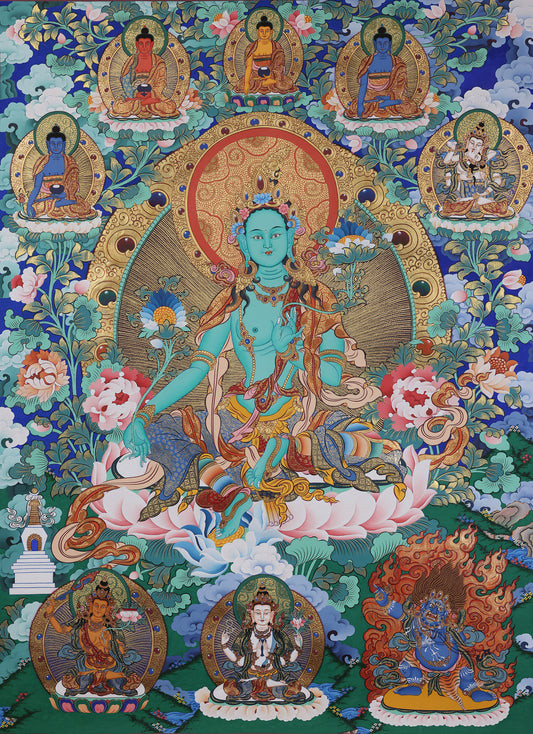
When a calm cobalt blue spreads across the canvas, and pure gold lines flow over natural mineral pigments to outline the Bodhisattva’s robes and the elephant’s silhouette—this is the Blue Thangka of Samantabhadra in Tibet’s Regong art. In the spiritual cosmos of Tibetan Buddhism, this great being riding a six-tusked white elephant is not only the right attendant of Vairocana Buddha in the “Three Saints of the Flower Adornment Sutra” but also the embodiment of “great vow power.” His image and teachings have long been woven into the faith and daily life of the Tibetan Plateau.
In Tibetan, Samantabhadra is called Kun tu bzang po (ཀུན་ཏུ་བཟང་པོ་), but within the Tibetan Buddhist system, his identity carries duality:
-
In the exoteric tradition: He is one of the “Four Great Bodhisattvas” (alongside Manjushri), symbolizing “action virtue” (practice), which pairs with Manjushri’s “wisdom virtue” to form the core of “integrating understanding and practice.” In the Flower Adornment Sutra, he forms the “Three Saints of the Flower Adornment” with Vairocana Buddha and Manjushri, representing the complete cycle of “truth-wisdom-practice.”
-
In the esoteric tradition (especially Nyingma): He is regarded as an incarnation of the “Adi Buddha” (the primordial Buddha), known as Samantabhadra Buddha. Often depicted as a naked blue figure in union with his consort, this form symbolizes “the original purity of the Dharmakaya”—as the 14th Dalai Lama notes, this is “the eternal union of emptiness and clear awareness.”
The Samantabhadra we see in the Blue Thangka is the “Bodhisattva form” from the exoteric tradition: adorned with a five-Buddha crown and jewel ornaments, his face radiates compassionate perfection, retaining worldly dignity while hinting at transcendental serenity.
This Blue Thangka is striking because every detail carries the symbolic language of Tibetan Buddhism:
Blue Thangkas use natural azurite as a base. This calm blue mineral pigment symbolizes the “empty expanse of the Dharma realm” in Tibetan art—echoing the Nyingma interpretation of Samantabhadra Buddha’s blue form, representing “the ultimate reality of non-birth and non-extinction.” Pure gold outlines, meanwhile, imply “Bodhi amidst afflictions”: even in the blue-black tones of samsara, the light of wisdom can pierce ignorance.
Samantabhadra’s mount, the six-tusked white elephant, holds meaning beyond its visual form:
-
Six tusks: Correspond to the “Six Perfections” (generosity, discipline, patience, diligence, meditation, wisdom)—the foundation of Bodhisattva practice;
-
White elephant: Symbolizes “purity and strength,” representing transcendence of afflictions and the resolve needed to practice the Dharma;
-
Four feet: Align with the “Four Methods of Guidance” (generosity, kind words, beneficial actions, empathetic companionship)—the Bodhisattva’s tools for guiding sentient beings.
In the Lotus Sutra, Samantabhadra even “appears riding a six-tusked white elephant” to protect those who recite the sutra—making the elephant a symbol of “vow power fulfilled.”
In the Thangka, Samantabhadra holds a wish-fulfilling scepter and a vase:
- The wish-fulfilling scepter represents “granting sentient beings’ wishes,” matching his “wish-granting mudra”;
- The vase symbolizes “nectar of the Dharma,” nourishing the good roots of sentient beings.
In Tibetan Buddhism, The Samantabhadra Chapter (the final section of the Flower Adornment Sutra) is a shared scripture across almost all schools. Its “Ten Great Vows” are seen as the core method for “accumulating merit and purifying obstacles”—even the Nyingma school’s “Seven-Limbed Prayer” is a condensation of these vows:
-
Homage to All Buddhas: Not just formal prostration, but cultivating the mind of “letting go of arrogance”;
-
Praise of the Tathagatas: Purifying verbal karma through praise, learning the compassionate conduct of the Buddhas;
-
Extensive Offering: Countering stinginess through giving, dismantling the foundation of “self-grasping”;
-
Confession of Karmic Obstacles: Like “clearing the field of the mind,” creating conditions for the growth of Bodhicitta;
-
Rejoicing in Merit: Countering jealousy, using others’ good deeds to enhance one’s own practice;
-
Requesting the Turning of the Dharma Wheel: Praying for the spread of the true Dharma, so more sentient beings may hear wisdom;
-
Requesting Buddhas to Remain in the World: Entreating spiritual mentors to stay in the world, like keeping a lamp lit in darkness;
-
Following the Buddhas’ Example: Taking the Buddhas as a model, clarifying the direction of practice;
-
Accommodating Sentient Beings: Using sentient beings as the field of practice, cultivating the “Four Immeasurables” (loving-kindness, compassion, joy, equanimity);
-
Universal Dedication: Dedication of all merit to sentient beings, moving beyond the limitation of “self-benefit.”
Tibetan practitioners often say: “The Samantabhadra Chapter is ‘the Dharma in action’”—it transforms the abstract “Bodhicitta” into actionable daily practices.
For modern people, Samantabhadra’s teachings transcend religion:
-
For professionals: He is regarded as the “protector of career” (especially for those born in the Year of the Dragon or Snake), with his “Six Perfections” corresponding to “focus, resilience, and wisdom” in the workplace;
-
For spiritual seekers: The idea of “integrating understanding and practice” reminds us: wisdom is not empty talk, but mindfulness in every emotional fluctuation and altruism in every conflict of interest;
-
For ordinary people: “Accommodating sentient beings” is not compromise, but understanding others with a compassionate mind, cultivating a “soft heart” in relationships.
Like the blue and gold of this Thangka: we need not escape the “blue tones” of life—we need only use “vow power” as the golden thread to weave a canvas of practice in the ordinary.
When we gaze at this Blue Thangka of Samantabhadra, we see not just a masterpiece of art, but a mentor who “realizes enlightenment through action”—riding the white elephant across the wilderness of samsara, holding the wish-fulfilling scepter to answer sentient beings’ prayers. Our practice may lie in living one line of the “Ten Great Vows” in every moment:
“In a single particle of dust, there are as many Buddhas as particles of dust; in the assemblies of Bodhisattvas everywhere, the infinite Dharma realm is the same—firmly believe that all Buddhas pervade it.”
#SamantabhadraBodhisattva #TibetanBuddhistArt #BlueThangka #TenGreatVows #BodhisattvaPractice #MahayanaBuddhism #SpiritualEnlightenment #DharmaTeachings