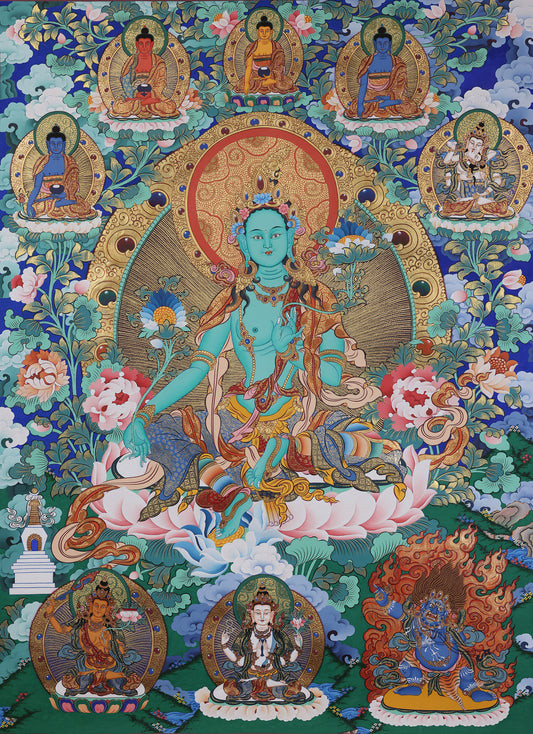
When a vivid, intricately detailed Tibetan colored Thangka unfolds before you—the white-robed goddess seated at its center, her face soft with light, seven eyes gazing outward, surrounded by lotus flowers and auspicious clouds—what you see is one of the most widely venerated embodiments of compassion in Tibetan Buddhism: White Tara.
In Tibet, White Tara’s name is nearly synonymous with "hope" and "salvation": she is the protection elderly devotees chant for beside prayer wheels, the gentle gaze in monastery murals watching over all beings, and the peace entrusted to believers’ prayer beads. As the principal figure among the "Twenty-One Taras," this Buddha-Mother’s worship spans millennia, bearing both the theological framework of Tibetan Buddhism and the spiritual undercurrent of Tibetan life.
In the pantheon of Tibetan Buddhism, White Tara is not an independent deity, but an emanation of Avalokiteshvara (the Bodhisattva of Compassion). Buddhist scriptures recount that when Avalokiteshvara wept for the suffering of sentient beings, his tears fell to form a lotus, from which Tara ("She Who Saves") was born. White Tara is the core among these emanations, also known as the "Seven-Eyed Buddha-Mother."
Across major Tibetan Buddhist schools (such as Gelug and Nyingma), White Tara holds clear theological roles:
- She is one of the "Three Longevity Deities" (alongside Amitayus and Ushnisha Vijaya), presiding over health and long life;
- She is a "Buddha-Mother of Activity," capable of dispelling misfortune, removing obstacles, and fulfilling wishes;
- In female devotion, she is further revered as a "Protector of Women," regarded as the guardian of pregnant women and children.
This multifaceted identity has woven White Tara’s worship into every corner of Tibetan life: herders offer prayers to her images before long journeys, expectant mothers recite the White Tara Mantra during labor, and even traditional Tibetan medical texts incorporate healing concepts inspired by her.
The Thangka opening this article is a classic example of White Tara’s "standardized" iconography—Tibetan Buddhist art is never arbitrary; every detail embodies theology and philosophy:
White Tara’s most iconic feature is the seven eyes on her body: two on her face, one on each palm, one on each foot sole, and one on her forehead. This is no "exotic design," but a symbol of her "seven eyes gazing over the three realms"—able to instantly perceive the suffering and prayers of all beings, without omission.
In Thangkas, these eyes typically feature black pupils and white sclera, striking and clear—as if to tell the viewer: every bit of your pain is seen with compassion.
White Tara in Thangkas is often depicted in a "peaceful aspect": dressed in plain white robes, adorned with simple jewels, her posture relaxed yet dignified (usually in the "half-lotus position," one foot resting on a lotus, the other hanging down). This gentle image aligns with her core role of "salvation"—dissipating fear with tenderness.
Yet strength lies in the details: her right hand forms the Varada Mudra (palm outward, fingers downward), symbolizing "bestowing comfort"; her left hand holds an Utpala (lotus), its stem extending to her shoulder, representing "untainted purity" and "enduring hope."
White Tara in Thangkas is often surrounded by other deities and scenes:
- The Buddha above (usually Amitayus) represents her "source";
- Attendants on either side (such as Red Tara and Green Tara in this Thangka) symbolize the collective protection of the "Tara family";
- The background of snow-capped mountains, lotus ponds, and auspicious clouds is a tangible representation of the "pure land" in Tibetan hearts—White Tara dwells in such a serene realm, yet leans forward always to look upon the human world.
White Tara’s worship is never "theology on a page," but a living part of Tibetan existence.
Nearly every Tibetan knows the White Tara Mantra ("Om Tare Tuttare Ture Soha")—this short incantation is regarded as the "code" of White Tara’s compassion. Devotees recite it while spinning prayer wheels, working, or before sleep; some even carve it into mani stones, letting wind and water carry the prayer.
During major religious festivals (such as the "Tara Festival"), monasteries hold White Tara Empowerment ceremonies: lamas bless believers with White Tara images, while devotees offer khata scarves and butter sculptures to pray for health and peace.
From Potala Palace murals to small Thangkas in herders’ homes, White Tara’s image is ubiquitous—this is both the spread of faith and the accumulation of art.
Traditional colored Thangkas of White Tara use mineral pigments: white from pearl powder, blue from lapis lazuli, gold from gold leaf—these precious materials reflect reverence for the Buddha-Mother, while keeping the images vibrant for centuries, just as White Tara’s compassion never fades.
Even outside a religious context, White Tara’s image and meaning resonate with modern people:
Her "seven eyes" are the wisdom of "seeing"—in a fast-paced life, can we see our own and others’ weariness?
Her
Varada Mudra is the tenderness of "giving"—in a competitive society, is gentle kindness also a form of strength?
Her lotus is the choice of "purity"—in a chaotic world, how do we keep inner peace?
Tibetans say: "White Tara’s compassion is not ‘saving,’ but ‘accompanying.’" This companionship may be one of the spiritual comforts modern people need most.
When we look again at that Thangka, White Tara’s smile is no longer just a religious symbol, but a gentle reminder across millennia: no matter when, compassion remains, and hope remains.
#WhiteTara #TibetanBuddhism #ThangkaArt #BuddhistBeliefs #CompassionateBuddhaMother #TibetanCulture #BuddhistIconography #TaraWorship #SpiritualHealing #TraditionalCulture