Kalachakra Mandala Thangka in Tibetan Buddhism: A Three-Dimensional Interpretation of Cosmology, Deity System, and Sacred Craftsmanship

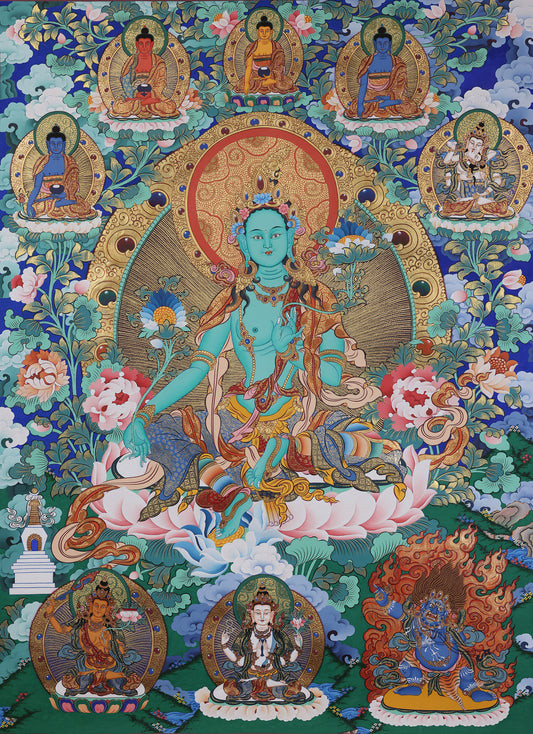
Within the vast and highly systematized artistic tradition of Tibetan Buddhism, the Kalachakra Mandala Thangka is widely regarded as one of the most complex, profound, and spiritually significant subjects. It is not merely a religious painting intended for visual appreciation, but a Vajrayana cosmological model rendered in visual form, condensing time, space, stages of practice, and the path to enlightenment into a single sacred diagram.
For those who truly understand Tibetan Buddhist tantra, the Kalachakra Mandala is not “art” in the secular sense. It is a painted scripture of the Kalachakra Tantra, not an ornament, but a spiritual gateway that can be entered through contemplative practice.
I. Core Theme: A Cosmological Model of Time and Space from the Pure Land of Shambhala
The central theme of this thangka is the Kalachakra Mandala, also known as the “Mandala of the Wheel of Time.” Within Vajrayana Buddhism, the Kalachakra teachings occupy a uniquely elevated position, as they articulate not only a religious worldview but a comprehensive philosophy of cosmic order and spiritual awakening.
According to the Kalachakra doctrine, the universe is not static. Rather, it is a dynamic continuum woven from time and space, governed by cyclical rhythms known as the “Wheel of Time.” This principle applies equally to the macrocosm of the universe and the microcosm of human consciousness, guiding the practitioner from ignorance toward realization.
The mandala functions as a microcosmic representation of this cosmic order. Visually, it unfolds through a rigorously structured system of geometric nesting:
-
The central square palace symbolizes the primordial Dharma realm and ultimate reality
-
Multiple concentric circles represent the flow of time and progressive stages of realization
-
The outermost decorative zones signify the impure, conditioned world of ordinary existence
This inward-to-outward structure is not decorative but doctrinal, precisely corresponding to the practitioner’s journey from conventional truth to ultimate truth.
At the same time, the Kalachakra Mandala embodies the sacred vision of Shambhala, the enlightened kingdom described in the Kalachakra Root Tantra. According to the text, Shambhala is ruled by twenty-five successive Dharma Kings, beginning with King Suchandra, who safeguard and transmit the Kalachakra teachings across generations.
Each architectural layer and deity within the mandala serves as a symbolic manifestation of Shambhala itself. For practitioners, contemplating the mandala is equivalent to entering Shambhala, making it a central meditative support for realizing the “Kalachakra Body” and harmonizing inner time with the cosmic order.
II. Central Deities: The Union of Kalachakra and the Consort Vishvamata
At the very heart of the mandala reside the principal deities: Kalachakra and his wisdom consort Vishvamata, known in Tibetan tradition as the “Great Seal of Emptiness and Form.” They appear in yab-yum (sacred union) posture, representing the ultimate Vajrayana principle—the inseparable unity of skillful means and wisdom.
1. Kalachakra: The Manifestation of Ultimate Emptiness
Kalachakra’s body is deep blue in color, symbolizing the vast emptiness of the Dharma realm. His iconography is extraordinarily intricate: four faces, twenty-four arms, and two legs, forming a highly systematized symbolic language unique to tantric Buddhism.
The four faces—blue, white, red, and yellow—correspond to the four enlightened activities: pacifying, increasing, magnetizing, and subjugating. Each of the twenty-four hands holds a ritual implement with specific meaning:
the vajra represents the destruction of ignorance, the Dharma wheel signifies the continuity of Buddhist teaching, the white conch proclaims the spread of the Dharma, and the skull cup symbolizes the non-duality of samsara and nirvana.
His left white and right red legs trample Mahadeva and his consort, symbolizing the complete subjugation of desire, anger, and ignorance, and embodying the Vajrayana principle of transforming afflictions into wisdom.
2. Vishvamata: The Radiance of Enlightened Wisdom
Vishvamata appears in luminous golden-yellow, representing awakened wisdom. She has four faces and eight arms, mirroring Kalachakra’s iconography and reinforcing their inseparable unity. Her ritual implements—such as the curved knife, drum, and wish-fulfilling jewel—express the tantric doctrine that wisdom embraces and perfects skillful means.
It is essential to understand that their embrace does not symbolize worldly desire. Rather, it represents the ultimate union of relative and absolute truth, compassion and wisdom, forming the doctrinal foundation of Vajrayana’s teaching of enlightenment within a single lifetime.
III. Retinue Deities: The Mandala as a Hierarchical Divine Network
The Kalachakra Mandala is not centered solely on its principal deities; it is an entire sacred universe. Retinue deities are arranged through concentric, nested layers, forming a complete system that extends from ultimate reality to worldly protection.
1. Inner Palace: Five Dhyani Buddhas and Bodhisattvas
Surrounding the central deities are the Five Dhyani Buddhas—Vairocana, Akshobhya, Ratnasambhava, Amitabha, and Amoghasiddhi—representing the full manifestation of the five transcendental wisdoms.
Accompanying them are major bodhisattvas such as Manjushri, Avalokiteshvara, and Vajrapani, embodying wisdom, compassion, and enlightened power. Together, they form the mandala’s core Dharma retinue.
2. Middle Ring: Kings of Shambhala and Protective Deities
The outer circular zone depicts the twenty-five Kings of Shambhala, the human lineage holders of the Kalachakra teachings. Interwoven among them are dakinis and heroic protectors, dynamic figures symbolizing freedom from worldly constraints and the active guardianship of both the mandala and its practitioners.
3. Outer Ornamentation: Auspicious Symbols and Worldly Protectors
The outermost decorative band features the Eight Auspicious Symbols, including the Dharma wheel and treasure vase, signifying completeness, harmony, and blessing. Subtle representations of deities such as Green Tara, Ksitigarbha, and Yellow Jambhala appear in the periphery, reflecting Vajrayana Buddhism’s compassionate concern for both spiritual liberation and worldly well-being.
IV. Painting Craftsmanship: Sacred Materials and Classical Techniques
As a fully hand-painted thangka, this work exemplifies the Tibetan tradition of “excellent materials and masterful craftsmanship,” closely aligned with the refined schools of Nepal and Central Tibet.
1. Base and Pigments: The Union of Nature and Faith
The painting is executed on hand-stretched cotton canvas, prepared with repeated layers of chalk and animal glue, polished to a mirror-like surface. All pigments are derived from natural mineral and plant sources—lapis lazuli, cinnabar, orpiment, malachite, and turquoise—while select areas are adorned with 24K pure gold leaf.
These materials are prized not only for their durability but also for their perceived spiritual potency, serving as tangible vessels of faith.
2. Technique and Detail: Creation as Spiritual Discipline
Line work is completed using ultra-fine brushes, producing lines as delicate as hair yet firm and precise. Gold application combines flat gilding, raised gold, and engraved gold techniques, creating a luminous, sculptural texture. The composition strictly follows the proportional and ritual prescriptions of the Kalachakra Tantra, ensuring doctrinal accuracy and meditative functionality.
3. Stylistic Origins: The Fusion of Nepalese and Tibetan Traditions
Judging from facial proportions, flowing garment lines, and elaborate gold ornamentation, the painting reflects the influence of the Newari style of Nepal, known for its richness and precision, while maintaining the rigorous iconographic discipline of Tibetan thangka art. Kalachakra mandalas of this caliber often require artists to work in seclusion for many months, sometimes over a year, to complete.
Conclusion: Sacred Art as a Tool for Awakening
The Kalachakra Mandala Thangka is, in essence, a work of functional sacred art. It serves simultaneously as a visual text of Tibetan Buddhist cosmology and a meditative instrument for tantric practice.
During its creation, the artist observes vows, recites mantras, and maintains purity of body, speech, and mind to imbue the painting with spiritual blessing. For the viewer or practitioner, sustained contemplation of the mandala’s layered structure enables an inner journey—from the conditioned world toward ultimate realization.
Its colors, lines, and materials are therefore not merely aesthetic elements, but material expressions of faith. This is the fundamental distinction between Tibetan thangka and secular painting, and the reason why the Kalachakra Mandala Thangka has endured for centuries as one of the most profound spiritual instruments in Vajrayana Buddhism.
#KalachakraMandala
#TibetanBuddhism
#VajrayanaBuddhism
#KalachakraTantra
#Shambhala
#ThangkaArt
#MandalaThangka
#SacredBuddhistArt
#HandPaintedThangka
#BuddhistIconography
#BuddhistCosmology
#MeditationArt
#TantricVisualization
#WisdomAndCompassion
#SpiritualAwakening
Tags:
Previous
Tibetan Buddhist Four-Armed Avalokiteshvara Gold Thangka: In-Depth Analysis of Compassion, Deity System, and Gold Thangka Craftsmanship
Next
Hand-Painted Tibetan Blue Thangka of the Pure Land of Medicine Master Lapis Lazuli Buddha: An In-Depth Analysis of Theme, Deities, and Craftsmanship