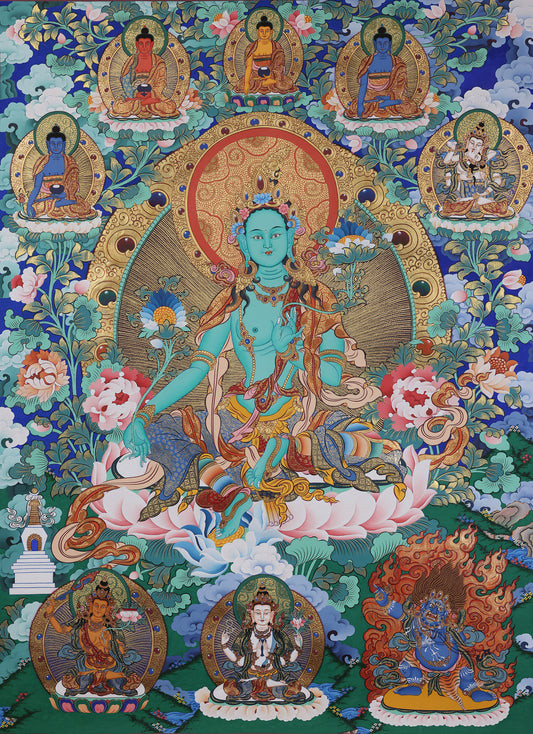
Black-Gold Thangka "Yellow Manjushri Bodhisattva": A Thousand-Year Legacy of Tibetan Buddhist Wisdom Aesthetics
wudimeng-Dec 19 2025-0 comments
I. The Buddhist Philosophical System Behind the Golden Hue
Within the vast pantheon of Tibetan Buddhist deities, Yellow Manjushri Bodhisattva, distinguished by his unique golden body color and profound symbolism of wisdom, stands as a deity of immense practice value within the "Five Manjushris" system. This black-gold thangka is not merely a religious image; it is a visual expression of a complete Buddhist philosophical system.
The Color Code of Yellow Manjushri: The Visual Presentation of the Wisdom of Equality
Manjushri Bodhisattva is revered in Buddhism as the "embodiment of the wisdom of all Buddhas." The golden body color of Yellow Manjushri contains profound symbolic meaning. Within the Tibetan Buddhist tantric system, yellow corresponds to the direction of Buddha Ratnasambhava among the "Five Dhyani Buddhas." Ratnasambhava represents the "Wisdom of Equality"—the ultimate wisdom that transcends all discrimination and perceives all phenomena as equal and undifferentiated.
This visual expression of wisdom is exquisitely subtle: gold is neither a glaring white nor a heavy black but a middle color, symbolizing the Middle Way wisdom that does not fall into extremes. When a practitioner gazes upon this golden hue, they are, in fact, undergoing mental training in "transcending dualistic opposition."
The Five-Pointed Crown: The Complete System of Five Wisdoms
Observing closely the five-pointed crown (ingeniously presented as "one topknot with five jewels") adorning the main deity reveals that this crown is actually a complete system of Buddhist wisdom philosophy:
Mirror-like Wisdom: Like a mirror reflecting objects, clear and unstained.
Wisdom of Equality: Transcends discrimination, viewing all as equal.
Discriminating Wisdom: Insight into the characteristics and interdependent origination of all phenomena.
All-Accomplishing Wisdom: The power of wisdom to benefit beings in the world.
Dharma-Realm Wisdom: The wisdom of ultimate reality, transcending all concepts.
These five wisdoms progress layer by layer, constituting the complete path of Buddhist practice. Yellow Manjushri Bodhisattva is the personified manifestation of these five wisdoms, serving as a model that practitioners can directly visualize and emulate.
Attributes and Posture: A Visual Textbook of the Stages of Practice
The arrangement of attributes held by Yellow Manjushri in the thangka cleverly illustrates the three-stage progression of Buddhist practice:
The Systematic Metaphor of the Lotus-Held Scripture in the Left Hand:
Lotus Stem by the Ear: Symbolizes "pure listening."
Practice begins with correctly hearing the teachings.
The straight lotus stem represents the focus and uprightness during listening.
Lotus Flower Level with the Ear: Represents "correct contemplation."
Deep reflection on the meaning of the teachings heard.
The blooming lotus symbolizes the openness and clarity of contemplation.
Scripture on the Lotus: Holds the Prajnaparamita Sutra in Eight Thousand Lines.
Symbolizes the final stage of "actual practice and realization."
The wisdom within the scripture must be realized in actual life.
The Dual Interpretation of the Right Hand Gesture:
Explicit Manifestation: Forms the "fearlessness mudra" (abhaya mudra), granting beings peace and courage.
Implicit Symbolism: The right hand concealed within the robe folds hints at the potential of the wisdom sword to "sever afflictions."
This design of one explicit, one implicit precisely reflects the profound meaning of Vajrayana practice: "externally manifesting compassion, internally harboring wisdom."
Aureole Ornamentation: The Symbolic Field of the Wisdom Realm
The radiant aureole behind the main deity is the essence of the entire thangka, with each ornament carrying specific symbolic meaning:
Flame Motifs: The fire of wisdom, burning away all ignorance and afflictions.
Scrollwork Patterns: The unbroken continuity of the Dharma lineage.
Utpala Flowers: The pure wisdom unstained by the mud of samsara.
Multiple Layers of Haloes: The infinite expansion of wisdom from the core into the dharma realm.
These ornaments together create a sacred visual field, guiding the viewer from ordinary space into a space of practice.
II. Black-Gold Thangka Craftsmanship: The Millennium Legacy of Religious Ritual and Artistic Excellence
Base Treatment: The Triple Transformation from Mundane Cloth to Dharma Realm
The canvas preparation for a black-gold thangka is a spiritual practice lasting over 45 days:
The Mental Correspondence of the "Three-Paste, Three-Polish" Craft:
text
Stage One: Coarse Paste Filling (Corresponds to "Eradicating Coarse Afflictions")
  Materials: Yak bone glue + Coarse chalk powder
  Duration: 15 days
  Mental Symbolism: Removing obvious afflictions and attachments

Stage Two: Medium Paste Leveling (Corresponds to "Taming Subtle Habitual Tendencies")
  Materials: Refined bone glue + Fine chalk
  Duration: 15 days
  Mental Symbolism: Smoothing out inner turbulence and restlessness

Stage Three: Fine Paste Polishing (Corresponds to "Achieving a Pure Mind Nature")
  Materials: Special glue solution + Extremely fine mineral powder
  Duration: 15+ days
  Target State: Smooth as a mirror, reflecting clearly
This process of slow work yielding fine results is itself a spiritual resistance to the fast-paced modern life. Each day of polishing is a deep dialogue between the artist and the material.
Black Base: The Color Philosophy of Dharma Realm Nature
The black background of the black-gold thangka uses a unique traditional formula:
Three Core Components of the Black Pigment:
Magnetite Powder: Sourced from sacred mountains in Tibet, repeatedly ground and settled.
Deer Antler Ash: Adds depth of color and adhesion to the black.
Yak Glue: Natural adhesive collected and prepared seasonally.
In the Tibetan Buddhist color symbolism system, black holds a unique philosophical position:
Not "Darkness": Does not symbolize ignorance or negativity.
Symbolizes "Dharma Realm Nature": The primordial state of the universe.
Transcends Duality: Contains all possibilities, transcends the opposition of light and dark.
This black background provides the perfect contrasting stage for the golden light of wisdom.
Gold Outlining: The Sacred Art of Drawing Light with Light
Ritual Requirements for Gold Material Processing:
Timing: Dawn (optimal angle of morning light).
Grinding Tool: Agate stone slab (moderate hardness, does not contaminate gold powder).
Fineness Standard: Above 800 mesh (fine enough to float with a breath).
Outlining and Building: Using a mouse-whisker brush to "write" three-dimensional lines.
Natural Drying: Slow curing under specific humidity.
Agate Burnishing: Polishing from different angles to produce multi-layered luster.
The completed gold lines produce a dynamic shimmering effect under different lighting, as if wisdom "instantaneously manifests" in the viewer's mind.
Color Philosophy: The Minimalist Expression of Tantric Aesthetics
Compared to traditional color thangkas, black-gold thangkas embody ultimate restraint:
The Three Meanings of "Sparing Use of Color":
Precious Materials: High cost of gold and mineral pigments.
Symbolic Focus: Fewer colors, greater concentration of the viewer's attention.
Philosophical Expression: Using simplicity to reveal complexity, using emptiness to represent fullness.
This aesthetic choice deeply aligns with the following traditions:
Tantric Philosophy: Non-dual in essence, simple in form.
Song and Yuan Landscape Painting: Using blank space as substance, ethereal artistic conception.
Zen Aesthetics: Pointing directly to the mind, not relying on words.
Iconometry: The Mathematical Precision of Sacred Geometry
Thangka painting follows the sacred "Twelve-Finger Measure" proportions of the Treatise on Iconometry:
Key Body Proportions (using finger-widths as units):
Total Height: 12 finger-widths
Face Width: 3 finger-widths
Eye Length: 1 finger-width
Distance Between Eyebrows: 0.5 finger-widths
Number of Lotus Petals: Usually 8 (symbolizing the Noble Eightfold Path).
This mathematical precision has deep religious significance:
Maintaining Purity: Prevents personal aesthetics from distorting the deity's form.
Ensuring Visualization Efficacy: Correct proportions aid in clear manifestation during meditation.
Connecting to the Lineage: Visualizing the same standard form as accomplished practitioners through the ages.
The "Eye-Opening" Ritual: The Sanctifying Process of Giving Life to the Thangka
The final "eye-opening" segment is the climax and sublimation of the entire thangka creation process:
The Purification Procedure of the Seven-Day Retreat:
text
First 3 Days: Mantra Purification (Reciting the Manjushri mantra 100,000 times)
Middle 2 Days: Fasting and Physical Purification (Consuming only pure vegetarian food)
Last 2 Days: Sitting in Meditation to Purify the Mind (Adjusting to the optimal physical and mental state)
Ritual Details of the Eye-Dotting Moment:
Tool: Consecrated gold-needle brush.
Timing: Selecting an auspicious day and hour.
State: The artist enters deep meditative absorption.
Visualization: Inviting the actual presence of wisdom to descend.
This process is called "infusing wisdom." From this point, the thangka transforms from an artwork into a companion for practice.
III. Cultural Value: The Millennial Wisdom Vessel as a "Living Dharma Implement"
Religious Dimension: The Body Support Among the Three Supports
Within the Tibetan Buddhist system, this black-gold thangka has a clear religious functional定位:
Specific Correspondences of the "Three Supports":
Body Support: Buddha statue/thangka (this work).
Speech Support: Buddhist scriptures (the Prajnaparamita Sutra in Eight Thousand Lines).
Mind Support: Stupa (symbolizing the enlightened mind).
As a Body Support, this thangka is not only an object for viewing but also:
A Focus for Visualization: A visual focal point during meditation.
A Vehicle for Blessings: Carrying the blessing power of generations of transmission.
A Witness to Accomplishment: A companion and inspiration on the path of practice.
Artistic Dimension: A Dialogue of Materials Across Time and Space
From an art history perspective, this thangka embodies the crystallization of wisdom from multiple civilizations:
The Perfect Fusion of Four Major Traditions:
Indian Origin: Iconometric measurements and symbolic systems.
Nepalese Heritage: Gold-working techniques and decorative aesthetics.
Chinese Influence: Spatial composition and意境 (artistic conception) creation.
Tibetan Innovation: Black-gold techniques and plateau materials.
The Promise of Material Timelessness:
Magnetite Black: Chemically stable, does not fade for millennia.
Pure Gold Lines: Never oxidize, shine eternally.
Mineral Pigments: High weather resistance, long-lasting color.
Just like the Ming Dynasty black-gold thangkas housed in the Palace Museum, which remain radiant after 600 years of weathering, this "material timelessness" is a superb metaphor for the "transcendence of time" inherent in Manjushri's wisdom.
Contemporary Significance: The Spiritual Resistance of Slow Craftsmanship
In the 21st-century digital deluge, the very process of creating this thangka is itself a profound cultural declaration:
Four Contrasts Between Traditional Craft and Modern Life:
45 days of polishing vs. second-by-second generation: A dialogue between depth and speed.
Hand grinding vs. mass production: A confrontation between individuality and standardization.
Ritual focus vs. fragmented attention: A contrast between wholeness and fragmentation.
Timeless materials vs. fast consumption: A comparison between endurance and transience.
Every traditional thangka reminds us: true value requires the sedimentation of time, and ultimate wisdom requires the focus of the mind.
Conclusion: A Visual Portal to a Millennial Dialogue on Wisdom
This black-gold thangka Yellow Manjushri Bodhisattva is a multi-dimensionally open system for practice. It invites every viewer to enter into dialogue at different levels:
Four Progressive Levels of Experience:
Aesthetic Level: Feeling the formal beauty of the black-gold contrast.
Intellectual Level: Understanding the Buddhist philosophy behind the symbols.
Practice Level: Using it as an aid in personal spiritual practice.
Wisdom Level: Directly experiencing the reality beyond the symbols.
In today's era of information overload, such a work that requires quiet contemplation, slow appreciation, and deep realization is like an antidote for the soul. It does not provide quick answers but guides the direction for finding them; it does not offer instant gratification but initiates a lasting exploration.
When you gaze upon this thangka, the golden lines against the black background seem to ask silently: beneath all rapidly changing appearances, what is the timeless, unchanging wisdom? Amidst complex and varied phenomena, how can one see that simple, bright, inherent mind?
This is perhaps the eternal invitation that Yellow Manjushri Bodhisattva extends across a millennium to every era and every destined individual—not to seek wisdom outwardly, but to illuminate the innate awareness within.
We use cookies to enhance your browsing experience, serve personalized ads or content, and analyze our traffic. By clicking "Allow cookies", you consent to our use of cookies. More infor
Thanks for subscribing!
This email has been registered!
Sorry! Products are not enough.
Recipient email can't be blank.
Send on must be within 90 days from now
Thank you for registering! We will notify you by email when it is back in stock.