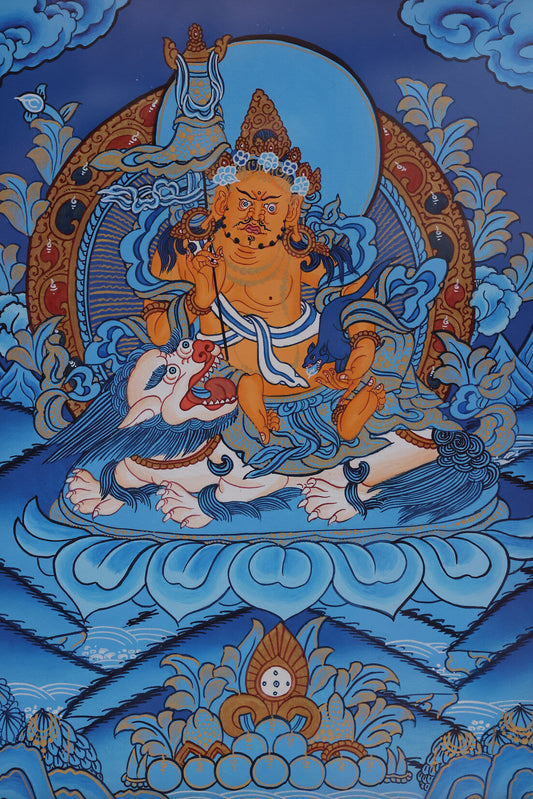
When the mineral pigments of Regong Red Thangka blend into a solemn, gold-and-red icon on cotton fabric—a yellow-skinned, wrathful king seated atop a white snow lion, his right hand holding a radiant victory banner, a treasure-spitting mongoose nestled in his left arm—this Vaishravana Thangka is not just a treasure of Himalayan art, but a tangible expression of "wealth" and "protection" in Tibetan Buddhist belief. In Tibet, Vaishravana (known as Langtse in Tibetan) is both the leader of the Four Heavenly Kings (guardian of the North) and the most beloved "God of Wealth" among devotees. Behind his image lies a millennium of cultural fusion and spiritual wisdom.
Vaishravana traces his roots to Kubera in ancient Hinduism—the god of wealth who ruled the northern world, famous for his "ugly form" and "three legs." According to the Puranas, Kubera was born from a cow at Brahma’s behest, but was exiled by his half-brothers due to his gentle nature. After a thousand years of ascetic practice at Mount Kailash, he was granted immortality, becoming the ruler of yakshas and rakshasas, and the guardian of worldly treasures.
With the rise of Buddhism, Kubera was incorporated into the Dharma protector pantheon as Vaiśravaṇa (the Northern Heavenly King, whose name means "he who hears much," signifying his widespread fame for virtue). In the Ashoka Sutra, the Buddha entrusted him to "protect the Dharma in the North"; the Sutra of Vaiśravaṇa further defined his merit: "Those who chant his name shall gain prosperity and be freed from misfortune."
Upon entering Tibet, Vaishravana’s identity evolved: he became both an emanation of Ratnasambhava (Buddha of the South) and Amoghasiddhi (Buddha of the North), as well as a subordinate of Vajrapani, residing in the "Willow Palace" pure land of the North. Legend has it that Vaishravana personally gifted gold to help Tsongkhapa, founder of the Gelug school, build Ganden Monastery—cementing his status as a core protector in Tibetan monasteries. Today in Tibet, Langtse is far more renowned than the other Heavenly Kings, revered as the "dual guardian of wealth and the Dharma."
This hand-painted Red Thangka precisely captures Vaishravana’s "standard configuration," with each ornament carrying specific symbolism:
-
Skin Tone and Attire: His yellow skin, like gold, symbolizes the brightness and purity of wealth. Adorned with a five-Buddha crown, golden armor, and celestial robes, he exudes royal majesty while embodying "inner and outer abundance"—the unity of material prosperity and spiritual dignity.
-
Right Hand: Victory Banner: The banner (dhvaja), originally an ancient Indian military standard, represents "smooth undertakings and freedom from obstacles" in Buddhism. The gilded patterns on the banner in the Thangka signify wealth flowing endlessly, like the turning of the banner.
-
Left Arm: Treasure-Spitting Mongoose: This plump weasel (nyule in Tibetan) is Vaishravana’s most iconic symbol—its mouth overflowing with treasures represents "inexhaustible merit." As weasels are natural predators of snakes (a symbol of greed), the mongoose serves as a reminder: wealth should be a tool for altruism, not an object of greed.
-
Mount: White Snow Lion: The green-maned white lion, a mythical beast in Tibet symbolizing "fearlessness and stability," is not just Vaishravana’s mount—it implies that wealth can only endure when rooted in "steadfast good intentions."
-
Red Thangka Background and Gilding: Regong Red Thangka uses mineral pigments like cinnabar and ochre to create a deep red base, evoking solemnity while aligning with Han Chinese aesthetics of "festivity and prosperity." The gilded patterns of lotus vines and jewels lend the work dynamism amid serenity, echoing the wish for "wealth and auspiciousness to coexist."
As the Tibetan iconographic tradition holds: "Every brushstroke is not decoration, but the language of faith." Each detail in this Thangka is a concrete interpretation of "abundance"—not mere material desire, but a state of life defined by "full merit and growing virtuous practice."
Many equate Vaishravana with a "god of fortune," but in Tibetan belief, his "bestowal of wealth" carries deeper logic:
Tibetan Buddhism holds that wealth is not an end, but a tool for "walking the Bodhisattva path." The Vaiśravaṇa Prayer states that his blessings bring "full material resources and the fulfillment of all wishes"—here, "wishes" refer to the smooth progress of altruistic deeds: merchants gain wealth to donate to monasteries; farmers harvest to support the Triple Gem; ordinary people attain stable lives to focus on Dharma practice.
As a Tibetan herder once put it: "Worshipping Vaishravana isn’t about getting rich overnight—it’s about hoping to ‘have the ability to care for family and the means to help others.’"
The core of Vaishravana’s worship rituals is not "begging," but "practicing virtue." The Vaishravana Dharma clarifies: "If one craves wealth without practicing compassion, even chanting mantras will bring no blessings." When worshipping, devotees first recite his mantra ("Om Bhe 玛 Sha Wa Ra Ya Svaha") and vow to "use wealth for altruism"—a reflection of Buddhism’s law of karma: wealth is the fruit of virtuous deeds, not something to be taken from others.
The treasure-spitting mongoose in the Red Thangka hides a metaphor: "Wealth is finite, but wisdom is infinite." In Tibetan esoteric texts, Vaishravana is also called the "Buddha of Many Treasures," and his "bestowal of wealth" essentially means "unlocking sentient beings’ inner treasures"—such as the "Seven Noble Treasures" (wisdom, compassion, generosity, etc.), which are the only inexhaustible wealth.
Today, this Red Thangka of Vaishravana has transcended its role as a religious icon to become a cultural symbol:
-
Artistic Value: Regong Red Thangka, painted with mineral pigments that resist fading for centuries, showcases the exquisite craftsmanship of Himalayan art through its gilding techniques. This work preserves the solemnity of Tibetan Thangka while integrating the delicacy of Han Chinese gongbi painting, witnessing the fusion of Han and Tibetan cultures.
-
Spiritual Value: In an era of material excess, Vaishravana’s belief reminds people that wealth is fundamentally about "responsibility" rather than "indulgence." His image prompts reflection: true abundance lies in "having the ability to give," not "possessing without restraint."
-
Lifestyle Value: Many now hang Vaishravana Thangkas in studies or offices not just to "seek fortune," but to embody the attitude of "steady progress and win-win altruism"—echoing the victory banner’s meaning in the Thangka: smooth undertakings stem from right intention and effort.
Gazing at this Red Thangka, the wrathful king’s fierce gaze is not an expression of authority, but a warning against greed; the mongoose’s treasures are not bait for desire, but the fruit of virtuous karma. From Indian God of Wealth to Tibetan Dharma Protector, Vaishravana’s evolving image mirrors humanity’s growing understanding of "wealth": it is not an illusion to chase outward, but a good fruit cultivated inward.
Perhaps this is the Thangka’s greatest value—it allows us to appreciate artistic beauty while grasping the true meaning of wealth: the true guardian is never an external deity, but the good intentions and wisdom in our own hearts.
#VaishravanaTibetanBuddhism #RedThangkaArt #RegongThangka #TibetanDharmaProtector #SpiritualMeaningOfWealth