In Tibetan Buddhist culture, a Thangka is more than a painting—it is a sacred vessel of prayer, devotion, and spiritual protection. Each brushstroke carries ritual significance, each color embodies symbolic meaning, and every composition reflects centuries of religious and cultural tradition.
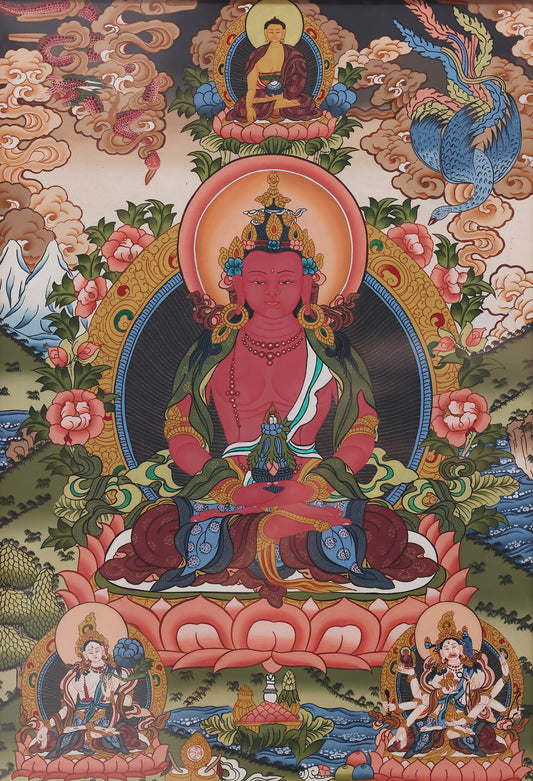
This hand-painted Amitayus (Long Life Buddha) Thangka, characterized by its cinnabar red hue, centers on the theme of longevity and merit enhancement. It exemplifies the Men Tang painting school, where rigorous iconometric accuracy converges with Tibetan folk aspirations for health, longevity, and spiritual abundance. As both a religious implement and a highland aesthetic artifact, it represents a dual heritage of devotion and artistry.
I. Core Theme: The Mandala of the Three Deities of Longevity
The Amitayus Thangka embodies the central Tibetan Buddhist aspiration of “blessings for long life through Amitayus and attendant deities.” In Tibetan culture, longevity is not merely the extension of time but signifies a harmonious state of body, mind, and spiritual merit. It encompasses:
-
Freedom from illness and suffering
-
Fulfillment of merit and wisdom
-
Continuity of positive karmic connections
This philosophy resonates deeply with life on the Tibetan Plateau, where harsh natural conditions inspire reverence for resilience, vitality, and spiritual endurance.
The composition reflects the mandala cosmology of Tibetan Buddhism. The central deity represents the core of the dharmadhatu, while the attendants are strategically positioned to provide four-directional protection. Mountains, clouds, and natural scenery in the background symbolize the connection between the mundane and the sacred. Devotees who display this Thangka establish a spiritual link between themselves and the deities, facilitating the threefold blessing of obstacle removal, longevity, and merit enhancement.
II. The Central Deity: Amitayus Buddha—Iconography and Symbolism
At the center of the composition sits Amitayus (Long Life Buddha, Tibetan: “Tsepa”), strictly adhering to the iconometric rules outlined in the Vinaya and Thangka manuals. Each detail carries profound symbolic meaning:
1. Physical Features
The cinnabar-red body symbolizes vitality, life energy, and flourishing merit. The five-Buddha crown represents the wisdom of the five directions, while pearl ornaments signify spiritual and material completeness. These embellishments are not decorative—they express the principle of the sambhogakaya, the transcendent form of the Buddha manifesting to benefit sentient beings.
2. Posture and Attribute
Amitayus sits in full lotus on a double lotus pedestal, with the moon disc beneath representing purity and serenity. His hands hold the meditation mudra (dhyana mudra), supporting the long-life vase filled with nectar. This nectar symbolizes the cleansing of karmic obstacles and the nourishment of wisdom and life force, making the vase Amitayus’s defining attribute for granting longevity.
3. Spiritual Significance
In Tibetan Vajrayana, Amitayus is considered an emanation of Amitabha, personifying life energy. The cinnabar-red body conveys vitality and strength, the nectar-filled vase represents nourishing virtuous qualities, and the serene facial expression communicates freedom from the fear of death.
For Tibetan practitioners, visualizing Amitayus is a meditative practice. Contemplating the cinnabar-red body evokes inner vitality, while focusing on the nectar vase inspires confidence in purification of obstacles and growth of longevity and merit.
III. Attendant Deities: Structured Network of Protection
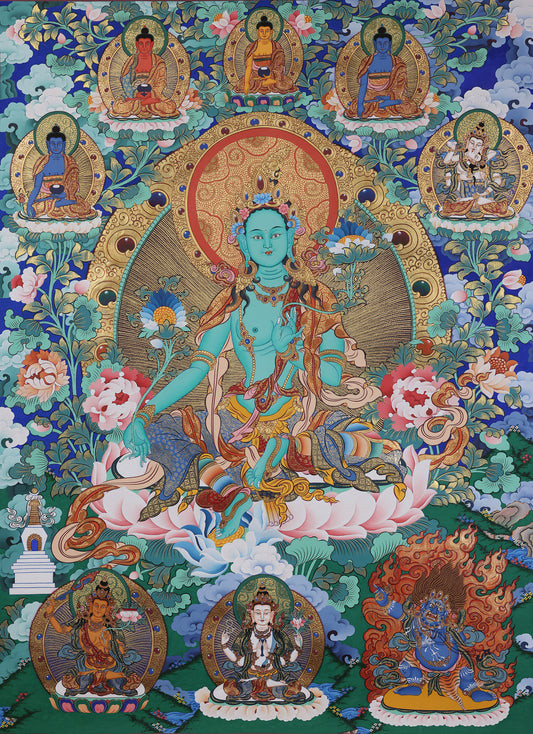
The surrounding deities form a comprehensive protective system, each serving a specific role in the theme of longevity:
Upper Deities
At the top are typically Shakyamuni Buddha or Buddha of Infinite Light (Akshobhya/Amitayus source). Shakyamuni represents the origin of Dharma, while the Buddha of Infinite Light reinforces the legitimacy of the longevity practice. Flanking them are Four-Armed Avalokiteshvara (compassion) and Manjushri (wisdom), completing the union of compassion and insight.
Side and Lower Attendants
-
Left: White Tara, with her seven eyes, observes suffering and alleviates illness, forming a central part of the longevity triad.
-
Right: Ushnishavijaya, three-faced and eight-armed, holds a vase and dharmachakra, symbolizing purification of karmic obstacles and prevention of untimely death.
-
Below: Yellow Jambhala (holding the treasure mouse) ensures material support for life, while protective deities like Mahakala remove obstacles.
This arrangement follows a ritual hierarchy: Amitayus grants fundamental longevity, White Tara heals illness, Ushnishavijaya purifies obstacles, and Yellow Jambhala nourishes life—together forming a holistic network of spiritual and material protection.
IV. Craftsmanship: Men Tang School’s Devotion and Technique
This Thangka reflects the Men Tang school’s fusion of ritual, natural materials, and handcraft. Every step embodies devotional offering and technical mastery:
1. Canvas and Base Treatment
Hand-woven Tibetan cotton is coated with animal glue and white clay, polished with stone to create a firm, durable surface. This prevents pigment penetration and ensures centuries-long preservation. Master painters call this step “building a house for the Buddha”, performed alongside ritual chanting to honor the sacred image.
2. Natural Pigment System
-
Cinnabar red from Tibetan cinnabar mines, refined over 49 days using the water-floating method, yields ultra-fine powder.
-
Blue from Ali copper mines, green from Changdu malachite, resistant to fading for up to 300 years (ISO 7+).
-
Gold: 24K gold leaf with a small amount of ox bile for adhesion, shifting from warm gold in the morning to crimson gold at noon, creating the effect of flowing Buddha light.
3. Painting Techniques
-
Line work: Wolf-hair brushes, following strict iconometric ratios (face 1/10 of body height, eye width equal to nose length). Lines are delicate yet firm, conveying dynamic serenity.
-
Shading: Gradual layering from cinnabar to coral red, sometimes over ten layers, producing a natural depth and vitality, symbolizing the flow of life energy.
-
Composition: Central deity occupies the golden section; attendants decrease in size according to rank, creating a “circle of reverence” effect.
4. Ritual Completion
The Thangka is consecrated with an “eye-opening” ceremony by a lama, applying cinnabar to the eyes and inscribing the Long Life Mantra on the back. This transforms the artwork from a mere painting into a ritually empowered sacred object.
V. Conclusion: Highland Philosophy of Life Encoded in Thangka
The Amitayus Thangka is both a spiritual tool and a cultural mirror of the Tibetan highlands. Its cinnabar color embodies the warmth of life, the nectar-filled vase symbolizes spiritual nourishment, and the attendant network constructs a protective web for body and soul. Through the Men Tang school’s meticulous craftsmanship, the Thangka conveys the philosophy of living in harmony with nature and faith.
Under the glow of butter lamps, the gold filigree shimmers—revealing not only a painting but a civilization’s commitment to life, longevity, and spiritual fulfillment. Every mineral pigment, every precise line, is infused with the Tibetan people’s pursuit of eternity within the finite, a vow quietly passed down through centuries.
#Amitayus
#LongLifeBuddha
#TibetanThangka
#TibetanBuddhism
#BuddhistArt#Longevity
#Blessings
#MeritEnhancement
#SpiritualProtection
#SacredArt#MeditationArt
#VisualizationPractice
#BuddhistMeditation
#CompassionAndWisdom#HandPaintedThangka
#TraditionalThangka
#MineralPigments
#RitualArt