White Tara: The Pure Light of Wisdom and Longevity That Reveals Life's True Essence

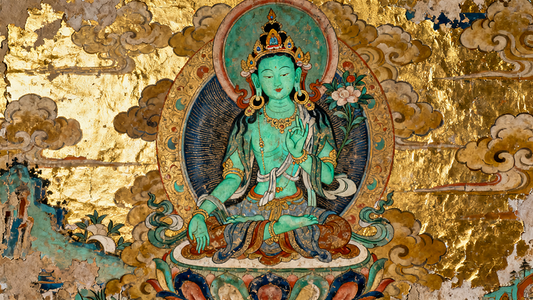
 In the brilliant galaxy of Tibetan Buddhism, the belief in Tara shines like a warm yet steadfast light, nourishing the souls of countless believers. As a compassionate symbol of delivering sentient beings from suffering, Tara manifests in numerous forms. Among them, Green Tara is renowned for her swift power to "relieve suffering and rescue the distressed," while White Tara, her counterpart, embodies the pure qualities of "wisdom and longevity," serving as a spiritual guide for people pursuing a fulfilling life. The bright radiance emanating from her body not only symbolizes the purification of afflictions but also contains profound insights into health, longevity, and wisdom. Particularly, the seven unique eyes on her body—like seven bright lamps—illuminate the illusions of the world and lead beings toward spiritual awakening and perfection. Today, let us delve into White Tara's spiritual world and explore the cultural connotations and contemporary value she embodies.
White Tara: The Pure Manifestation from Buddhist Scriptures
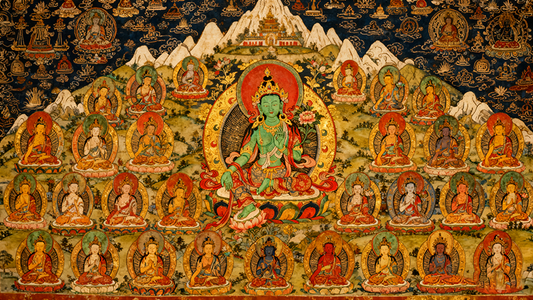
To understand the spiritual core of White Tara, we must first trace her origins in Buddhist scriptures. In numerous canonical texts such as The Origin of Tara and Hymns to the Twenty-One Taras, White Tara is recorded as an incarnation of Avalokiteshvara Bodhisattva's compassion and wisdom. When Avalokiteshvara witnessed sentient beings trapped in the cycle of samsara, enduring immense suffering, his tears fell to the earth and transformed into Tara, who manifests in various forms to deliver beings in different predicaments. White Tara, with her body as pure as a white lotus atop snow-capped mountains, is thus named "White." She is also one of the "Three Deities of Longevity" (the other two being Amitayus Buddha and Ushnishavijaya Buddha), specifically tasked with safeguarding sentient beings' health and lifespan.
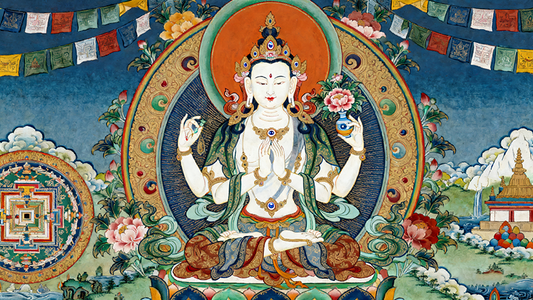
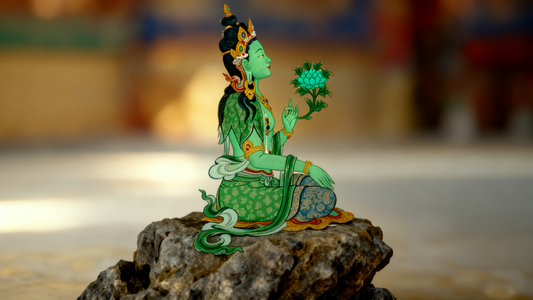
In Tibetan Buddhist art, White Tara has a highly recognizable image: she sits serenely on a lotus throne. The lotus symbolizes the pure nature of "remaining unstained amidst muddy waters," representing the ability to maintain a pure mind even when surrounded by the afflictions of samsara. Adorned with a five-Buddha crown, celestial robes, and precious ornaments, these majestic adornments are not mere decorations but symbols of her perfect virtues. The five-Buddha crown represents the wisdom and compassion of the Five Dhyani Buddhas, while the celestial robes and ornaments symbolize her vow to protect sentient beings through her meritorious power. Most notably, she has seven eyes—one on her forehead, one in each palm, and one on each sole of her feet. This unique feature is a symbol of her wisdom to "see all things clearly" and serves as the key to interpreting her spiritual connotations.
Unlike Green Tara's "dynamic deliverance," White Tara embodies a more "static compassion." If Green Tara is a guardian who "responds instantly" when sentient beings face urgent hardships, White Tara is a companion who provides "sustained protection" throughout the long journey of life. Her compassion, like melting snow water from mountain peaks, is continuous and nourishing, permeating every aspect of life—health, longevity, and karmic purification—providing people with unwavering spiritual strength. This quality has allowed the belief in White Tara to transcend mere religious boundaries, evolving into a pursuit of quality of life and a yearning for spiritual purity.
Seven Eyes Illuminating: White Tara's Wisdom Code
In White Tara's symbolic system, the "seven eyes" are undoubtedly the core symbol. These seven eyes—one on the forehead, one in each palm, and one on each sole—collectively form the wisdom imagery of "all-encompassing vision." From the perspective of Buddhist doctrine, the number "seven" is not merely a numerical value but a symbol of perfection. In Tibetan Buddhism, seven represents many perfect concepts such as the Seven Buddhas, the Seven-Limb Offering, and the Seven-Tiered Jeweled Pavilion. White Tara's seven eyes are the concrete embodiment of this "perfect wisdom."
The eye on her forehead is the "wisdom eye that perceives essence." This eye symbolizes White Tara's ability to transcend appearances and see the true nature and reality of all things. In a complex world, people are often bewitched by desires and afflictions, like wandering in a dense fog, unable to discern the direction of life. The eye on White Tara's forehead is the light that guides people to dispel the fog of "ignorance," enabling us to penetrate external temptations and distractions when making choices and connect with our inner true needs. This wisdom is not an innate talent but an "awareness" gained through practice and reflection—awareness of our own thoughts and intentions, and awareness of the karmic connections between things, thereby allowing us to make choices aligned with our true nature.
The eyes in her palms are the "action eyes that practice compassion." If the forehead eye represents "knowledge," then the palm eyes represent "action." These two eyes symbolize that White Tara's wisdom is not empty talk but is manifested in concrete compassionate actions. Our hands are tools for creating value and helping others, and the eyes in the palms remind us that every gesture and movement should be rooted in kindness and awareness. Whether it is caring for family, helping friends, engaging in public welfare, or serving society, these actions should stem from inner compassion rather than external utilitarianism. Just as White Tara uses her hands to bear the sufferings of sentient beings, we should also practice kindness with "hands that see," turning every action into a process of purifying the mind and accumulating virtuous karma.
The eyes on the soles of her feet are the "steadfast eyes that take root in the earth." These eyes symbolize that White Tara's wisdom and compassion can be "grounded," penetrating into every subtle aspect of life. Our feet support our bodies and sustain our journey through life; the eyes on the soles remind us that no matter how far we go, we must maintain reverence for life and focus on the present moment. In the fast-paced modern life, people often fall into anxiety about the future or regret over the past, neglecting the existence of the present. The eyes on White Tara's soles are an enlightenment guiding us to "live in the present"—to be down-to-earth, cherish every moment, and perceive the beauty and meaning of life in the ordinary. This "rooted" wisdom is our foundation for coping with life's storms and the psychological basis for achieving longevity and health.
As a whole, White Tara's seven eyes form a complete wisdom system of "knowing, acting, and abiding": the forehead eye clarifies the "knowledge" of essence, the palm eyes practice the "action" of compassion, and the sole eyes stabilize the "abiding" in the present. These seven eyes work together, illuminating both the external world and the inner mind, allowing us to see the truth clearly while acting with kindness and standing firm with focus, ultimately achieving spiritual awakening and life perfection. This wisdom is not only applicable to religious practice but also provides important guidance for modern life—in the era of information explosion, we need the "forehead eye" to distinguish truth from falsehood; in a society with complex interpersonal relationships, we need the "palm eyes" to convey kindness; in a life full of uncertainties, we need the "sole eyes" to abide in the present.

Health and Longevity: White Tara's Blessing for Life
As one of the "Three Deities of Longevity," White Tara's connection with health and
longevity is her most well-known trait. However, in Buddhist doctrine, the "longevity" guarded by White Tara is not merely "living a long life" but "longevity with quality"—a life free from physical suffering and mental afflictions, filled with meaning and value. This understanding of longevity coincides with the modern concept of "physical and mental health," endowing White Tara's life blessings with timeless significance.
On the physical level, White Tara's trait of "karmic purification" is closely linked to health. Buddhism holds that physical suffering is often related to past "karmic obstacles"—which can be understood not as mysterious fatalism but as "negative physical and mental habits." For example, prolonged anxiety can lead to endocrine disorders, and poor living habits can damage physical health. White Tara symbolizes "karmic purification," which means eliminating these negative physical and mental habits through awareness and correction to attain physical health. In the practice tradition of Tibetan Buddhism, people recite White Tara's mantra and visualize her image to adjust their mindset, alleviate negative emotions such as anxiety and fear. This psychological regulation often exerts a positive impact on the body. Modern psychological research also confirms that a positive mental state can enhance immunity and promote the body's self-repair, which is consistent with White Tara's concept of "attaining health through karmic purification."
On the mental level, White Tara's "wisdom" is the core support for longevity. Even if a person has a strong body, a life filled with mental afflictions and pain cannot be considered truly happy. What White Tara bestows is "mental longevity"—through the awakening of wisdom, one transcends the bondage of afflictions and maintains a youthful and vibrant mind regardless of age. In Tibet, many elderly people who practice devotion to White Tara remain energetic and peaceful-minded even in their advanced years, which is the vitality brought by mental health. This mental longevity stems from a profound understanding of life's essence: recognizing that life is a natural process, not clinging to the illusion of "eternal youth" nor fearing the arrival of "death," but cherishing every moment and allowing life to bloom with its due radiance at every stage.
White Tara's blessings for health and longevity also contain the wisdom of "balance." Her image is dignified yet gentle, neither aggressive nor timid—a balanced quality that lies at the core of health. Physical health requires the balance of yin and yang and the harmony of qi and blood, while mental health requires emotional balance and a peaceful mindset. In modern life, people often fall into an unbalanced state of "excessive pursuit"—overworking leads to physical exhaustion, and excessive anxiety leads to mental breakdown. White Tara's presence reminds us to find the balance in life: to work hard while knowing how to rest, to pursue goals while accepting the process, and to care for ourselves while being considerate of others. This wisdom of balance is the key to achieving physical and mental health and a long life.
Karmic Purification and Wisdom: White Tara's Spiritual Guidance
If health and longevity are the "external guarantees" that White Tara bestows upon life, then karmic purification and wisdom are the "inner core" she endows upon the mind. "Karmic purification" and "wisdom" are complementary concepts: karmic purification is the removal of "dust" from the mind, while wisdom is the "light" that illuminates the mind. Only when the dust is removed can the light shine into the mind; and with the guidance of the light, the dust can be eliminated more thoroughly. As a symbol of "karmic purification" and "wisdom," White Tara provides a clear path for our spiritual practice.
"Karmic purification" is not simply "atonement" but "self-purification and growth." In Buddhist doctrine, "karma" refers to all conscious actions, words, and thoughts; "karmic purification" means restoring the mind to purity by correcting these actions, words, and thoughts. The core of "karmic purification" symbolized by White Tara lies in "awareness"—just as her seven eyes see all things, we need to use "self-awareness" as a tool to distinguish which of our thoughts and intentions are negative and harmful, and which are positive and beneficial. For example, when we feel negative emotions such as jealousy or anger, we can promptly become aware of their existence, understand that they will harm both ourselves and others, and actively adjust our mindset to replace them with tolerance and understanding. When we have selfish or greedy thoughts, we can recognize their narrowness and actively cultivate the spirit of altruism and dedication. This continuous process of self-awareness and correction is the process of "karmic purification" and the path of spiritual growth.
Wisdom, on the other hand, serves as the "navigation system" in the process of karmic
purification. White Tara's wisdom is not mere book knowledge but "Prajna wisdom"—the wisdom of "emptiness." Here, "emptiness" does not mean "nothingness" but "non-attachment": understanding that all things are the result of the combination of causes and conditions, without an eternal and unchanging self-nature, thus not clinging to external gains and losses, success and failure, honor and disgrace. This wisdom helps us avoid complacency in times of good fortune and despair in times of adversity. For instance, when we achieve success in our careers, we can recognize that it is the result of various factors—our own efforts, the help of others, and the opportunities of the times—and not attribute all the credit to ourselves, thus maintaining humility. When we encounter setbacks, we can understand that they are temporary and an inevitable part of growth, and not deny ourselves because of them, thus maintaining resilience. This wisdom of non-attachment is the key to escaping afflictions and the ultimate goal of karmic purification.
The guidance of "karmic purification" and "wisdom" is particularly important in modern life. We live in an era full of temptations; material desires, the evaluations of others, and social pressures often make our minds impetuous and anxious. At such times, White Tara's wisdom of "karmic purification" reminds us to learn to "look inward"—not to be disturbed by external hustle and bustle, to focus on our inner world, and to eliminate the negative mindsets that cause afflictions. Her "Prajna wisdom" tells us to learn to "let go"—not to cling to things beyond our control, not to be bound by past regrets or future anxieties, to live in the present, and to enjoy the true essence of life. This spiritual guidance helps us maintain a clear mind in a complex world and a peaceful mindset in an impetuous society, thereby attaining true spiritual freedom.
Contemporary Value: The Practical Significance of White Tara Belief
In today's era, characterized by advanced technology, abundant material wealth, and growing spiritual confusion, the cultural connotations and spiritual wisdom embodied by White Tara still hold great practical significance. Her belief has long transcended religious boundaries, becoming a universal spiritual pursuit—the yearning for compassion, the desire for wisdom, and the expectation of health and longevity are all common life needs of humanity.
For ordinary people, White Tara's "seven-eyed wisdom" can be transformed into practical life wisdom: using the "forehead eye" to maintain clear cognition and not be misled by online rumors or consumerism; using the "palm eyes" to practice kindness, fulfilling duties at work, caring for family in daily life, and spreading warmth in society; using the "sole eyes" to abide in the present, not indulging in past glories or regrets, not being anxious about the unknown or challenges of the future, and focusing on doing every task well in the moment. This wisdom helps us find balance in a fast-paced life and maintain our true nature in a complex world.
For those pursuing physical and mental health, the concept of "karmic purification and health" embodied by White Tara provides important insights: health is not merely the absence of disease but the harmony of body and mind. We can attain true health by adjusting our mindset (purifying the mind), cultivating good living habits (purifying the body), and building positive interpersonal relationships (purifying karma). For example, spending a little time each day meditating to calm the mind like visualizing White Tara, maintaining physical vitality through regular exercise, and proactively communicating with family and friends to convey kindness and care—these are all modern practices of "attaining health through karmic purification."
For those pursuing spiritual growth, White Tara's "compassion and wisdom" are eternal spiritual guides. Compassion is not weakness but the courage to "understand others' pain and be willing to help." Wisdom is not indifference but the clarity to "see the essence of things and still love life." On the path of spiritual growth, we can take White Tara as a role model, cultivating our awareness (wisdom) while practicing kindness (compassion), allowing our minds to grow continuously in purification and move toward perfection in growth.

Conclusion: Let the Pure Light Illuminate the Path of Life
White Tara, this pure manifestation symbolizing wisdom, longevity, karmic purification, and compassion, has long transcended the realm of religious symbols, becoming a pursuit of life perfection and a yearning for spiritual awakening. Her seven eyes illuminate not only the illusions of the world but also the light within our hearts; her pure radiance warms not only
the souls of believers but also every life longing for health, wisdom, and happiness.
In this era full of opportunities and challenges, we may not be able to practice in seclusion all day like ancient practitioners, but we can integrate White Tara's wisdom into every moment of daily life: using the eyes of wisdom to distinguish right from wrong, using compassionate hands to help others, and using a pure mind to perceive life. When we can do this, we will realize that the pure light represented by White Tara has long been ignited in our hearts—it makes our bodies healthier, our minds freer, and our lives longer, enabling us to maintain clarity and determination on the journey of life and bloom with our own unique brilliance.
May White Tara's wisdom and compassion bless every person pursuing life perfection, and may the pure light illuminate every step of our journey forward.
Etiquetas: