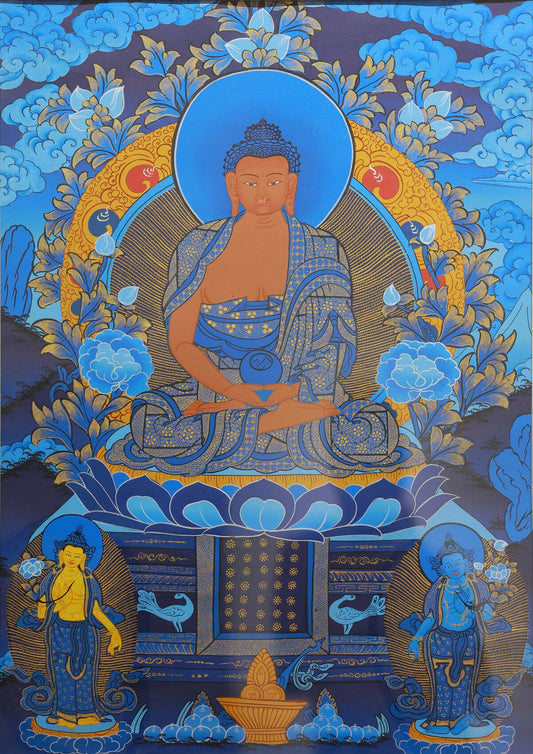
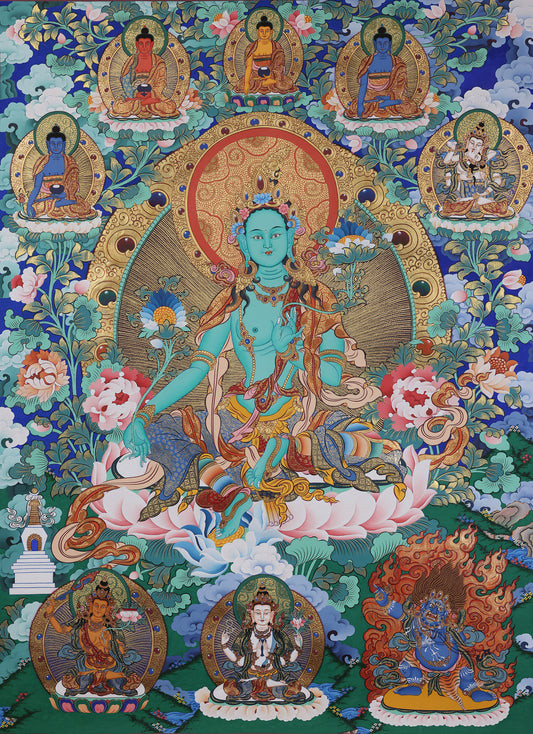
When a vividly colored Tibetan Thangka unfolds before your eyes—Shakyamuni Buddha sits on a lotus throne at the center, his eyes lowered in a gentle smile, with a halo and clouds interwoven behind him—this is no ordinary painting. It is a visual scripture of the "Root Guru Buddha" in the Tibetan Buddhist belief system. In Tibet, Shakyamuni is not only the founder of Buddhism but also a spiritual hub connecting the secular world and enlightenment. His image and teachings permeate the fabric of Thangkas, festivals, practice, and even daily life.
Tibetan Buddhist Thangka art is known as a "mobile temple," and Shakyamuni’s iconography is the "grammatical core" of this visual language. Taking this colored Thangka as an example, every detail is an annotation of his identity as the "Enlightened One":
The Buddha’s body bears the "golden hue" (representing perfect enlightenment in Tibetan Buddhism), with long 耳垂 (symbolizing the abandonment of royal luxury), a raised ushnisha (cranial protuberance, signifying the perfection of wisdom), and a hidden urna (cranial protuberance, signifying transcendent insight) between his eyebrows. These "Thirty-Two Major Marks of a Great Man" are not artistic exaggerations but doctrinal norms derived from the Long Discourses (Dīgha Nikāya)—each feature is a mark of the Buddha’s "transcendence of the mundane."
In the Thangka, the Buddha’s right hand touches the earth and his left hand holds a bowl—a posture known as the Bhumisparsha Mudra (Earth-Touching Mudra): Legend has it that when the Buddha attained enlightenment, Māra (the tempter) tempted him with beauty and wealth to abandon his practice. The Buddha touched the earth with his right hand, summoning the Earth Goddess to witness his enlightenment. This mudra symbolizes "victory over afflictions" in Tibetan Buddhism and often appears in images of Shakyamuni’s enlightenment. The begging bowl held in his left hand represents his practice of simple living through alms-giving.
The Buddha sits on a "thousand-petal lotus throne"—the lotus, in Tibetan Buddhism, is a metaphor for "rising unsoiled from mud," symbolizing that mundane beings can transcend suffering through practice. The nimbus (head halo) and mandorla (body halo) behind him use red and gold as main hues: red corresponds to "compassion," gold to "perfection," and the scrollwork patterns on the halo’s edge are the Tibetan artistic visualization of the "eternal dharma realm."
The three small Buddhas above the Thangka (usually the Past, Present, and Future Buddhas) align with the Tibetan Buddhist cosmology of the "Three Buddhas of the Three Times"—as the "Present Buddha," Shakyamuni is the hub connecting the enlightened ones of the past and the teachers of the future.
In the Tibetan Buddhist system, Shakyamuni is revered as the "Root Guru" (fundamental teacher), and his status surpasses that of other Buddhas and Bodhisattvas. This is because he is not only a historical enlightened one but also the embodiment of the Dharma (teachings).
Although Tibetan Buddhism is characterized by esotericism, Shakyamuni is the foundation of the "unity of exoteric and esoteric teachings":
-
Exoteric Dimension: He is the speaker of scriptures such as the Prajñāpāramitā Sūtras and the Lotus Sūtra. The "Five Great Treatises" (e.g., the Abhisamayālaṅkāra) studied in Tibetan Buddhist monasteries are centered on his teachings, and monks must engage in debate to deeply understand his philosophy of "dependent origination and emptiness."
-
Esoteric Dimension: He is regarded as the nirmanakaya (manifestation body) of Vairocana (the Dharma Body Buddha). Many tantras (e.g., the Mahāvairocana Sūtra) take him as the fundamental transmitter, and practitioners align with the esoteric core of "one’s own mind is Buddha" by visualizing his image.
This "unity of exoteric and esoteric" positioning makes Shakyamuni both a "learnable teacher" and a "realizable essence."
After the suppression of Buddhism by Langdarma in the 8th century, Tibetan Buddhism entered the "Later Dissemination Period," and Shakyamuni’s image became a spiritual banner for revival:
- When the great translator Rinchen Zangpo retranslated scriptures, he took "Shakyamuni’s teachings" as orthodox, distinguishing between "old translations" and "new translations."
- After Atisha entered Tibet, he reformed the monastic community with "Shakyamuni’s teachings on the Bodhicitta" and established the practice sequence of "exoteric first, then esoteric."
Today, although Tibet’s major schools (Nyingma, Gelug, Sakya, etc.) have different lineages, all take "following Shakyamuni" as their practice tenet.
Tibetans’ belief in Shakyamuni is not confined to temples but integrated into the time and space of daily life.
The 4th month of the Tibetan calendar is called "Saga Dawa" (the month of the Dīrghā constellation), believed to be the month in which Shakyamuni was born, attained enlightenment, and entered nirvāṇa. During this month:
- The kora (circumambulation) crowds on Lhasa’s Barkhor Street last from dawn to late night. People hold prayer wheels and chant "Om Mani Padme Hum," commemorating the Buddha through circumambulation.
- Tibetans release cattle and sheep (marked with colored cloth as "sacred beings") and give alms to beggars, believing that merit from good deeds in this month is "multiplied ten thousandfold."
- Monasteries display Shakyamuni Thangkas and hold "Thangka Unfolding" ceremonies, allowing the public to receive "blessings" through visual contact.
This festival has even evolved into Tibet’s "spring-summer garden party," but its core of "honoring the Root Guru with good intentions" has never changed.
The 4th day of the 6th Tibetan month is "Zhubacixi Festival," commemorating Shakyamuni’s "First Turning of the Dharma Wheel" (first sermon) at Deer Park. On this day:
- Monks offer a "thousand offerings" (a thousand butter lamps, a thousand ritual items) to Shakyamuni’s image, recreating the sacred moment of his "turning the Dharma wheel."
- The public goes on lingkor (mountain circumambulation) to nearby sacred mountains and monasteries, simulating the "turning of the Dharma wheel" through physical movement and praying to attain the Buddha’s teaching wisdom.
In modern Tibet, Shakyamuni’s image still has strong vitality:
-
Artistic Inheritance: When young painters learn Thangka, their first work is often a Shakyamuni image. Its proportions must strictly follow the Iconometric Canon, which is both skill training and a practice of faith.
-
Spiritual Healing: In Lhasa’s teahouses, elders point to Shakyamuni Thangkas on the wall and say, "When you’re in trouble, look at his smile—you’ll know afflictions are temporary."
-
Cultural Symbol: His image appears in Tibetan architecture and clothing patterns, becoming a symbol of "compassion and wisdom" in Tibetan culture.
Shakyamuni in this colored Thangka is not a distant historical figure but the "enlightenment gene" of Tibetan Buddhism. He transmits symbols through images, ideas through scriptures, and warmth through festivals—ultimately becoming an "approachable enlightened one" in Tibetans’ hearts. Just as the colors of the Thangka remain vivid for centuries, Shakyamuni’s teachings have become a timeless spiritual light on Tibetan soil.
#TibetanBuddhism #Shakyamuni #ThangkaArt #SagaDawaFestival #TibetanCulture #RootGuruBuddha #TibetanBuddhistIconography #ThreeBuddhasOfTheThreeTimes #BhumisparshaMudra #ZhubacixiFestival #TibetanBuddhistTeachings #ThangkaSymbols #TibetanFestivals #ShakyamuniBelief #TibetanBuddhistArt