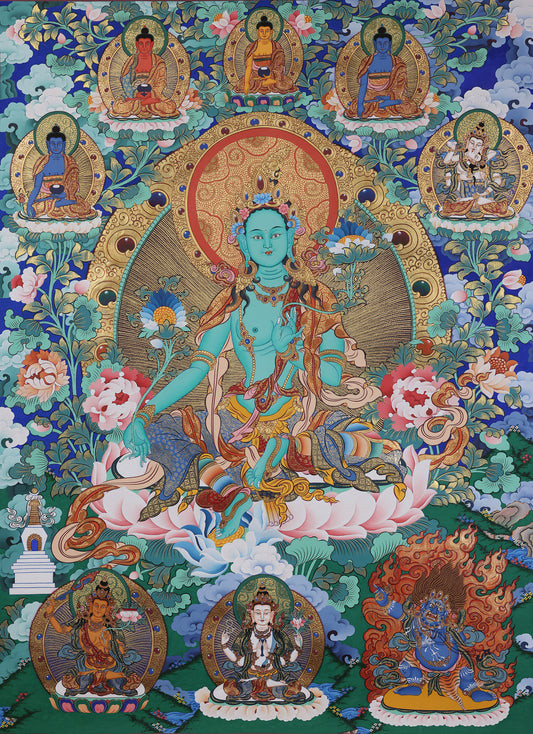
When a vibrant, intricately lined Tibetan thangka unfolds, the golden figure seated at its center immediately draws the eye: his right shoulder bare beneath a crimson monk’s robe, left hand cradling a kalasha (or medicine bottle, in the style of Bhaisajyaguru) filled with nectar, his halo and body aura glowing with warm gold—this is the being Tibetan Buddhists revere as "Guru Shakyamuni."
Yet in the Tibetan Buddhist framework, he is far more than the "6th-century BCE prince of Kapilavastu" of historical texts. From thangka compositions to daily rituals, from mandala symbolism to the philosophy of tulku reincarnation, Shakyamuni Buddha is the central hub that weaves together the worldview of Tibetan Buddhism.
In the opening thangka, the central main figure is the Nirmanakaya (Emanation Body) Shakyamuni—the "manifestation body" that appeared as Prince Siddhartha Gautama, attained enlightenment in Bodh Gaya, turned the first Dharma wheel in Sarnath, and entered nirvana in Kushinagar. The six figures surrounding him (making seven total) are the "Seven Buddhas of the Past" commonly venerated in Tibetan Buddhism: Vipashyin, Shikhin, Vishvabhu, Krakuchchanda, Kanakamuni, Kashyapa, and Shakyamuni himself, together forming the "Seven Buddhas of the Bhadrakalpa."
In the iconographic logic of Tibetan thangkas, this arrangement is not a "side-by-side display" but a reflection of Shakyamuni’s continuity: he is the fourth Buddha to attain enlightenment in the Bhadrakalpa and the "Guru" who reveals the path to liberation for sentient beings in the Sahā world. Each Buddha’s body color and attributes follow strict ritual rules: the green figure on the left, for example, is Krakuchchanda Buddha, the red figure on the right is Kanakamuni Buddha, and the central golden figure is the standard hue of the Nirmanakaya—this is Tibetan Buddhism’s visual expression of "the Buddha manifesting in different forms to guide sentient beings of varying capacities."
While Han Buddhism often emphasizes Shakyamuni’s identity as the "historical Buddha," Tibetan Buddhism focuses more on the philosophy of his "three bodies," which is the core of understanding Shakyamuni in the Tibetan context:
This is the golden figure at the center of the thangka—the form that was born as Prince Siddhartha, attained enlightenment, taught the Dharma, and entered nirvana. Tibetan Buddhism holds that this is Shakyamuni’s manifestation for the "stubborn and difficult-to-liberate" sentient beings of the Sahā world, demonstrating the process of "transcending the mundane to become sacred" so that sentient beings may believe liberation is attainable.
In Tibet, during the Saga Dawa Festival (commemorating Shakyamuni’s birth, enlightenment, and nirvana), believers circumambulate Jokhang Temple and the Potala Palace, spinning prayer wheels and chanting the Shakyamuni mantra (Om Muni Muni Mahamuni Ye Soha)—a tribute and devotion to the Nirmanakaya.
Tibetan Buddhist scriptures like the Avatamsaka Sutra describe Shakyamuni’s Sambhogakaya as residing in the "Vairocana World," with a perfect, infinitely luminous form visible only to bodhisattvas who have reached the bhūmi stages. Unlike the Nirmanakaya, which experiences birth, old age, sickness, and death, the Sambhogakaya is the "eternal teacher of sacred beings"—an embodiment of the Buddha’s "perfect self-benefit."
In Tibetan thangka depictions of "pure lands," the Sambhogakaya Shakyamuni often appears with brighter hues, more elaborate adornments, and surrounded by countless bodhisattvas and dakinis. This iconography is not "fictional" but a concretization of Tibetan Buddhism’s vision of enlightenment: the Buddha’s awakening is not merely freedom from suffering, but the perfection of merit and wisdom.
In Tibetan Buddhism, Shakyamuni’s Dharmakaya is not a physical form but "the empty and luminous essence of all phenomena." The Diamond Sutra’s line, "When one sees that all forms are not forms, one sees the Tathagata," is an explanation of the Dharmakaya. In Tibetan Mahamudra and Dzogchen teachings, the Dharmakaya is "the Buddha-nature inherent in all sentient beings"—Shakyamuni’s enlightenment, in essence, was the realization of his own inherent Dharmakaya.
This is the root of Tibetan Buddhism’s concept of "attaining Buddhahood in this lifetime": believers do not "beg for the Buddha’s protection from outside" but cultivate to reveal their own inherent Buddha-nature. Here, Shakyamuni is both a "model of enlightenment" and the "potential within every sentient being."
In the Tibetan Buddhist practice system, Shakyamuni Buddha is the most foundational and central object of cultivation:
Whether in the Bhaisajyaguru mandala, Manjushri mandala, or Sukhavati mandala, Shakyamuni Buddha often occupies a 尊贵 position (central or beside the main figure). The mandala symbolizes the "cosmic order" of Tibetan Buddhism, and Shakyamuni’s placement represents his role as the hub connecting the mundane and the sacred, sentient beings and enlightenment.
In the Kalachakra mandala, for example, Shakyamuni represents the "Buddha of the Past," alongside the present Kalachakra and the future Manjushri to form the "Three Buddhas of the Three Times," conveying the "eternity of time and enlightenment."
Tibetan monks, nuns, and lay believers often include "praises to Shakyamuni," "recitation of the Shakyamuni mantra," and the "Seven-Limbed Offering" (confession, rejoicing, requesting the turning of the Dharma wheel, etc., to Shakyamuni and other Buddhas) in their daily practice. In the Gelug school’s Lamrim Chenmo (Great Treatise on the Stages of the Path to Enlightenment), the central figure in the "refuge tree" visualization is Shakyamuni Buddha, surrounded by Manjushri, Chenrezig (Avalokiteshvara), Tsongkhapa, and other saints—this integrates devotion to Shakyamuni with the cultivation of bodhicitta.
In Tibetan Buddhism, thangkas are not mere "artworks" but "objects of visualization." When venerating a Shakyamuni thangka, believers first offer water and butter sculptures, then visualize the thangka’s Shakyamuni "dissolving from form into emptiness, then manifesting from emptiness, merging with their own Buddha-nature"—this is a practice that transforms the "external Buddha" into "internal enlightenment."
In Tibet, Shakyamuni’s influence extends far beyond religion, becoming part of daily life and culture:
The Jowo Shakyamuni (12-year-old emanation statue) enshrined in Jokhang Temple’s main hall is one of Tibet’s most sacred images—brought to Tibet by Princess Wencheng during the reign of Songtsen Gampo, it has been the spiritual center of Tibetan believers for over a millennium. Every Tibetan New Year, countless believers travel from Qinghai, Sichuan, Yunnan, and other regions to offer a khata before the Jowo Shakyamuni.
The "Shes rab sgo gsum" hall in the Potala Palace also houses a silver statue of Shakyamuni, surrounded by the stupas of successive Dalai Lamas—this binds "the Buddha’s enlightenment" to "the continuity of the tulku lineage," conveying the belief in "unbroken Dharma transmission."
In Tibet’s Epic of King Gesar, Gesar is described as "Shakyamuni Buddha’s emanation to guide 雪域 sentient beings"; the Tibetan opera Princess Wencheng includes scenes of "the Shakyamuni statue bringing peace and well-being." In art forms like thangkas, appliqué, and butter sculptures, Shakyamuni’s image remains the most classic subject—every detail of color, line, and attribute is a tribute to the "spirit of enlightenment."
When we gaze at Shakyamuni in this thangka, we see more than a Buddha image—we see Tibetan Buddhism’s reflection on the "essence of life": suffering can be transcended, perfection can be achieved, and every sentient being inherently possesses the potential for enlightenment.
On Tibet’s circumambulation paths, in the chants of monastic practice, and in the colors of thangkas, Shakyamuni is never far—he is the Guru, the Model, and the inner light of every sentient being.
#TibetanBuddhism #Shakyamuni #ThangkaCulture #BuddhistThreeBodies #TibetanDevotion