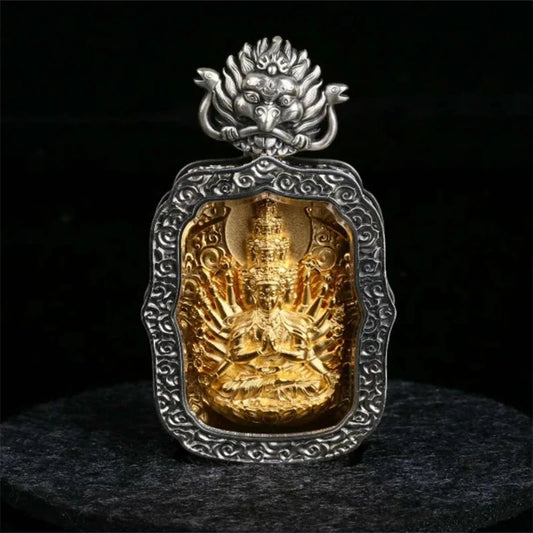
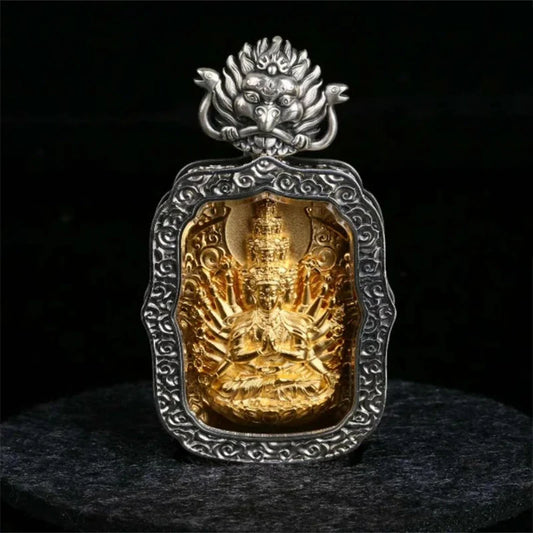
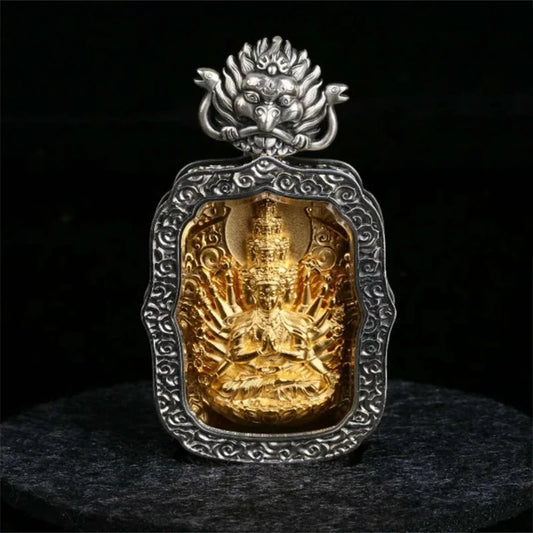
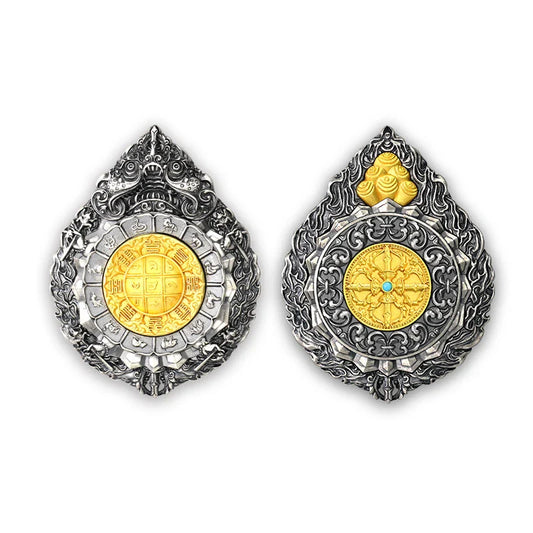
The Green Tara in Silver Thangka: The Goddess of Compassion in Tibetan Buddhism, a Spiritual Guardian Across Millennia

When a Green Tara thangka embroidered with silver threads unfolds, your gaze is first captured by that calm shade of "green"—not the bright green of the secular world, but a "Tara green" with the luster of 酥油 (butter tea), like a plateau lake. In the spiritual universe of Tibetan Buddhism, this color itself is the embodiment of "compassion."
Green Tara’s image is ever-present beside prayer wheels in Tibetan areas, on altars in temples, and even in herders’ tents. She is one of the most revered female Buddhas and Bodhisattvas in Tibetan Buddhism, known as the "Tara Who Saves from Eight Calamities" and "Swift and Courageous Mother." Every pattern on that silver thangka is a code for her compassionate power.
I. Green Tara: From "Guanyin’s Tear" to "Buddha of Saving Suffering"
In the scriptures of Tibetan Buddhism, Green Tara’s birth carries a sacred, compassionate origin.
According to The Origin of Tara, Green Tara was manifested from a tear shed from the left eye of Avalokiteshvara (Guanyin). When Guanyin looked down at the suffering of the world, a tear of compassion fell to the earth and transformed into Green Tara. She is the "concrete avatar" of Guanyin’s compassion, hence also called "Guanyin’s Right Eye," bearing the vow of "swiftly saving suffering." In Tibetan belief, reciting the Green Tara Mantra ("Om Tare Tuttare Ture Soha") will prompt Green Tara to respond to prayers at the fastest speed, delivering sentient beings from the "Eight Calamities": lion, elephant, fire, snake, water, imprisonment, theft, and non-human threats.
This "swift compassion" has made Green Tara one of the most approachable 本尊 (yidam) in Tibetan areas: herders offer a butter lamp to Green Tara before traveling; mothers give their children Green Tara amulets; even in blizzards on the plateau, believers reciting the mantra believe Green Tara is approaching as the warm air in the wind.
II. Symbols in the Silver Thangka: Green Tara’s "Language of Compassion"
Every detail of Green Tara in the silver thangka is a "symbolic code" of Tibetan Buddhism. To understand these symbols is to touch her spiritual core.
1. Body Color and Posture: Strength in Calm
Her body is "emerald green"—in the color system of Tibetan Buddhism, green corresponds to "pacifying disasters," representing the calming of suffering and healing of pain. Her posture is the "half-lotus position" (one leg crossed, one leg slightly bent), different from the full lotus position of Buddhas. This posture is called the "liberated position," symbolizing "being ready to rise and deliver sentient beings at any time": she is not a figure 高居 on an altar, but a "companion" always prepared to respond to prayers.
2. Implements and Mudras: Every Gesture is a "Vow"
In the silver thangka, Green Tara’s right hand forms the "Fearless Mudra" (palm facing outward), a signature gesture of Buddhas and Bodhisattvas to "grant sentient beings peace and fearlessness." Her left hand gently holds an utpala (lotus), with the stem extending to her shoulder. The utpala symbolizes "purity" in Tibetan Buddhism, and it bears three flowers: one in bud, one half-bloomed, one fully open—corresponding to "past, present, future," signifying that Green Tara’s compassion covers sentient beings across the three times.
3. The "Silver" of the Thangka: A Material Carrier of Faith
This thangka is a "silver thangka"—with a silver-thread base, painted with mineral pigments. In Tibetan areas, silver thangkas themselves embody "precious faith": the purity of silver corresponds to Tara’s compassion, while the durability of mineral pigments symbolizes that her vows "endure through time." The five Buddhas above the thangka (usually five of the Seven Past Buddhas) represent that Green Tara’s compassion is an "extension of the Buddha’s teachings," and her power originates from the Buddha’s wisdom.
III. Green Tara: A "Female Spiritual Totem" of Tibet
In a religious system dominated by male deities, Green Tara’s presence is a vital pillar of the spiritual world of Tibetan women.
She is not a "fragile goddess" but a "female protector" with both compassion and strength: in the Tibetan epic The Epic of King Gesar, Green Tara repeatedly incarnates as a female hero to help King Gesar defeat evil; in folk tales, she is the "Tara Who Brings Children" who saves mothers in difficult labor, and the "Tara of Wisdom" who protects girls’ growth.
This projection of "female power" elevates Green Tara beyond a religious symbol—she is a "spiritual mirror" for Tibetan women: possessing the softness to embrace all suffering, and the courage to face adversity. Even today, young girls in Lhasa’s Barkhor Street still wear Green Tara pendants, saying: "When I see her, I feel I can be as gentle and strong as she is."
IV. From Thangka to the Present: The "Compassionate Modernity" of Green Tara
As modern people grapple with anxiety and exhaustion, Green Tara’s "compassion" is entering life in new ways.
Some find calm in reciting the Green Tara Mantra—not as a religious "prayer," but in the repetitive syllables, finding a rhythm to converse with their inner selves. Others interpret the "Eight Calamities" of Green Tara as "courage to cope with life’s difficulties": her "Eight Calamities" correspond to modern people’s "workplace anxiety, relationship troubles, emotional exhaustion," and her "swift salvation" actually tells people: "You already have the power to overcome suffering."
The Green Tara in that silver thangka may now hang in a city study—her green is no longer exclusive to the plateau, but has become an "oxygen tank" for modern souls: in the fast pace of life, that calm green reminds people that compassion starts with being gentle to oneself.
When you see Green Tara’s image again, there’s no need to fixate on religious definitions—she is a thangka, a mantra, the wind of Tibet, and the little bit of "refusal to give up gentleness" in our hearts. After all, compassion is never a doctrine far on an altar, but a warmth that every ordinary person can hold when facing the world.
#GreenTara #TibetanBuddhism #ThangkaArt #GoddessOfCompassion #TibetanBelief #FemaleSpirit #SpiritualHealing #ReligiousSymbol #SilverThangka #BuddhistCulture
Tags:
Previous
The Dragon Mandala in Tibetan Buddhism: A Three-Dimensional Poem of Divine Oracle and Cosmos
Next
Manjushri in Tibetan Buddhism: The Deity of Wisdom in Black-Gold Thangka Art