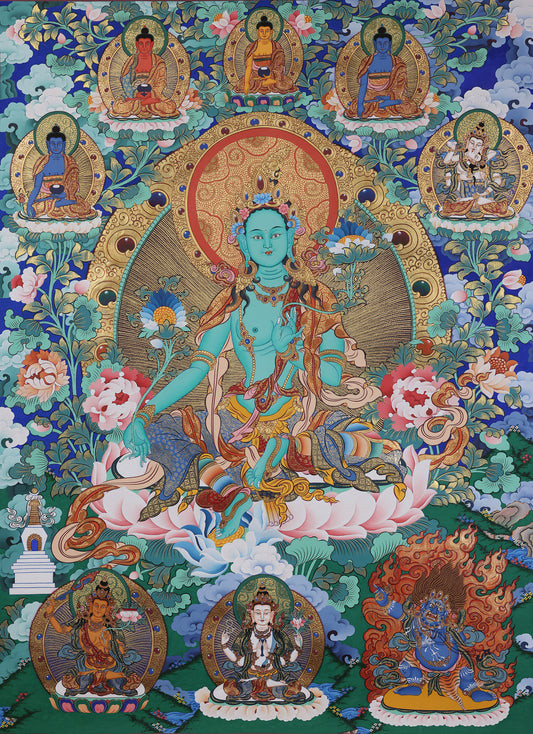

When a four-armed Manjushri thangka—rendered on a pure black background with 24K gold lines—unfolds before you, you’re not just seeing the craftsmanship of a Regong painter. The gilded lines outlining the five-jeweled crown, the flame-wreathed Prajna sword, and the Sanskrit sutra scroll resting on a lotus petal are, in fact, the most tangible totem of "wisdom" in the Tibetan Buddhist cosmos. In Tibet’s spiritual universe, Manjushri (known as Jampelyang in Tibetan) was never merely a deity—he is the "essence of wisdom" that pierces ignorance, the key linking the mundane to enlightenment.
I. Decoding Manjushri Through Black-Gold Thangka: Esoteric Symbols in Form
The yellow-bodied four-armed Manjushri thangka before you is the central form of the "Five Forms of Manjushri" in Tibetan Buddhism. Its black-gold base is no decorative gimmick: in esoteric teachings, black symbolizes "the emptiness that dispels ignorance," while gold represents "the unchanging light of wisdom." Their collision is precisely the metaphor of Manjushri "cutting through afflictions with the sword of emptiness."
In the Tibetan iconographic system, every detail of Manjushri embodies doctrinal meaning:
- Five-jeweled crown: The five topknots correspond to the "five wisdoms of the Five Dhyani Buddhas" (dharmadhatu wisdom, mirror-like wisdom, equality wisdom, discriminating wisdom, and accomplishment wisdom), signifying that Manjushri is the synthesis of all Buddhas’ wisdom.
- Four-armed attributes: The Prajna flame sword in the upper right hand is the ritual tool for "severing delusion"; the arrow (right lower) and bow (left upper) symbolize "penetrating confusion with wisdom"; the Prajna sutra scroll held in the left lower hand represents "the transmission of dharma."
- Yellow body color: Yellow corresponds to Vairocana Buddha (the central Buddha), symbolizing "the middle-path wisdom that illuminates all." The surrounding red, blue, white, and green forms of Manjushri are his manifestations to guide beings of different capacities (e.g., blue Manjushri governs "obstacle removal," while white Manjushri governs "mind purification").
This "one Buddha, many forms" design embodies Tibetan Buddhism’s principle of "skillful means for benefiting beings"—Manjushri is not a distant deity, but "wisdom itself" appearing in forms suited to sentient beings’ karmic conditions.
II. Manjushri in Tibetan Buddhism: From "Dharma Prince" to "Wisdom Yidam"
In Tibetan Buddhist lineage, Manjushri’s status transcends that of a mere "bodhisattva":
- Teacher of all Buddhas: The Avatamsaka Sutra calls him "the mother of all Buddhas of the three times, the teacher of all Tathagatas," meaning all Buddhas of the past, present, and future attained enlightenment through Manjushri’s wisdom.
- Core esoteric yidam: In the Garbhadhatu Mandala, Manjushri is the principal deity of the "Manjushri Court," with the esoteric title "Prajna Vajra." His wrathful form, Yamantaka (nine heads, thirty-four arms), is the most important "demon-subduing yidam" in the Gelug school, symbolizing "crushing the army of afflictions with the power of wisdom."
- Bridge between secular and sacred: Tibetans venerate Manjushri as the protector of scholarship, career, and eloquence—monks at Lhasa’s three great monasteries worship Manjushri before debating scriptures, while herders print his mantra on prayer flags to pray for increased wisdom.
This devotion reached its peak in the Qing Dynasty: Tibetan Buddhist lamas honored emperors like Kangxi and Qianlong as "incarnations of Manjushri," strengthening the legitimacy of 政教合一 (政教 unity) while embedding Manjushri devotion in every corner of secular life.
III. Black-Gold Thangka: More Than Art—A Practice Mandala
The black-gold thangka before you is no ordinary decorative painting. In Tibetan tradition, thangkas are "portable mandalas," and black-gold thangkas are among the most sacred:
- Blessed materials: Painters use white cotton as a base, dye with mineral pigments (e.g., lapis lazuli for blue, cinnabar for red), then outline lines with 24K gold leaf powder. Each gold line requires the painter to "visualize Manjushri’s wisdom infusing the work"—so this thangka is both art and a "vessel of wisdom."
- Layout of the Five Forms of Manjushri: With yellow Manjushri at the center, surrounded by red, blue, white, and green Manjushri and Buddhas above, the thangka forms a wisdom mandala. When practitioners gaze at it, they visualize themselves as Manjushri, thus "aligning their mind with Manjushri’s wisdom."
- Regong school heritage: This work comes from the Regong Nyima Tsering Painting Academy. Regong thangkas are renowned for their "sacred facial rendering": Manjushri’s face must take a childlike form—a 16-year-old appearance symbolizing "the purity of wisdom," while half-closed eyelids represent "compassionate observation of sentient beings."
For Tibetan believers, enshrining such a thangka is equivalent to "inviting Manjushri’s wisdom into the home." Daily offerings and visualization are dialogues with wisdom itself.
IV. Manjushri Practice: From Mantra to Ritual—Tibet’s Wisdom Cultivation Methods
In Tibetan Buddhism’s practical system, Manjushri’s teachings are central to "awakening prajna wisdom":
- Manjushri mantra: "Om Ah Ra Pa Tsa Na Dhih" is the most widely recited mantra. The syllable Dhih is the seed syllable of "wisdom"; when chanting, practitioners visualize "the mantra’s sound transforming into wisdom light, merging with their own mind."
- Manjushri rituals: Monks follow the Manjushri Nama Samgiti (True Name Sutra) ritual: first accumulating merit through the "Seven-Limbed Offering," then visualizing Manjushri descending from the sky to cut through their "greed, anger, and delusion" with the Prajna sword, and finally realizing "non-duality between one’s own mind and Manjushri’s wisdom."
- Festivals and observances: On the 4th day of the 4th Tibetan month (Manjushri’s birthday), Lhasa’s Jokhang Temple holds the "Manjushri Temple Procession"—monks and laypeople carry Manjushri thangkas around Barkhor Street, praying that "wisdom pervades the world."
This practice is not about "pursuing knowledge," but as Khenpo Sodargye puts it: "Manjushri’s wisdom is about seeing the illusion of the ‘self,’ thus liberating oneself from afflictions."
V. Manjushri in the Modern World: The Contemporary Resonance of Wisdom Devotion
Today, Manjushri devotion has spread beyond Tibet: Urbanites enshrine small Manjushri thangkas on desks to pray for academic or career success; business leaders study "Manjushri wisdom" to translate "dispelling delusion" into "rational decision-making"; even psychologists integrate Manjushri’s "mindful observation" into mindfulness therapy to help people free themselves from emotional distress.
The black-gold thangka before you is the bridge between tradition and modernity—it carries millennia of esoteric wisdom, yet allows modern people to briefly step away from chaos and touch "the essence of wisdom" when gazing at its gilded lines.
#TibetanBuddhism #Manjushri #BlackGoldThangka #FiveFormsOfManjushri #WisdomYidam #RegongThangka #BuddhistArt #ManjushriMantra #TantricPractice #TibetanCulture
Tags:
Previous
The Green Tara in Silver Thangka: The Goddess of Compassion in Tibetan Buddhism, a Spiritual Guardian Across Millennia
Next
The Compassion of the Snowlands in Thangka Art: The Four-Armed Chenrezig in Tibetan Buddhism – Belief, Symbolism, and Art