Nepalese Newari Four-Armed Avalokiteshvara Thangka: A Microcosmic Art Universe of Tibetan Compassion

$499.00 USD
Thangka Name: Cai Tang Four-Armed Guanyin
size: 20cm×30cm
origin: Nepal
Eine Frage stellen

Beeil dich! Nur noch [Anzahl] auf Lager!

Geschätzte Lieferzeiten: 12–26 Tage (International), 3–6 Tage (USA).

Rückgabe innerhalb von 45 Tagen nach dem Kauf. Zölle und Steuern werden nicht erstattet.

Hand-painted Tibetan Buddhist color thangka depicting Four-Armed Avalokiteshvara, symbol of compassion and mercy
Nepalese Newari Four-Armed Avalokiteshvara Thangka: A Microcosmic Art Universe of Tibetan Compassion
$499.00 USD
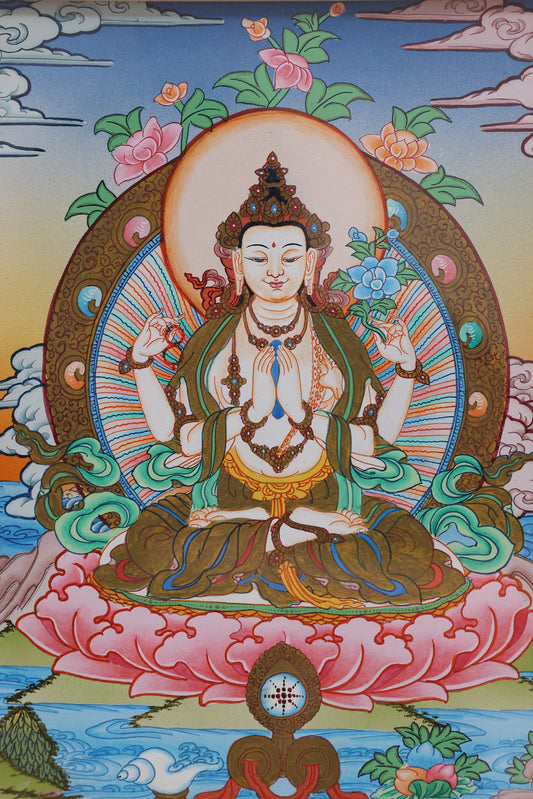
When you unfold this 20×30cm hand-painted Nepalese thangka, what rests in your palm is not just cotton cloth dyed with mineral pigments, but a microcosm where Tibetan Buddhist "compassion" faith intertwines with Himalayan artistic traditions. This Newari-style thangka, centered on the Four-Armed Avalokiteshvara, is both a vessel for religious visualization and a local interpretation of Tibetan ritual by Nepalese artisans.

I. Core Theme: Four-Armed Avalokiteshvara—The Embodiment of Himalayan Compassion

In the Tibetan Buddhist system, the Four-Armed Avalokiteshvara (Tibetan: Chenrezig) is a peaceful emanation of the Bodhisattva of Compassion, revered as the "Protector of Snowy Tibet." This thangka’s core theme is "Avalokiteshvara’s Compassionate Deliverance," belonging to the esoteric "Peaceful Deity" thangka category. Its iconography strictly follows the Iconometric Canon, while incorporating the soft aesthetic of Nepalese art.

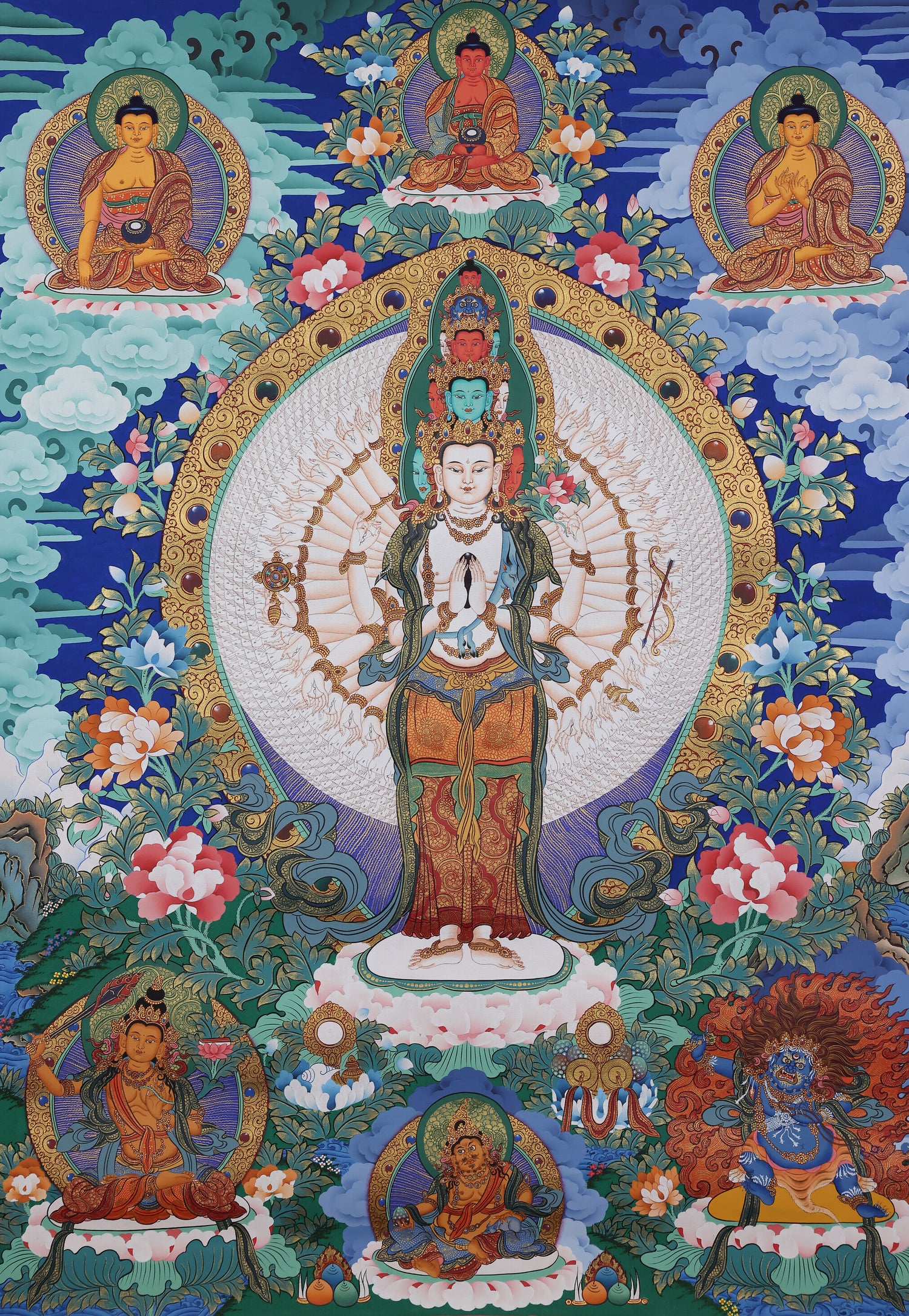
As the central deity of the "Three Protectors" (Avalokiteshvara, Manjushri, Vajrapani), every detail of the Four-Armed Avalokiteshvara carries esoteric meaning:

  • Body Color & Posture: The moon-white body symbolizes "innate purity, untainted by afflictive or cognitive obscurations." Seated in full lotus posture on a double lotus base, it represents "neither trapped in samsara nor detached from nirvana";
  • Four Hands & Implements: The central hands press palms together holding a wish-fulfilling jewel (union of wisdom and skillful means); the right rear hand holds a crystal rosary (each bead represents delivering one being from samsara); the left rear hand holds an eight-petaled white lotus (purity free from affliction);
  • Ornamentation Symbols: The five-Buddha crown represents "the wisdom of the five Dhyani Buddhas"; the Amitabha Buddha finial atop the crown signifies "Avalokiteshvara as the compassionate emanation of Amitabha"; the deer skin draped over the left shoulder symbolizes "freedom from samsara yet refusal to abandon sentient beings."

Unlike the solemnity of Tibetan thangkas, this work’s main deity bears a "Newari smile"—almond-shaped eyes drooping gently, lips soft-lined—translating divine compassion into a more humanly warm visual language.

II. Retinue Deities: Symbolic Ritual of the Three Protectors

Constrained by the 20×30cm size, this thangka does not use the detailed retinue figures common in Tibetan thangkas, but instead completes its ritual logic through symbolic configuration:

  • Explicit Symbols: Hidden within the background scrollwork are a "lotus branch" and "rosary string," corresponding to the implements of Manjushri (wisdom) and Vajrapani (power), respectively. These replace concrete forms with imagery, subtly referencing the "Three Protectors" ensemble;
  • Implicit Guardians: The "dharma wheel/wish-fulfilling jewel" motif at the base of the lotus seat implies the protection of Buddha-family retinue (such as Amitabha); the five-colored aura (red, blue, green, yellow, white) corresponds to the five Dhyani Buddhas, signifying "the convergence of all Buddhas’ compassion in Avalokiteshvara."

This simplification is not a compromise of skill, but a Newari micro-thangka tradition of "centralizing the main deity"—it functions as a portable visualization tool while maintaining ritual integrity within limited space.

III. Craftsmanship: The Millennium Color Code of Mineral Pigments

This thangka is painted with local Nepalese mineral and earth pigments, whose materials and processes are material expressions of traditional craftsmanship:

  • Pigment Preparation:
    • White is derived from lowland chalk, washed in three layers, with the top fine powder used for the deity’s face;
    • Blue is based on "Nepali blue" (azurite), mixed with lapis lazuli powder to deepen its richness;
    • Green is ground from a blend of malachite and turquoise, creating a clear, lake-like layered effect;
    • Gold uses "nine-hammered" gold leaf (0.12 microns thick), applied over a garlic juice base to outline robes, producing a "rainbow halo" effect.

      All pigments undergo "stone mortar rough crushing → granite millstone fine grinding → clay pot layered settling," with grinding taking up to 48 hours to ensure colors "endure for millennia without fading."
  • Canvas & Creation: Nepalese fine cotton cloth serves as the base, coated with a mixture of yak bone glue and barley flour, then repeatedly polished to a mirror finish. Creation follows the ritual order of "background first, foreground later; light colors first, dark colors later," culminating in the "eye-opening" with gold powder—a step accompanied by chanting, transforming the act of painting into a spiritual practice.

IV. Newari Style: The Transit Point of Himalayan Art

This work’s artistic language belongs to the Nepalese Newari School, distinct from Tibet’s Menri and Khyenri schools:

  • Composition: The main deity occupies 80% of the frame; background scrollwork is intricate but not distracting, lacking the landscape negative space of Tibetan thangkas—reflecting the tradition of "centering the main deity as the visual focus";
  • Color: Dominated by white, blue, and gold, accented with red to create high-contrast saturation; the "transparent layering" of mineral pigments gives the small size remarkable visual impact;
  • Lines & Form: Robes use "wave lines" to convey softness; jewelry employs the "double-line fill" technique; figures have balanced proportions and faces with Newari features, differing from the square facial structure of Tibetan thangkas.

Historically, Newari art is a "transit point" of Himalayan culture: 7th–9th century Newari artisans traveled to Tibet to build monasteries, infusing Tibetan iconography with Hindu "divine anthropomorphism"; today, this thangka is a reverse export, a micro-specimen of cultural fusion.

Conclusion: A Compassionate Universe in the Palm of Your Hand

This 20×30cm thangka exemplifies "great faith in a small frame"—it is both a tool for Tibetan esoteric visualization, a carrier of Newari aesthetic, and a material testament to cross-regional exchange in Himalayan civilization. When your fingertips glide over the gold-leaf outlined robes, you touch not just a painting, but a "compassionate universe" forged from millennia of faith and craftsmanship.

Would you like me to compile a Four-Armed Avalokiteshvara Thangka Visualization Guide to help you understand its religious practice function?

#NepaleseThangka #NewariArt #FourArmedAvalokiteshvara #TibetanBuddhistThangka #MineralPigmentThangka #MicroThangka #HimalayanArt

Entdecken Sie das perfekte tibetisch-buddhistische Thangka, das zu Ihren Wünschen, Ihrem Lebensstil und Ihrem Raum passt. Jedes Thangka hat eine spirituelle Bedeutung und bringt Segen, wenn es richtig platziert wird.

1. Definieren Sie Ihre Absicht

Reichtum & Erfolg → Gelber Dzambhala (Gottheit des Reichtums)

Mitgefühl und Frieden → Avalokiteshvara, Grüne Tara

Weisheit & Lernen → Manjushri

Gesundheit & Heilung → Medizinbuddha

Langlebigkeit und Familienschutz → Weiße Tara

2. Wählen Sie nach Identität

Unternehmer und Geschäftsinhaber → Reichtumsgottheiten für Wohlstand.

Studenten und Gelehrte → Weisheitsgottheiten für Konzentration und Klarheit.

Heiler und Yoga-Praktizierende → Medizinbuddha für Energie und Gleichgewicht.

Familien und Hausfrauen → Tara-Gottheiten für Harmonie und Sicherheit.

Sammler und Kunstliebhaber → Seltene Mandalas oder Meisterwerk-Thangkas.

3. Passen Sie Ihren Raum an

Heimschrein / Meditationsraum → Mittlere Thangkas (60–80 cm).

Büro / Geschäftshalle → Große Thangkas für Wohlstand und Autorität.

Wohnzimmer / Arbeitszimmer → Dekorative Thangkas für Frieden und Schönheit.

4. Authentische Handwerkskunst

Jedes Thangka ist mit natürlichen Mineralpigmenten und feiner Leinwand handbemalt und spiegelt tibetische Kunstfertigkeit und spirituelle Kraft wider. Überprüfte Quellen gewährleisten Qualität und Respekt für die Tradition.

✨ Wählen Sie Ihr Thangka mit Herz – es ist nicht nur Kunst, sondern ein Segen für Ihr Leben.

Jeder Mensch hat unterschiedliche Bedürfnisse. Die Wahl des richtigen Thangkas kann spirituelle Unterstützung, Schutz, Glück und Segen bieten. Nachfolgend finden Sie Thangka-Empfehlungen für verschiedene Rollen:

1. Unternehmer

  • Bedürfnisse : Weisheit, Reichtum, Gesundheit, beruflicher Erfolg.
  • Empfohlene Thangkas :
    Manjushri : Verbessert die Entscheidungsfindung und Geschäftsweisheit.
    Gottheit des Reichtums : Bringt Reichtum und Wohlstand.
    Medizinbuddha : Unterstützt die Gesundheit und reduziert Stress.
    Mahakala : Schützt Unternehmen vor Konkurrenz und Herausforderungen.

2. Erfolgreiche Einzelpersonen

  • Bedürfnisse : Innerer Frieden, Familienharmonie, Langlebigkeit.
  • Empfohlene Thangkas :
    Amitabha Buddha : Bringt inneren Frieden und Ruhe.
    Avalokiteshvara (Guanyin) : Fördert Harmonie und Glück in der Familie.
    Amitayus (Langlebens-Buddha) : Betet für gute Gesundheit und ein langes Leben.
    Manjushri : Stärkt weiterhin die Weisheit.

3. Hausfrauen/Ehemänner

  • Bedürfnisse : Familienharmonie, Schutz, Gesundheit.
  • Empfohlene Thangkas :
    Avalokiteshvara : Steigert das Familienglück und die Harmonie.
    Schutzgottheiten : Beschützen die Familie vor äußeren Störungen.
    Weiße Tara : Segnet die Familie mit Gesundheit.

4. Studierende und Wissenschaftler

  • Bedürfnisse : Weisheit, Konzentration, akademischer Erfolg.
  • Empfohlene Thangkas :
    Manjushri : Fördert Lernfähigkeit, Gedächtnis und Weisheit.
    Shakyamuni Buddha : Hilft bei der Konzentration und spirituellen Praxis.
    Jixiang Tianmu : Bringt akademisches Glück und Prüfungserfolg.

5. Künstler und Kreativprofis

  • Bedürfnisse : Inspiration, Kreativität, künstlerische Leistung.
  • Empfohlene Thangkas :
    Manjushri : Regt kreatives Denken und Inspiration an.
    Vajrapani : Hilft, kreative Blockaden zu überwinden.
    Maitreya : Sorgt für eine entspannte und optimistische Einstellung und baut Stress ab.

6. Reisende und Abenteurer

  • Bedürfnisse : Schutz, Glück, Erfolg bei Abenteuern.
  • Empfohlene Thangkas :
    Hayagriva : Bietet starken Schutz auf Reisen und beseitigt Hindernisse.
    Mahakala : Bringt Glück und Schutz, insbesondere für Abenteurer.
    Vajrasattva : Hilft, Schwierigkeiten und Herausforderungen während der Reise zu überwinden.

7. Ältere Menschen

  • Bedürfnisse : Gesundheit, Langlebigkeit, spiritueller Frieden.
  • Empfohlene Thangkas :
    Amitayus : Betet für ein langes Leben und gute Gesundheit.
    Medizinbuddha : Fördert Heilung und körperliches Wohlbefinden.
    Avalokiteshvara : Bringt Mitgefühl und inneren Frieden in späteren Jahren.

8. Führungskräfte

  • Bedürfnisse : Führung, Weisheit, Teamarbeit und geschäftlicher Erfolg.
  • Empfohlene Thangkas :
    Manjushri : Verbessert Führungsqualitäten und Entscheidungsfindung.
    Gottheit des Reichtums : Bringt dem Unternehmen und dem Team Erfolg und Wohlstand.
    Avalokiteshvara : Fördert Harmonie und Gleichgewicht innerhalb des Teams.

9. Gesundheits- und Fitnessbegeisterte

  • Bedürfnisse : Gute Gesundheit, Vitalität, Energie.
  • Empfohlene Thangkas :
    Medizinbuddha : Verbessert die körperliche Gesundheit und Vitalität.
    Weiße Tara : Bringt Gesundheit und Verjüngung.
    Vajrasattva : Beseitigt gesundheitliche Probleme und steigert die Energie.

10. Politiker

  • Bedürfnisse : Führung, Weisheit, Frieden.
  • Empfohlene Thangkas :
    Manjushri : Verbessert Führungsqualitäten und Entscheidungsfindung.
    Vairocana Buddha : Hilft, inneren Frieden und Weisheit zu bewahren.
    Avalokiteshvara : Fördert den gesellschaftlichen Frieden und die Harmonie in der Familie.

Für alle Bestellungen über 100 USD ist der Versand kostenlos.

Rücksendungen werden bis zu 10 Tage nach Erhalt des Kaufbelegs bzw. der Sendungsnummer (bei ungetragenen Artikeln) akzeptiert. Sie als Kunde sind verpflichtet, uns vor der Rücksendung des Artikels per E-Mail zu informieren.

Andernfalls fallen die Standardversandkosten an. Weitere Informationen finden Sie in unseren Lieferbedingungen .

Rücksendungen werden bis zu 10 Tage nach Erhalt des Kaufbelegs oder der Sendungsnummer (bei ungetragenen Artikeln) akzeptiert. Sie als Kunde sind verpflichtet, uns vor der Rücksendung des Artikels per E-Mail zu informieren, nur in folgenden Fällen:

– Den falschen Artikel erhalten.
– Artikel kam nicht wie erwartet an (z. B. beschädigte Verpackung).
– Artikel hatte Mängel.
– Über die Lieferzeit hinaus.
– Der Spediteur gestattet keine Besichtigung der Ware vor der Bezahlung.

Die zurückgesendeten Produkte müssen in der Originalverpackung, sicher verpackt, unbeschädigt und ungetragen sein. Dies bedeutet, dass die Artikel zum Schutz während des Transports sicher in einem Karton verpackt sein müssen, möglichst im selben Karton, in dem sie an Sie als Kunde versendet wurden.

Kürzlich angesehen

Nicht vergessen! Die Produkte, die Sie angesehen haben, legen Sie jetzt in den Warenkorb.

Passt gut zu

Erweitern Sie Ihre Auswahl mit perfekt abgestimmtem Zubehör und ergänzenden Produkten.

Leute kauften auch

Hier sind einige unserer ähnlichsten Produkte, die die Leute kaufen. Klicken Sie hier, um den Trendstil zu entdecken.