Hand-Painted Tibetan Manjushri Thangka: Decoding Theme, Deities, and Sacred Craftsmanship

Thangkas, as a central form of Tibetan Buddhist visual art, carry not only religious significance but also profound cultural, artistic, and spiritual meanings. Among various thangka subjects, Manjushri Bodhisattva is renowned for embodying wisdom, serving as a protector of study and practice, and conveying rich religious symbolism. This article explores the hand-painted Manjushri thangka from four perspectives: theme, principal deity iconography, attendant deities, and painting craftsmanship, revealing its cultural and artistic value.
I. Core Theme: Wisdom as a Visual Expression of Faith
Manjushri Bodhisattva is revered in Tibetan Buddhism as the “Teacher of all Buddhas”, symbolizing prajñā, the wisdom that transcends ignorance. Practitioners, particularly in the Gelug tradition, meditate on Manjushri to cultivate insight, clarity, and the ability to overcome mental attachments.
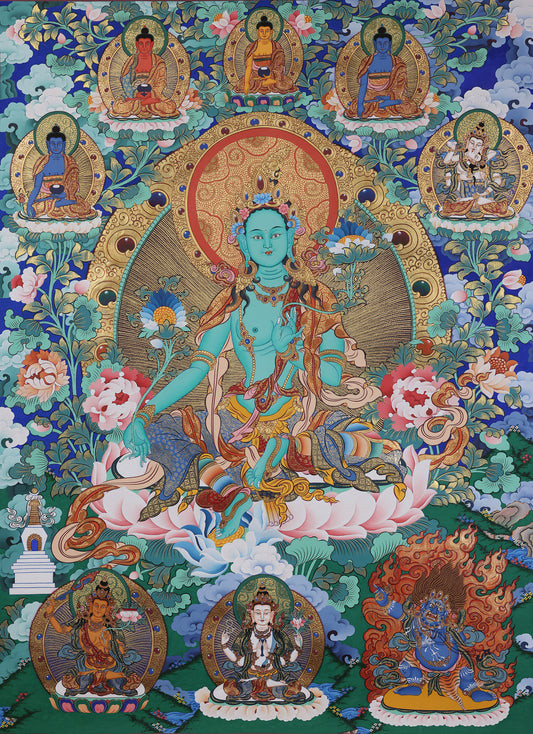
This thangka presents Manjushri as the central deity, complemented by attendant deities and auspicious symbols, forming a complete devotional cycle of “Wisdom – Protection – Auspiciousness.” The composition communicates the teaching of cutting through afflictions with the sword of wisdom, reinforced by attendants for spiritual protection, while natural motifs such as clouds, mountains, and flowers symbolize the unity of wisdom and worldly fulfillment.
Thus, the thangka functions not only as a visual embodiment of religious doctrine but also as a daily meditation and spiritual aid for devotees.
II. Principal Deity: Iconography and Symbolic Meaning of Manjushri
At the center of the painting stands Yellow Manjushri (also called Lion’s Roar Manjushri), whose depiction strictly follows the canonical Iconometric Treatises. Every detail embodies religious symbolism and reflects the principle of “expressing the Dharma through images.”
1. Physical Attributes
Yellow Manjushri has a distinctive orange-yellow body, representing wisdom that illuminates like sunlight. His serene expression and gently lowered gaze illustrate the union of wisdom and compassion. The Five-Buddha Crown symbolizes mastery over the wisdom of the Five Dhyani Buddhas, while a wish-fulfilling jewel in the topknot signifies the power of wisdom to generate all virtuous qualities.
2. Ritual Implements and Hand Gestures
In his right hand, Manjushri holds the flaming sword of wisdom, representing the cutting through of ego-clinging and conceptual delusion. His left hand forms the teaching mudra or holds a lotus flower supporting the Prajñāpāramitā scripture, symbolizing the transmission of supreme wisdom. The combination of sword and scripture epitomizes Manjushri’s essence: cutting ignorance with wisdom and spreading insight through the Dharma.
3. Lotus Throne and Halo
Manjushri is seated on a double lotus throne: the lower red lotus symbolizes worldly purity, while the upper white lotus represents transcendental perfection. The radiating halo behind him has an inner white circle for the Dharmakāya and an outer multicolored aura for the Sambhogakāya, visually expressing the Tibetan Buddhist doctrine of the Three Bodies of Enlightenment while enhancing sacred presence.
III. Attendant Deities: Hierarchy and Devotional Function
Attendant deities in a thangka are not merely decorative—they represent the “Principal Deity – Attendant – Protector” hierarchy, following strict religious logic.
1. Attendant Manifestations: Collaborators in Wisdom
Four-Armed Manjushri and White Manjushri often appear above or beside the central deity:
-
Four-Armed Manjushri holds a sword, scripture, bow, and arrow, symbolizing conquering afflictions with wisdom and guiding beings with compassion.
-
White Manjushri, pure and undefiled, is commonly meditated upon by beginners to enhance intellectual clarity and wisdom.
These attendants reflect the concept of “one wisdom manifesting in multiple forms”, in line with Tibetan Buddhist teachings that the deity manifests countless forms to suit different capacities of sentient beings.
2. Protective and Auspicious Deities: Guardians in the World
The lower or peripheral areas of the thangka may feature Yellow Jambhala (Wealth Deity) and Saraswati (Yangchenma):
-
Yellow Jambhala symbolizes the union of wisdom and material abundance, reflecting the balance between spiritual cultivation and worldly sustenance.
-
Saraswati, holding a lute, represents the purifying sound of wisdom, protecting art, eloquence, and scholarly pursuits, complementing Manjushri’s role as the Bodhisattva of Wisdom.
3. Background Elements: A Microcosm of the Buddhist Universe
Clouds, mountains, flowers, and jewels are symbolic, not decorative:
-
Multicolored auspicious clouds represent the celestial realms.
-
Lotus flowers and jewels derive from the Eight Auspicious Symbols and Seven Precious Treasures, symbolizing worldly fulfillment.
-
Blue-green mountains reflect Chinese gongbi landscape influence, highlighting centuries of Tibetan-Han artistic exchange while symbolizing the omnipresence of wisdom in nature.
IV. Painting Craftsmanship: Spiritual Practice Through Art
This hand-painted thangka integrates Tibetan sacred craftsmanship (Śilpa Vidyā) with ritual observance, making every step a practice of devotion.
1. Canvas Preparation
The base cloth undergoes repeated coating, polishing, and application of white powder, transforming ordinary material into a sacred vessel for divine imagery, symbolizing purification and sanctification.
2. Mineral Pigments
-
Body color from ochre conveys groundedness and enduring wisdom.
-
Halo colors from azurite and malachite, painstakingly layered, ensure longevity and permanence.
-
Gold detailing from 24K gold mixed with saffron and animal glue outlines robes and ritual implements, symbolizing the imperishability of wisdom.
3. Painting Process
-
Before sketching, the artist purifies themselves, observes precepts, and recites the Manjushri mantra to invite wisdom.
-
Sketching follows strict proportions based on canonical standards.
-
Coloring progresses from background to deity, from light to dark, ending with the “eye-opening” ritual, symbolizing the awakening of the deity within the painting and establishing spiritual connection with viewers.
4. Artistic Style
This thangka may belong to the Rebgong or Men-Tang school:
-
Rebgong style is known for vivid colors and elaborate gold detailing.
-
The incorporation of blue-green Chinese landscape techniques reflects centuries of Tibetan-Han cultural exchange, as seen in Manjushri thangkas of the Qing dynasty in the Palace Museum.
V. Conclusion: Thangka as a Living Vessel of Faith
A Manjushri thangka is not a static artwork but a living spiritual medium:
-
Its theme embodies wisdom faith;
-
The deity system visually conveys doctrine;
-
The craftsmanship is a form of spiritual practice.
For Tibetan devotees, it serves as a meditation focus and a symbol of wisdom and protection. For cultural scholars, it is a microcosm of Tibetan Buddhist cosmology, aesthetics, and artisanal tradition. Every mineral pigment and gold line carries the weight of devotion and skill, culminating in a timeless spiritual container that transcends centuries.
#Manjushri
#ManjushriThangka
#TibetanBuddhistArt
#HandPaintedThangka
#BodhisattvaOfWisdom
#TibetanArt
#SacredArt
#BuddhistWallArt
#MeditationArt
#RebgongThangka
#MenTangThangka
#BuddhistWisdom
#SpiritualArt
#TibetanCulture
#ArtCollectors
Schlagwörter:
Vorherige
The "Protective Umbrella" in Tibetan Thangka: The Aesthetics and Compassion of the Sitatapatra Thangka
Nächste
Tibetan Thousand-Armed, Thousand-Eyed Avalokiteshvara Thangka: A Visual Epic of Compassion — Theme, Deities, and Craftsmanship Decoded