Tibetan Manjushri Buddha Thangka: A Millennium Heritage of Wisdom, Art, and Spirituality

$1,699.00 USD
Thangka Name: Cǎi táng wénshū púsà 6 Cai Tang Manjushri Bodhisattva
Size: 45*60
Orgin: Tibet
Eine Frage stellen

Beeil dich! Nur noch [Anzahl] auf Lager!

Geschätzte Lieferzeiten: 12–26 Tage (International), 3–6 Tage (USA).

Rückgabe innerhalb von 45 Tagen nach dem Kauf. Zölle und Steuern werden nicht erstattet.

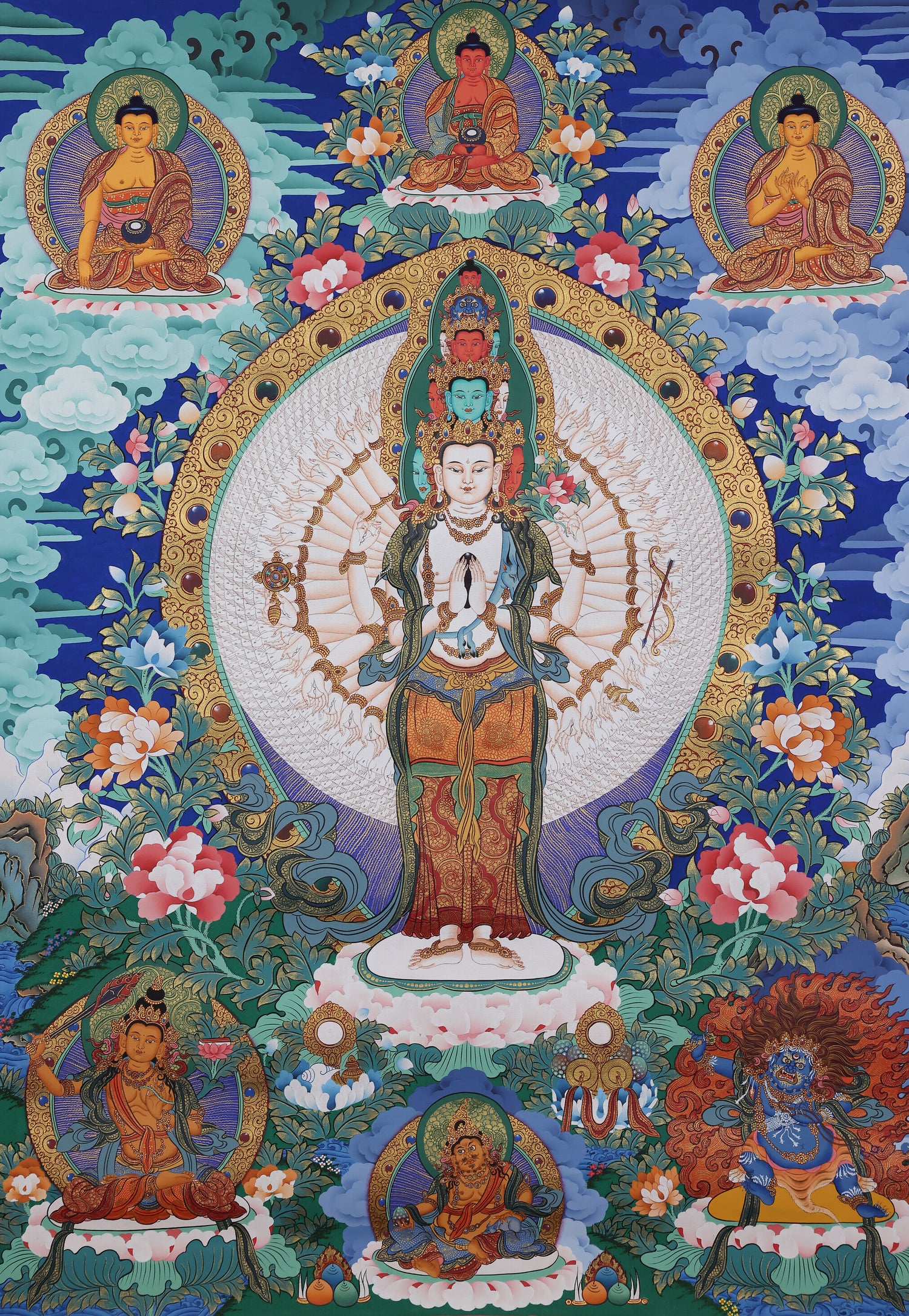
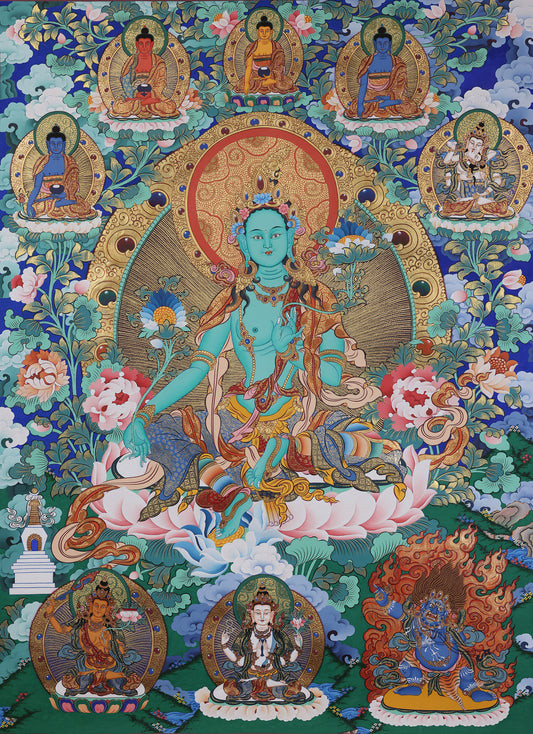
Tibetan Buddhist culture, a color thangka painting of Manjushri Bodhisattva seated on a lotus throne, holding a wisdom sword and lotus flower, symbolizing wisdom and compassion.
Tibetan Manjushri Buddha Thangka: A Millennium Heritage of Wisdom, Art, and Spirituality
$1,699.00 USD

Before this hand-painted thangka, filled with reverence and spirituality, you are experiencing not just a work of art, but a gateway to the profound wisdom of Tibetan Buddhism. Centered on the theme of Manjushri's Pure Land of Wisdom, this thangka is the supreme visual expression of "wisdom faith." Having endured centuries of cultural sedimentation and masterful craftsmanship, it transforms intangible Buddhist teachings into a tangible object of meditation, guiding practitioners to unlock inner wisdom and dispel the darkness of ignorance. In Tibetan tradition, Manjushri is revered as the "Teacher of All Buddhas," symbolizing the ultimate wisdom that transcends all dualities. Owning such a thangka is not only about adding solemnity and harmony to your space but also about inviting an eternal wisdom guide into your life and practice.


I. Decoding the Main Deity: Yellow Manjushri—The Perfect Embodiment of Ultimate Wisdom

The main deity, Yellow Manjushri, at the center of the thangka is the energetic core and spiritual symbol of the entire piece. Its depiction is by no means an artist's free creation but strictly adheres to the 37:25 golden ratio recorded in the Tibetan Buddhist classic, The Treatise on Iconometry. This represents the pinnacle of "skill in bodily form," ensuring the completeness of the blessings and energy embodied in the image.

  • The Mystical Language of Form and Color:

    • Golden Body Color: The pure, translucent golden-yellow hue is not ordinary pigment. It symbolizes "perfect merit," "supreme nobility," and the "increase of wisdom." This golden color is a visualization of the fire of wisdom, signifying the growth of virtue, longevity, and insight.

    • Compassionate Countenance: The Bodhisattva's face is youthful, handsome, and serene, with gentle eyebrows, smiling lips, and downcast yet profound eyes. It displays both boundless compassion (towards sentient beings) and supreme dignity (towards the nature of reality). The white curl of hair (ūrṇā) between the eyebrows, like a third eye of wisdom, symbolizes transcendental insight that perceives all truths.

    • Five-Buddha Crown: The radiant five-leaf crown represents the five Dhyani Buddhas and their perfected wisdom, signifying that Manjushri encompasses the wisdom of all enlightened beings.

  • The Profound Meaning of Attributes and Posture:

    • Sword of Wisdom and Prajñāpāramitā Sutra: The right hand holds aloft a flaming sword of wisdom that instantly severs all afflictions, ignorance, and attachments. The left hand forms the teaching mudra (vitarka) at the heart and gently holds the stem of a blue lotus, which blooms at the shoulder, supporting the volume of the Prajñāpāramitā Sutra (Perfection of Wisdom Sutra). This iconic combination is the core teaching of Manjushri: using the sword of wisdom (prajñā) to cut through delusion and the sutra of emptiness (śūnyatā) to realize ultimate truth—a perfect illustration of "the union of compassion and wisdom" and "guiding action with insight."

    • Sacred Seat and Aureole: The Bodhisattva sits serenely in full lotus posture (vajrāsana) upon a double-layered lotus throne. The downward-facing petals of the lower layer, touched by mud (symbolizing the world of afflictions), contrast with the upward-facing, immaculate petals of the upper layer (symbolizing pure enlightenment), vividly illustrating the profound teaching that "afflictions themselves are enlightenment." The surrounding oval body aureole (prabhāmaṇḍala) in a green-yellow gradient is precisely outlined in gold. The inner layer of flaming patterns represents the "fire of wisdom that burns all the fuel of ignorance," while the outer layer of auspicious cloud motifs symbolizes the coolness, peace, and pure land-like state brought about by wisdom.


II. Attendant Deities: The Harmonious Resonance of the Three Realms

The composition of this thangka strictly follows the Tibetan Buddhist cosmology of the "Three Realms and Five Directions." Every corner is inhabited by deities with specific virtues, together forming a complete mandala of practice and a network of protection.

  • Upper Realm · Celestial Realm (Lineage and Dharma Source):
    Directly above the main deity are the most sacred lineage masters and Buddhas. The center typically features Amitabha Buddha or one's root guru, forming the dhyāna mudra, symbolizing the source of Dharmakāya wisdom. On the sides are often White Manjushri (holding a sutra, emphasizing exoteric, theoretical wisdom) and Green Manjushri or Vajrapāṇi (holding a blue lotus or vajra, emphasizing esoteric, experiential wisdom). This juxtaposition of "exoteric and esoteric unity" points the practitioner toward a complete and unbiased spiritual path. Of particular note, details in these master images (such as the pointed pandita hat or the sutra and sword in hand) often indicate the presence of Je Tsongkhapa, founder of the Gelug school, who is considered an emanation of Manjushri. This directly embodies the core Tibetan Buddhist principle of "viewing the guru as a Buddha."

  • Middle Realm · Human Realm (Attendants and Offerings):
    Flanking the main deity are elegant offering goddesses and majestic dharmapālas (protector deities). The goddesses hold precious vases, pouring forth nectar, symbolizing a continuous flow of "meritorious resources" and auspiciousness. The dharmapālas hold banners and ritual implements, symbolizing the "subjugation of all obstacles and external negative interferences in practice." They originate from descriptions of the sacred assembly in the Mañjuśrīvikurvāṇa-parivarta Sūtra, representing the harmonious, abundant, and well-protected environment of the Pure Land of Wisdom.

  • Lower Realm · Earth Realm (Protectors and Foundation):
    At the bottom center of the painting, one often finds the wrathful emanations of Manjushri, such as Yamāntaka (Vajrabhairava) or a protective form. They typically appear with blue bodies, holding vajras, and with fierce countenances. They do not represent fear but rather the "ferocious power born of wisdom," used to destroy the most stubborn inner afflictions and obstacles and to safeguard the practitioner's successful activities. Beside them is an exquisite offering table displaying the Seven Precious Royal Treasures (such as the golden wheel, wish-fulfilling jewel, queen, minister, etc.). This represents the perfect unity of the worldly conditions needed for practice and the supreme achievements beyond the world, implying that the cultivation of wisdom leads to ultimate fulfillment and abundance.


III. Craftsmanship: Every Stroke is Practice

This thangka is the work of an experienced painter from the Menthang school of the Rebkong (Regong) region in Qinghai. The creative process itself is a solemn offering of "body, speech, and mind." Every step is infused with devotion and generations of secret techniques.

  1. Canvas Preparation (Purifying Mental Defilements):
    Creation begins with the simplest pure cotton canvas. Through a complex series of 10-12 steps—soaking in glue, stretching on a frame, applying a mixture of glue and chalk whiting, and repeated polishing with smooth river stones—the canvas ultimately achieves a state of perfection: "smooth as a mirror, soft as an infant's skin." This process is likened to the practitioner's preparatory stage of "purifying the defilements of one's own mind."

  2. The Secret of Pigments (A Vow of Eternity):
    All colors are derived from natural minerals and plants. Their preciousness and stability give the thangka a life that lasts for millennia without fading.

    • Blue: From top-grade lapis lazuli from Afghanistan, ground to a micron level, presenting the deep, sky-like color of the Buddha realm.

    • Green: Carefully selected malachite and Tibetan turquoise, blended to create a vibrant color of compassion.

    • Red and Yellow: Using cinnabar from Tibet, orpiment, and blended with 24K pure gold powder. The brilliance of the yellow main deity is a testament to the perfect fusion of gold and minerals.

    • These colors are not only beautiful but also strictly correspond to the symbolic system of Buddhist tantra: Yellow (increase, wisdom), Blue (subjugation, emptiness), Red (magnetizing, compassion).

  3. Painting Technique (Conveying the Dharma with Lines, Revealing Light with Gold):

    • Line Drawing: The artist uses a specially made lynx-tail brush, employing a combination of the "iron-wire" and "orchid-leaf" line-drawing techniques to outline the forms. The lines must be "fine yet unbroken, curved yet powerful." Especially for flowing scarves and auspicious clouds, they require a single, continuous breath, showcasing the vitality and rhythm of the imagery.

    • Gold Application: This is the essence of the Menthang school. Pure gold leaf is meticulously ground into paste and mixed to create gold ink, applied using the "layered wash" technique. Finally, an agate burnisher is used repeatedly to polish and press the gold lines, giving them a three-dimensional luster that flows like sunlight. This is called the "Light of Wisdom," making the entire thangka come alive as light changes.

  4. Final Consecration (Infusing Sacred Life):
    Completion of the painting is not the end. A true religious sacred object must undergo a consecration ceremony by an accomplished lama or yogi. This includes writing the Sanskrit or Tibetan seed syllable or mantra of Manjushri, "Oṃ A Ra Pa Ca Na Dhīḥ", on the back center of the thangka, along with chanting and empowerment rituals. Through this ceremony, the thangka transforms from a beautiful "art object" into a blessed "support for wisdom" (Skt. ādhiṣṭhāna), becoming a spiritual medium connecting the practitioner to the very source of Manjushri's wisdom.


IV. Conclusion: Welcome Wisdom into Your Home

This Tibetan Color Thangka of Manjushri is the crystallization of a high degree of integration between culture, art, and spirituality. It is a museum-grade collectible, whose historical and artistic value grows more precious with time. It is an incomparable piece of home decor, capable of bringing indescribable tranquility, dignity, and cultural sophistication to your residence, studio, or meditation space. Most importantly, it is a powerful aid for spiritual practice. Whether through daily contemplation or respectful veneration in a clean place, it can help you and your family, amidst the distractions of modern life, to unlock inner wisdom, gain peace, clarity, and inspiration.

We assure you that every thangka you acquire bears months or even years of the painter's devoted effort and originates from an authentic lineage. We provide exquisite packaging and detailed instructions to ensure this sacred object arrives intact and dignified at its new home.

May Manjushri's Sword of Wisdom sever your confusion; may the profound light of the Prajñāpāramitā Sutra illuminate your path ahead.

#TibetanThangka #ManjushriBodhisattva #BuddhistArt #HandPaintedThangka #WisdomThangka#MenthangSchool #RegongArt #GoldLeafArt #MineralPigments #SacredArt #MeditationArt #SpiritualDecor #BuddhistAltar #CollectibleArt #MindfulnessGift #ConsecratedThangka #YellowManjushri #TibetanBuddhism #TraditionalCraft #HeirloomQuality
Entdecken Sie das perfekte tibetisch-buddhistische Thangka, das zu Ihren Wünschen, Ihrem Lebensstil und Ihrem Raum passt. Jedes Thangka hat eine spirituelle Bedeutung und bringt Segen, wenn es richtig platziert wird.

1. Definieren Sie Ihre Absicht

Reichtum & Erfolg → Gelber Dzambhala (Gottheit des Reichtums)

Mitgefühl und Frieden → Avalokiteshvara, Grüne Tara

Weisheit & Lernen → Manjushri

Gesundheit & Heilung → Medizinbuddha

Langlebigkeit und Familienschutz → Weiße Tara

2. Wählen Sie nach Identität

Unternehmer und Geschäftsinhaber → Reichtumsgottheiten für Wohlstand.

Studenten und Gelehrte → Weisheitsgottheiten für Konzentration und Klarheit.

Heiler und Yoga-Praktizierende → Medizinbuddha für Energie und Gleichgewicht.

Familien und Hausfrauen → Tara-Gottheiten für Harmonie und Sicherheit.

Sammler und Kunstliebhaber → Seltene Mandalas oder Meisterwerk-Thangkas.

3. Passen Sie Ihren Raum an

Heimschrein / Meditationsraum → Mittlere Thangkas (60–80 cm).

Büro / Geschäftshalle → Große Thangkas für Wohlstand und Autorität.

Wohnzimmer / Arbeitszimmer → Dekorative Thangkas für Frieden und Schönheit.

4. Authentische Handwerkskunst

Jedes Thangka ist mit natürlichen Mineralpigmenten und feiner Leinwand handbemalt und spiegelt tibetische Kunstfertigkeit und spirituelle Kraft wider. Überprüfte Quellen gewährleisten Qualität und Respekt für die Tradition.

✨ Wählen Sie Ihr Thangka mit Herz – es ist nicht nur Kunst, sondern ein Segen für Ihr Leben.

Jeder Mensch hat unterschiedliche Bedürfnisse. Die Wahl des richtigen Thangkas kann spirituelle Unterstützung, Schutz, Glück und Segen bieten. Nachfolgend finden Sie Thangka-Empfehlungen für verschiedene Rollen:

1. Unternehmer

  • Bedürfnisse : Weisheit, Reichtum, Gesundheit, beruflicher Erfolg.
  • Empfohlene Thangkas :
    Manjushri : Verbessert die Entscheidungsfindung und Geschäftsweisheit.
    Gottheit des Reichtums : Bringt Reichtum und Wohlstand.
    Medizinbuddha : Unterstützt die Gesundheit und reduziert Stress.
    Mahakala : Schützt Unternehmen vor Konkurrenz und Herausforderungen.

2. Erfolgreiche Einzelpersonen

  • Bedürfnisse : Innerer Frieden, Familienharmonie, Langlebigkeit.
  • Empfohlene Thangkas :
    Amitabha Buddha : Bringt inneren Frieden und Ruhe.
    Avalokiteshvara (Guanyin) : Fördert Harmonie und Glück in der Familie.
    Amitayus (Langlebens-Buddha) : Betet für gute Gesundheit und ein langes Leben.
    Manjushri : Stärkt weiterhin die Weisheit.

3. Hausfrauen/Ehemänner

  • Bedürfnisse : Familienharmonie, Schutz, Gesundheit.
  • Empfohlene Thangkas :
    Avalokiteshvara : Steigert das Familienglück und die Harmonie.
    Schutzgottheiten : Beschützen die Familie vor äußeren Störungen.
    Weiße Tara : Segnet die Familie mit Gesundheit.

4. Studierende und Wissenschaftler

  • Bedürfnisse : Weisheit, Konzentration, akademischer Erfolg.
  • Empfohlene Thangkas :
    Manjushri : Fördert Lernfähigkeit, Gedächtnis und Weisheit.
    Shakyamuni Buddha : Hilft bei der Konzentration und spirituellen Praxis.
    Jixiang Tianmu : Bringt akademisches Glück und Prüfungserfolg.

5. Künstler und Kreativprofis

  • Bedürfnisse : Inspiration, Kreativität, künstlerische Leistung.
  • Empfohlene Thangkas :
    Manjushri : Regt kreatives Denken und Inspiration an.
    Vajrapani : Hilft, kreative Blockaden zu überwinden.
    Maitreya : Sorgt für eine entspannte und optimistische Einstellung und baut Stress ab.

6. Reisende und Abenteurer

  • Bedürfnisse : Schutz, Glück, Erfolg bei Abenteuern.
  • Empfohlene Thangkas :
    Hayagriva : Bietet starken Schutz auf Reisen und beseitigt Hindernisse.
    Mahakala : Bringt Glück und Schutz, insbesondere für Abenteurer.
    Vajrasattva : Hilft, Schwierigkeiten und Herausforderungen während der Reise zu überwinden.

7. Ältere Menschen

  • Bedürfnisse : Gesundheit, Langlebigkeit, spiritueller Frieden.
  • Empfohlene Thangkas :
    Amitayus : Betet für ein langes Leben und gute Gesundheit.
    Medizinbuddha : Fördert Heilung und körperliches Wohlbefinden.
    Avalokiteshvara : Bringt Mitgefühl und inneren Frieden in späteren Jahren.

8. Führungskräfte

  • Bedürfnisse : Führung, Weisheit, Teamarbeit und geschäftlicher Erfolg.
  • Empfohlene Thangkas :
    Manjushri : Verbessert Führungsqualitäten und Entscheidungsfindung.
    Gottheit des Reichtums : Bringt dem Unternehmen und dem Team Erfolg und Wohlstand.
    Avalokiteshvara : Fördert Harmonie und Gleichgewicht innerhalb des Teams.

9. Gesundheits- und Fitnessbegeisterte

  • Bedürfnisse : Gute Gesundheit, Vitalität, Energie.
  • Empfohlene Thangkas :
    Medizinbuddha : Verbessert die körperliche Gesundheit und Vitalität.
    Weiße Tara : Bringt Gesundheit und Verjüngung.
    Vajrasattva : Beseitigt gesundheitliche Probleme und steigert die Energie.

10. Politiker

  • Bedürfnisse : Führung, Weisheit, Frieden.
  • Empfohlene Thangkas :
    Manjushri : Verbessert Führungsqualitäten und Entscheidungsfindung.
    Vairocana Buddha : Hilft, inneren Frieden und Weisheit zu bewahren.
    Avalokiteshvara : Fördert den gesellschaftlichen Frieden und die Harmonie in der Familie.

Für alle Bestellungen über 100 USD ist der Versand kostenlos.

Rücksendungen werden bis zu 10 Tage nach Erhalt des Kaufbelegs bzw. der Sendungsnummer (bei ungetragenen Artikeln) akzeptiert. Sie als Kunde sind verpflichtet, uns vor der Rücksendung des Artikels per E-Mail zu informieren.

Andernfalls fallen die Standardversandkosten an. Weitere Informationen finden Sie in unseren Lieferbedingungen .

Rücksendungen werden bis zu 10 Tage nach Erhalt des Kaufbelegs oder der Sendungsnummer (bei ungetragenen Artikeln) akzeptiert. Sie als Kunde sind verpflichtet, uns vor der Rücksendung des Artikels per E-Mail zu informieren, nur in folgenden Fällen:

– Den falschen Artikel erhalten.
– Artikel kam nicht wie erwartet an (z. B. beschädigte Verpackung).
– Artikel hatte Mängel.
– Über die Lieferzeit hinaus.
– Der Spediteur gestattet keine Besichtigung der Ware vor der Bezahlung.

Die zurückgesendeten Produkte müssen in der Originalverpackung, sicher verpackt, unbeschädigt und ungetragen sein. Dies bedeutet, dass die Artikel zum Schutz während des Transports sicher in einem Karton verpackt sein müssen, möglichst im selben Karton, in dem sie an Sie als Kunde versendet wurden.

Kürzlich angesehen

Nicht vergessen! Die Produkte, die Sie angesehen haben, legen Sie jetzt in den Warenkorb.

Passt gut zu

Erweitern Sie Ihre Auswahl mit perfekt abgestimmtem Zubehör und ergänzenden Produkten.

Leute kauften auch

Hier sind einige unserer ähnlichsten Produkte, die die Leute kaufen. Klicken Sie hier, um den Trendstil zu entdecken.