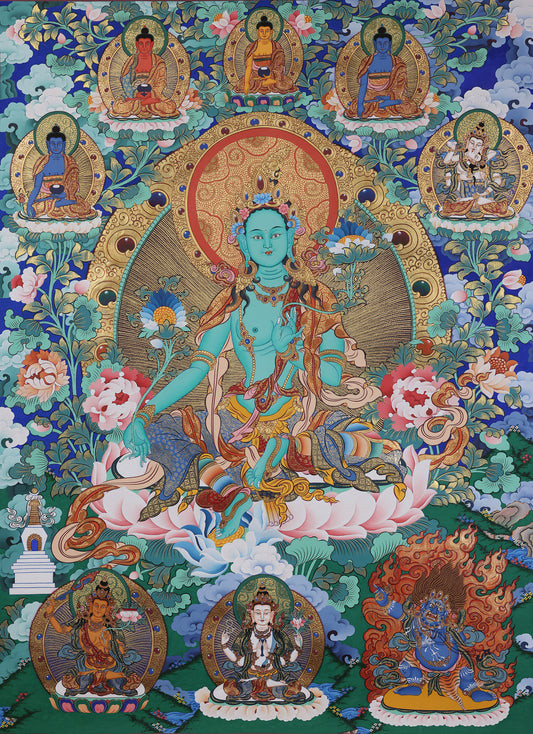
Within the vast and profound universe of Tibetan Buddhist Vajrayana (the Diamond Vehicle), a mandala is far more than a mere exquisite geometric pattern. It is a microcosmic model of the universe, a structural blueprint of a Buddha's pure land, and a complete map of the practitioner's inner journey towards spiritual awakening. This meticulously hand-painted "Seed Syllable Mandala" Thangka is a quintessential practice manual from this ancient wisdom tradition. With the seed syllable as its spiritual core and sacred geometry as its steadfast framework, it constructs a precise field for practitioners to engage in the "generation stage" of deity yoga. This is not simply a decorative art object; it is a dynamic map and sacred tool that guides the mind from ordinary distraction to ultimate emptiness.
I. The Core Theme: The Tantric Philosophy of Visualization from Symbol to Essence
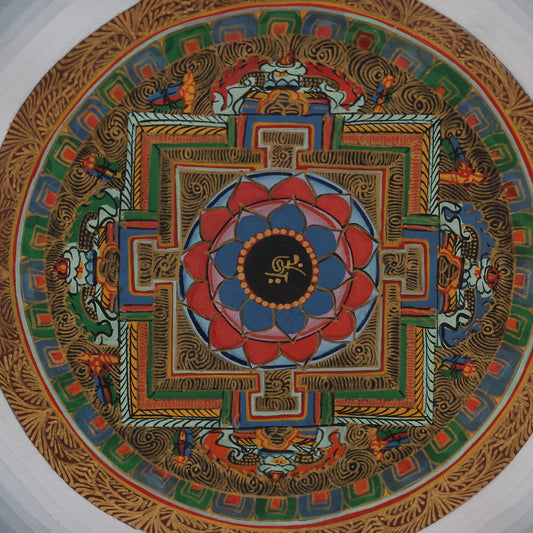
The central theme of this thangka is a mandala constructed around the seed syllable of a specific meditational deity (yidam). The central seed syllable is considered the quintessence and energetic core of the deity's body, speech, and mind. For instance, the syllable "Om" (ༀ) or its variants are often associated with deities embodying limitless wisdom and compassion, such as Samantabhadra or Amitabha Buddha. This is not a depiction of an external landscape but the internal construction of a "mandala of the mind."
In Vajrayana practice, particularly the "generation stage," visualizing a mandala is a rigorous process of mental creation and purification: the practitioner first clearly visualizes the entire mandala structure in space, from the outside in, invites the deity to reside within it, ultimately dissolves everything back into the central seed syllable, and rests in the luminous emptiness it symbolizes. This is known as "using form to point to essence, employing the provisional to realize the true" — utilizing tangible, perfect symbols and images ("form") to comprehend and merge with the intangible, absolute Buddha-nature ("essence"). Therefore, every inch of space, every line in this mandala, serves as a visual track and mental anchor, guiding awareness from the coarse to the subtle, from attachment to appearances to abiding in primordial awareness.
II. Decoding the Symbols: The Cosmic and Mental Order Within the Mandala Structure
This circular mandala strictly adheres to the ritual measurements of the Mandala Measurement Sutras. Its structure is a symbolic system of layers progressing from the outer to the inner, revealing the stages of practice: "purification, transformation, and union."
1. The Outer Circular Boundary: A Field of Protection and Transformation
The outermost ring, often adorned with a band of flames or a chain of vajras, symbolizes the fire of wisdom that burns away all obscurations, forming an inviolable sacred boundary. It may be painted with the Eight Auspicious Symbols or the Four Guardian Animals (like snow lions and garudas). These are not external guards but representations of the practitioner's inner afflictions such as greed, anger, ignorance, and pride, transformed through practice into the power of wisdom protectors. They symbolize the conversion of negative energies into dynamic forces guarding right mindfulness.
2. The Middle Square Palace: The Steadfast Temple of Buddha-Nature
Within the boundary lies a majestic square palace, sometimes composed of multi-colored, intricate geometric patterns representing a pure Buddha-land constructed from the essences of the Five Elements (earth, water, fire, wind, space). The palace has four sides and four gates, facing the cardinal directions, symbolizing the Four Immeasurables (loving-kindness, compassion, empathetic joy, equanimity) and the Four Means of Attraction through which the Dharma benefits all beings. The square structure itself represents the stability, solidity, and indestructibility of the Dharma teachings, the doctrinal framework within which the practitioner's mind can rest.
3. The Inner Lotus and Central Seed Syllable: The Core of Awakening
At the center of the palace rests a blooming lotus. The lotus, unsullied by the mud from which it grows, represents ultimate purity and awakening arising from the mire of cyclic existence. The number of petals (commonly eight) corresponds to the Noble Eightfold Path, the route to enlightenment. Upon this lotus seat lies the heart of the entire mandala — the deity's seed syllable.
The central seed syllable (like "Om") is typically placed upon a dark-colored (such as black or deep blue) disc or moon, the background color representing the emptiness that is the nature of all phenomena. The syllable itself is written in pure gold or a bright color, shining brilliantly, symbolizing the inherently present luminous Buddha-nature within emptiness. This is the ultimate focal point of visualization: from complex external appearances, awareness is gathered inward, finally abiding in the vibration and light of this seed syllable, realizing mind's true nature as Buddha-nature.
III. Artisan Craftsmanship: Ritual Rigor and Devoted Skill
Creating such a mandala thangka is itself a solemn act of spiritual practice. Its supreme technical demands are not merely for beauty but to ensure its accuracy and efficacy as a practice tool.
1. The Ground: An Absolutely Perfect "Canvas Sanctuary"
The canvas, often high-quality, tightly woven cotton, undergoes the ancient process of "triple washing and boiling" to remove impurities. It is then primed with a mixture of yak-bone glue and white clay, applied and polished over a dozen times. The final surface must be as smooth as a mirror and as level as still water, for any slight texture or imperfection could become a subtle cause for mental distraction during prolonged visualization. The perfection of the ground symbolizes the preparation and pliancy of the mind at the outset of practice.
2. Line Drawing: Cosmic Laws Within a Hair's Breadth
The creation of the mandala begins with precise geometric layout using charcoal and compasses. All circles, squares, angles, and distances must conform without the slightest deviation to the secret transmission of the Measurement Sutras. Even a minute error is considered in Vajrayana to potentially compromise the integrity of the energetic structure the mandala represents. When outlining, the artist must concentrate fully, using a specially made weasel-hair brush to draw each line with steady, unwavering motion in a single breath, especially when writing the seed syllable, requiring strokes that are fluid and complete, embodying the sense of Buddha-nature's inherent perfection.
3. Coloring: The Spectrum of Wisdom in Mineral Form
All colors are derived from natural minerals and plants: lapis lazuli blue represents emptiness and the Buddha-family of Akshobhya, coral and cinnabar red represent magnetizing activity and the Padma (Lotus) family, malachite green represents enriching and karma activity, while gold represents the central Buddha-family of Vairocana and supreme luminosity. The sequence and layering of colors strictly correspond to the stages of practice, transitioning from the outer layers' brilliance inward to the central purity and contrast (like gold on black), visually narrating the soul's journey from outer form to inner nature, from complexity to simplicity.
4. Consecration: The Sacred Ritual of Infusing Life
Completion of the painting is not the end. A true mandala thangka intended for practice must undergo a consecration ceremony performed by a qualified lama. Through visualization, mantra recitation, and offering rituals, the lama invites and establishes the wisdom and compassionate energy of the deity within the thangka, transforming it from a beautiful painting into a tangible "support" with which the practitioner can connect and receive blessings. The artist themselves often engages in meditation during the process, infusing their own spiritual cultivation and devotion into the brushstrokes.
IV. Ultimate Value: A Practice Sacred Object Connecting Ancient Wisdom and the Modern Mind
To invite this "Seed Syllable Mandala" Thangka is to acquire not only a masterpiece embodying the highest philosophy and art of Tibetan Buddhism but also to establish within your living space or meditation area a sacred center that continuously radiates stabilizing, purifying, and awakening energy.
-
For Practitioners: It is a silent teacher for daily meditation, a precise tool for deepening samadhi and exploring the nature of mind.
-
For Seekers of Inner Peace: Its perfect geometric structure inherently possesses powerful energy to calm the mind and focus scattered thoughts, making it an excellent aid for meditation and stress management.
-
For Connoisseurs of Art and Culture: It is a condensed encyclopedia of Vajrayana, a perfect synthesis of sacred geometry, color philosophy, religious symbolism, and supreme craftsmanship.
This thangka quietly proclaims: The true path to awakening begins with inner order. It invites every viewer to construct, within the tumult of the world, an inner, unshakable mandala of wisdom, and ultimately to discover that the most brilliant light at the mandala's very center is none other than one's own inherently present, pure mind-nature.
#HandPaintedThangka
#TibetanMandala
#MeditationMandala
#BuddhistAltar
#SacredArtCollectible
#SeedSyllableArt
#RegongArt
#MindfulnessGift
#YogaStudioDecor
MineralPigmentArt
#SpiritualPracticeTool
#MantraVisualization