1. Core Theme: Nyingma’s “Supreme Refuge” as a Convergence of Faith
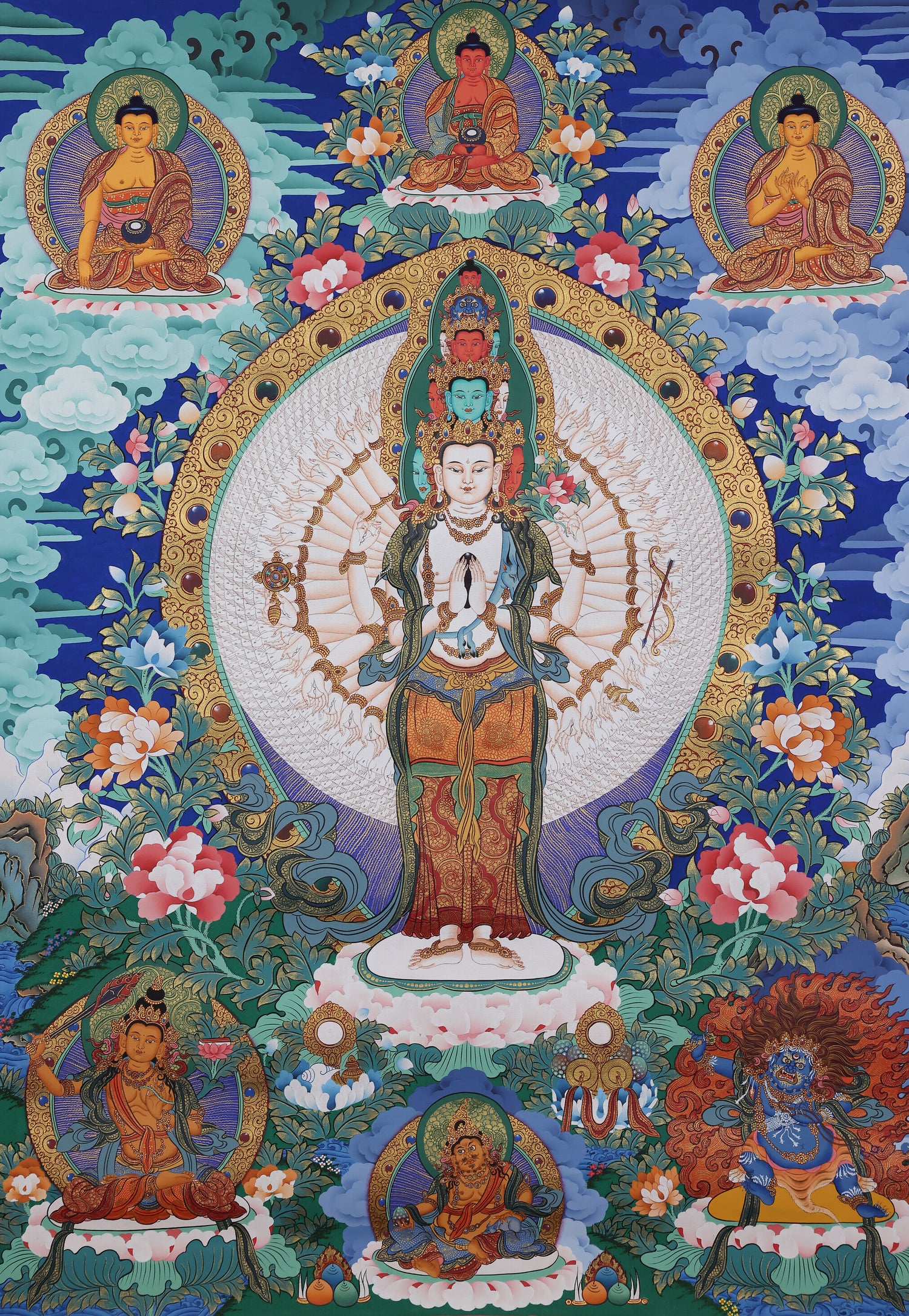
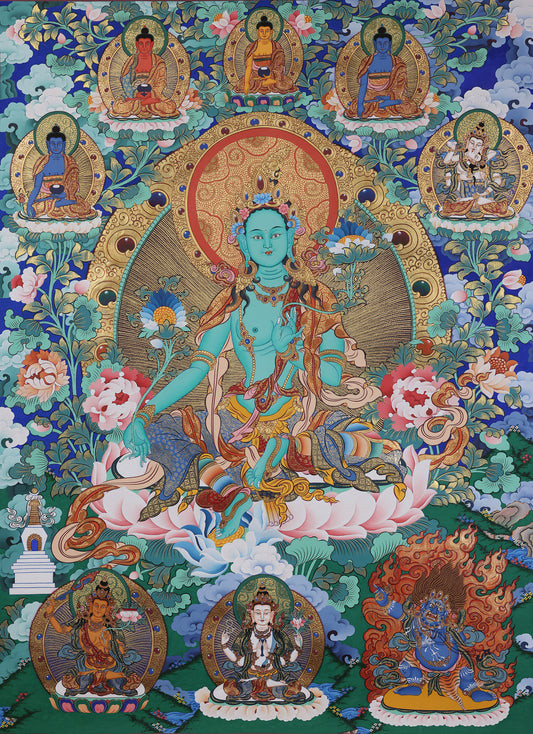
This exquisite Tibetan Thangka centers on the Refuge Field of Guru Padmasambhava, a hallmark visual representation of the Nyingma school (Red Sect). In the context of Tibetan Buddhism, a “Refuge Field” is not merely a portrait of a single deity. Instead, it condenses an entire lineage’s spiritual spectrum—including the Buddhas of the three times, past masters, the principal deity, dakas and dakinis, and protective deities—into a single sacred tableau, serving as a universal field of blessings. Through meditative visualization, practitioners connect their body, speech, and mind seamlessly to the lineage, receiving collective spiritual empowerment.
The profound logic of this theme stems from Guru Padmasambhava’s status as a founding figure of Tibetan Buddhism. In the 8th century, he entered Tibet, subdued indigenous Bon deities, and integrated esoteric and exoteric teachings to establish Samye Monastery and ordain the “Seven Realized Ones.” By fusing Indian Tantric methods with local traditions, he laid the foundation for Tibetan Buddhism. This Thangka serves as a visual manifestation of the Three Secrets of Padmasambhava—body, speech, and mind. Meditating on this Refuge Field is equivalent to simultaneously taking refuge in the Three Jewels, the Guru, the Yidam deity, dakas and dakinis, and protectors, forming a preparatory ritual for Dzogchen practice while embodying the wisdom of “encompassing all teachings within a single field.”
2. Principal Deity: Iconography and Symbolism of Guru Padmasambhava
At the center of the composition is Guru Padmasambhava, meticulously rendered according to the Iconometry Sutra and Nyingma ritual texts. Every detail carries symbolic meaning from Vajrayana teachings:
Attire and Physical Form:
-
He wears the Ushnisha Lotus Hat, with a lotus bud motif at the crown, symbolizing enlightenment arising from the mundane world.
-
Underneath is a crossed-collar monastic robe representing the Vinaya (monastic discipline). Over this, he drapes a brocade cloak of red-brown and sapphire blue—red for wrathful subjugation of obstacles, blue for compassion and acceptance, symbolizing the union of wisdom and compassion.
-
His complexion is pale with a rosy hue; his slightly furrowed brow conveys authority blended with compassion, embodying the principle of overcoming obstacles with wrathful energy while embracing beings with loving-kindness.
Attributes and Mudras:
-
Left hand holds a Gaw Bala bowl filled with the “immortal nectar of wisdom,” decorated with Vajra motifs, symbolizing liberation from cyclic existence through the union of emptiness and bodhicitta.
-
Left elbow carries the Kha Dkar Ga (Heavenly Staff), Padmasambhava’s primary implement: it features a cross Vajra, vase, three human heads, and triple-flaming trident, symbolizing mastery over the five elements, completion of the tantric elixir, and eradication of the three poisons—greed, hatred, and delusion—while uniting the trikaya (Dharma, reward, and emanation bodies).
-
Right hand forms the granting-wish mudra, with the palm facing outward and fingers slightly curved, representing the fulfillment of sentient beings’ aspirations. Combined with the left-hand bowl, this forms a visual language of compassion and wisdom in balance.
Lotus Seat and Aura:
-
Guru Padmasambhava sits in the Royal Dancer posture (semi-lotus) on a double-layer lotus throne.
-
The lower pink lotus symbolizes purity arising from the mud of samsara, while the upper white lotus represents realized enlightenment.
-
Beneath the lotus is a sun-and-moon pedestal, symbolizing illumination dispelling ignorance and cooling afflictions.
-
The halo and aura, painted with gold leaf and mineral pigments, feature inner red flames signifying wisdom burning afflictions and outer seven-colored auspicious clouds representing the celestial Pure Land, all framed in gold to emphasize sanctity.
3. Attendant Deities: Lineage and Faith Network
The surrounding deities form a spiritual lineage and protective network, interpreted through Tibetan Buddhist ritual context:
-
Upper Deity: The small image above the head usually represents Amitabha Buddha (Infinite Light), the Dharmakaya origin of Padmasambhava, highlighting the lineage’s root from the ultimate enlightened nature.
-
Lateral Attendants:
-
Left: Master Shakya Senge (Jingming), a companion of Padmasambhava, wearing red-brown robes and holding ritual implements. Represents the transmission of exoteric teachings.
-
Right: Female figure, Yeshe Tsogyal, Padmasambhava’s principal disciple and consort, embodying the “skillful means” of tantric practice and the source of the Nyingma terma (hidden treasure) tradition.
-
Lower Deities: Protective spirits and offerings below the lotus throne symbolize worldly and transcendental support. Smaller wrathful deities like Vajrakilaya provide protection, ensuring uninterrupted practice and removal of obstacles.
4. Artistic Craftsmanship: Fusion of Newar and Menri Schools
This Thangka is a high-level fusion of the Newar (Nepal) and Menri (Tibetan) painting traditions, combining artistic sophistication with devotional intent:
Canvas Preparation:
-
Six-step preparation: washing, stretching, applying animal glue, coating with white clay, coarse and fine polishing. Each layer is sun-dried, and fine polishing is repeated 3–5 times to create a paper-like smoothness that resonates when tapped. This is not merely craftsmanship but a spiritual practice in itself, accumulating merit for the artist.
Pigments:
-
Mineral-based pigments include lapis lazuli, malachite, cinnabar, and gold leaf.
-
Lapis lazuli and malachite are purified through repeated grinding, boiling, and settling, yielding nuanced shades.
-
Gold is ground into “gold paste,” mixed with gum and saffron, applied to outlines, and burnished with gem-tipped brushes to produce long-lasting, radiant brilliance, symbolizing the eternal light of the Dharma.
Techniques:
-
Iron-line (tie-line) and fine-wire line work: main deity’s robes and instruments are painted in strong, continuous strokes, demonstrating Newar precision; clouds and floral patterns use delicate wire lines for softness.
-
Shading (dry and wet): skin tones and robes are shaded to create natural transitions and depth, enhancing solemnity and vitality.
Eye-Opening Ceremony:
-
Final ritual involves the artist or lama bathing in incense and chanting before dotting the deity’s pupils, animating the Thangka with spiritual presence, transforming it from artwork to a field of blessings capable of empowering viewers.
5. Cultural Significance: Living Tibetan Cultural Canon
This Thangka is more than a painting—it is a visual embodiment of faith. It records the Nyingma lineage, meditation practices, and core teachings, serving as a living codex of Tibetan culture.
-
Artistic Perspective: Balanced composition, mineral pigments with gold leaf, and combined line techniques exemplify the fusion of Newar and Menri styles.
-
Faith Perspective: Practitioners use it to visualize Guru Padmasambhava, receiving empowerment, connecting deeply with the pursuit of awakening and liberation.
-
Contemporary Relevance: As a cultural artifact, it preserves centuries-old ritual and craft traditions while communicating the dual principles of wisdom and compassion in a modern visual language. It exemplifies the symbiosis of faith, art, and culture.
#TibetanThangka
#GuruPadmasambhava
#PadmasambhavaThangka
#NyingmaBuddhism
#HandPaintedThangka
#BuddhistArt
#SacredArt
#MeditationArt
#Vajrayana
#TibetanBuddhistArt
#SpiritualArtwork
#TantricArt
#HomeAltar
#ArtCollector
#CulturalHeritage