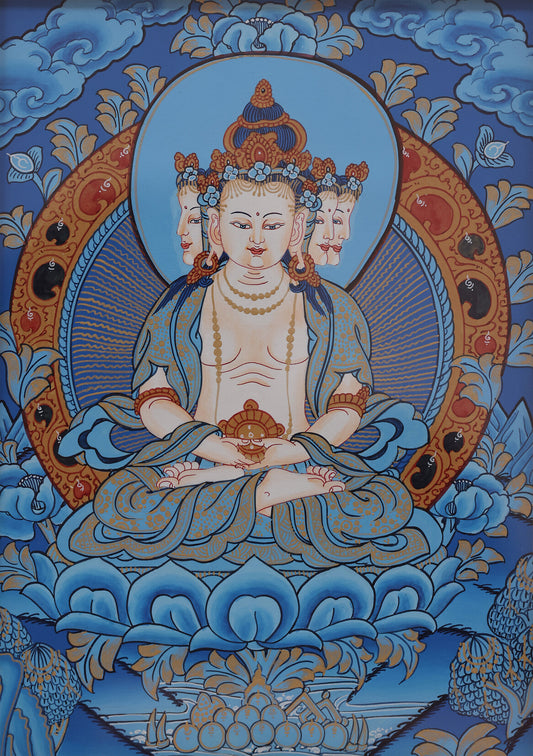
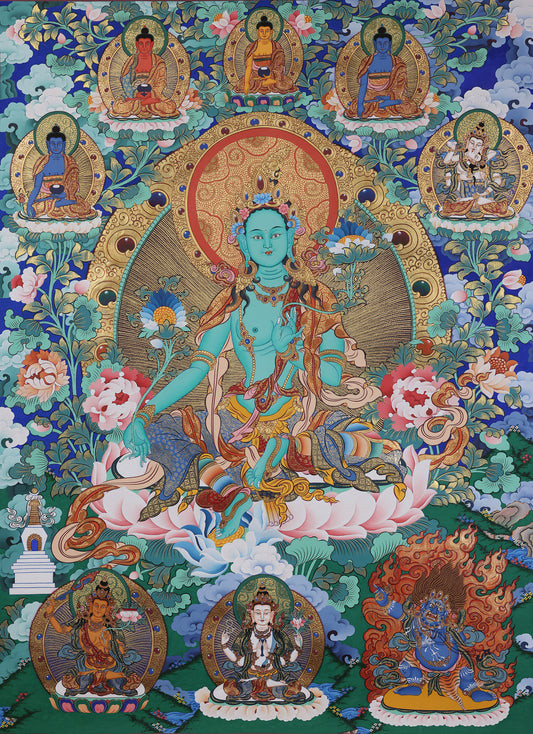
When a 20×30cm Nepalese blue thangka unfolds before you, what you see is not just a painting—it is the embodiment of the Dharmakaya (truth body) in esoteric Tibetan Buddhism, a philosophical vessel for Vairocana Buddha (Mahavairocana), whose "light illuminates the entire Dharmadhatu."
In esoteric Tibetan Buddhism, Vairocana Buddha is not an "individual Buddha" but the shared Dharmakaya essence of all Buddhas: he represents the "absolute truth" beyond form, the unity of Buddha-nature and the cosmic essence. As stated in the Vajrasekhara Sutra Commentary, "he has no distinction of day or night, inner or outer; he awakens sentient beings’ good roots and fulfills both worldly and supramundane endeavors"—this is the core theme of this thangka: using visual symbols to transform the abstract "Dharmadhatu Visuddhi Jnana" into a practice tool for visualization and connection.
The "blue thangka" format further aligns with esoteric color symbolism: in Nepalese thangkas, blue corresponds to the "emptiness of the Dharmadhatu," which resonates with Vairocana’s Dharmakaya attribute of "formless yet omnipresent." The compact 20×30cm size is a standard specification for Tibet’s "portable thangkas" (a variant of gau thangkas)—practitioners can carry it with them, using the "universal illumination" in this small space to visualize their inherent Buddha-nature at any time.
Every detail of the four-faced Vairocana Buddha at the center of the thangka adheres to esoteric rituals, visually expressing the esoteric core of "the non-duality of the Dharmakaya, Sambhogakaya, and Nirmanakaya":
-
Form and Mudra: The main deity sits in the full lotus position (padmasana), with hands folded at the abdomen in the Dharmacakra Mudra (gesture of the Dharma wheel)—this symbolizes "the eternal abiding of the Dharmakaya and the union of concentration and wisdom," Vairocana’s signature mudra. His body is "pure white" (the standard color of the Dharmakaya), with the upper body exposed and adorned with ornaments, embodying both the 庄严 majesty of the Sambhogakaya (enjoyment body) and the educational function of the Nirmanakaya (manifestation body), perfectly illustrating the "three bodies as one."
-
Symbolism of the Four Faces: Two additional faces flank the main one, totaling four, corresponding to "the four directions and eight cardinal points," signifying Vairocana’s "illumination of all realms and embrace of all sentient beings." Each face bears a "compassionate expression": eyes slightly lowered, lips curved in a smile, adhering to the Iconometric Sutra’s standard of "a Buddha’s face like a full moon." It also incorporates the soft lines of Nepalese iconography—rounded features and relaxed contours, distinct from the stern solemnity of Tibetan thangkas, lending a more approachable, secularized warmth.
-
Headdress and Robes: Adorned with a "Five Buddha Crown" (inlaid with five small Buddhas, representing the convergence of the Five Dhyani Buddhas under Vairocana), the celestial robes are painted in "blue with gold outlines," featuring traditional Nepalese scrollwork patterns—blue’s serenity echoes "emptiness," while gold’s luster echoes "universal illumination," satisfying both the solemnity of esoteric rituals and the Nepalese aesthetic of "splendor with softness."
The 20×30cm space cannot accommodate a full mandala retinue, but this thangka preserves the mandala’s structural logic through symbolic substitution:
-
Aura as Implicit Retinue: The "radiating aura" behind the main deity is not mere decoration—it symbolizes the "thirty-seven deities of the Vajradhatu Mandala," a visual expression of the main deity’s dominion over his retinue; the "blue cloud patterns" outside the aura correspond to the "outer Vajra division protectors," with simplified motifs fulfilling the retinue’s religious function.
-
Miniature Symbols as Allusions: The "small emanated Buddhas" hidden in the cloud patterns at the thangka’s edges are Vairocana’s "manifestation bodhisattvas" (miniature substitutes for Vajrapani, Samantabhadra, and Avalokiteshvara). This "symbol-instead-of-icon" technique is typical of small Nepalese thangkas—adapting to the compact size without weakening the mandala’s religious integrity.
This thangka’s "hand-painted" quality fuses traditional Nepalese Pauba painting techniques with Tibetan thangka methods, with ingenuity in every step:
-
Canvas Base: White cotton cloth is used as the base, coated with "white earth glue" (a mixture of glue and white clay), air-dried, and repeatedly polished with pebbles until "smooth as a mirror"—this is critical for ensuring sharp details in a small thangka; the flatness of the 20×30cm canvas directly determines line precision.
-
Layers of Mineral Pigments: Using mineral and earth pigments such as "lapis lazuli (azurite), ochre, and gold leaf," strictly following Nepalese "five-color norms":
-
Blue: Azurite (lapis lazuli ore) is ground in layers (first, second, and third grades)—the background uses deep, rich first-grade blue, while the robes use translucent, soft second-grade blue; the natural texture of mineral pigments gives the blue both serenity and layered variation.
-
Gold: 24K pure gold leaf is ground into powder, mixed with cowhide glue, and applied with an "agate brush" (called gold outlining in Nepal)—the polished gold lines have a "matte metallic sheen," distinct from the harsh glare of chemical gold, exuding solemnity and antiquity.
-
Skin Tone: Blended from "ochre + chalk," the warm texture of earth pigments softens the distance of religious iconography.
-
Sacredness of the Painting Process: From "charcoal grid sketching (following Iconometric Sutra proportions)" to "layered thin pigment application (air-drying each layer before the next)" to "gold outlining on auspicious days and meditative eye-opening"—Nepalese painters view "eye-opening" as a sacred ritual: they must meditate and invoke "the deity to inhabit the image" before applying the final brushstrokes, elevating this work beyond a "craft object" to a practice tool that unites art and religion.
This thangka belongs to the traditional Nepalese school, incorporating modern blue thangka innovations with distinct stylistic features:
-
Composition: The main deity occupies over 70% of the frame, with the background simplified to "blue clouds + aura"—aligning with the Nepalese school’s tradition of "prominent main deity" while avoiding clutter in the small space.
-
Lines and Colors: Lines are soft and rounded, with robe folds rendered via "curved gradient" instead of the "straight outlines" of Tibetan thangkas; the color palette centers on "blue and gold," balancing serenity and solemnity, preserving the religious nature of Tibetan thangkas while fitting Nepalese aesthetics.
This 20×30cm Nepalese blue thangka of Vairocana Buddha is a symbiosis of "religious philosophy + traditional craftsmanship + local aesthetics": it carries the esoteric core of "Vairocana’s universal illumination" through the weight of mineral pigments; it gives abstract Buddhist principles an approachable visual form via the softness of the Nepalese school; it continues the tradition of "thangkas as practice tools" through its portable size.
For collectors, it is a work of art; for practitioners, it is a "Dharmakaya universe" in a small space—this is the unique value of Nepalese thangkas, transcending both religion and art.
#NepaleseBlueThangka #VairocanaBuddhaThangkaAnalysis #EsotericTibetanBuddhismThangka #MineralPigmentThangka #HandPaintedThangkaCraftsmanship #ThangkaArt #NepaleseBuddhistArt #VairocanaThangka #EsotericBuddhismArt #PortableThangka