Among the vast galaxy of ritual objects and artistic treasures in Tibetan Buddhism, the Six-Syllable Mantra Mandala Thangka stands as a spiritual bridge across time and space, renowned for its profound philosophical meaning and exquisite artistic beauty. This piece is not merely a work of art; it is a complete, visually accessible practice system—a dual cipher for cosmic structure and spiritual awakening. This product description will unveil, layer by layer, the religious wisdom, intangible cultural heritage craftsmanship, and contemporary spiritual value behind this hand-painted Nepalese Mandala Thangka.
I. The Mandala and the Six-Syllable Mantra: The Dual Symbolic System of "Cosmos-Mind"
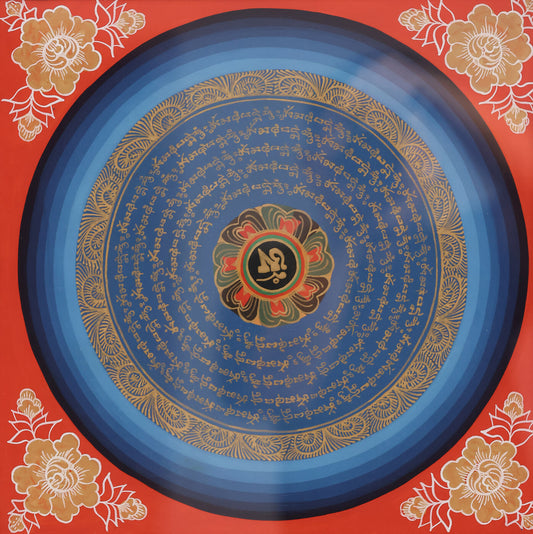
At the heart of this thangka lies the mandala, known as "Kyilkhor" in Tibetan and "Maṇḍala" in Sanskrit. It is far from a mere geometric decoration; it is a precise diagram of the origin of the universe and the nature of mind within Tantric philosophy—a microcosmic model condensing the boundless Dharma realm onto a small canvas.
1. Mandala Structure: The Hierarchical Metaphor of Dharma Realm Order
The mandala's rigorous concentric structure is a visualization of a clear path of practice and a philosophical system:
-
Outer Gradient Blue Circle: The Veil of the Mundane World. Painted with precious lapis lazuli powder, the gradient blue layers from dark to light symbolize the conventional realm—the world of impermanence and phenomena where sentient beings dwell (the "outer mandala"). This blue is not static; its gradient implies the potential transition from the ignorant world to the wisdom pure land.
-
Middle Golden Mantra Wheel: The Path of Transformative Practice. The tightly encircling Tibetan Six-Syllable Mantra, written in immortal gold, forms a luminous pathway. It represents the path of practice connecting the mundane and the sacred (the "inner mandala"). Each character is a guiding light, and each cycle symbolizes the accumulation of merit from mantra recitation and the continuous purification of the mind.
-
Core Seed Syllable "Om": The Manifestation of the Mind's Essence. The Sanskrit seed syllable "Om" at the absolute center is the sonic root from which all phenomena arise, representing the dharmata—the nature of reality—unborn, unceasing, and free from all conceptual elaboration (the "secret mandala"). It is the source of power and the spiritual destination of the entire mandala.
This structure, moving from the outer to the inner, from phenomena to essence, guides the viewer through a visual "inner journey": from the complexity of the mundane world (outer blue), through diligent practice (middle gold), to finally arriving at the core of awakening (central seed syllable).
2. The Six-Syllable Mantra: Avalokiteshvara's Matrix of Compassionate Energy
The flowing mantra "Oṃ Maṇi Padme Hūṃ" within the mandala is the essence of Avalokiteshvara's (Chenrezig's) compassionate heart. In this mandala, the function of the mantra is geometrized and spatialized:
-
The Energy Field of Layout: The mantra letters are not arranged randomly. They radiate from the central "Om" like rays of light, forming a stable energy matrix. This radiant structure symbolizes the compassion and wisdom of Avalokiteshvara shining upon all corners of the Dharma realm like sunlight, leaving nothing untouched.
-
The Object of Visualization: In actual practice, the practitioner gazes at the mandala, visualizing themselves as Avalokiteshvara at the mandala's center, with the rotating mantra letters becoming streams of light purifying the defilements of body, speech, and mind. Thus, the thangka transforms from an object of appreciation into a dynamic "laboratory for the mind."
II. Craftsmanship Decoded: "Material Practice" in Nepalese Hand-Painted Artistry
This thangka originates from the Kathmandu Valley of Nepal, inheriting the pure hand-painted artistry of the centuries-old Newar School. Its creation process is itself a solemn "material practice," with each step imbued with devotion and meditative focus.
1. Canvas Preparation: The Sanctification of the Cloth
-
Purification of Material: High-thread-count fine cotton cloth from the Himalayan region is selected and undergoes "three washes and three sunnings." It is washed with clear melted snow water and dried in the morning sunlight—a ritual the artists regard as cleansing the "dust" from both the canvas and their own minds.
-
Stabilization of the Foundation: Using a hereditary formula, yak bone glue is mixed with mineral chalk for dozens of rounds of application and polishing on the canvas. This process takes nearly two months until the surface is smooth as a mirror and solid as rock. This level and stable foundation symbolizes the "steadiness and purity of mind" required for practice, the prerequisite for supporting the sacred mandala.
2. Color and Gold Lines: The Eternality of Minerals and the Blessing Power of Mantra
-
Lapis Lazuli Blue (Outer Layer): Premium lapis lazuli is hand-ground into powder. This gemstone blue from the depths of the earth, unchanging for millennia, is the perfect material metaphor for the "unchanging nature of the Dharma realm." Each layer of blue applied is a contemplation on the depth and vastness of that realm.
-
Cinnabar Red (Border): The vibrant red of the border comes from natural cinnabar (vermilion). In tradition, cinnabar possesses protective, guardian energy. This red border constructs a solid protective boundary for the mandala, symbolizing the pacification and protection of the space, warding off external distractions.
-
Golden Mantra Letters (Core): The true essence lies here. The mantra letters are painted using 24K pure gold leaf, ground on an agate slab for over eight hours into powder fine as morning mist, then mixed with special deer antler glue. With a special mouse-whisker brush holding only one or two hairs, the artist pours their entire concentration into writing each Tibetan "Uchen style" mantra character. The crucial ritual is this: For every character written, the artist must mentally recite that syllable of the mantra once with clarity. Therefore, these gold lines are not just pigment; they are materialized crystallization of mantra energy and focused attention, the process of "speech blessing" merging with the canvas.
3. The Central Seed Syllable: The "Eye-Opening" Ritual
The "Om" at the mandala's center marks the sacred moment when life-force is instilled into the entire work. Before painting it, the artist undergoes retreat, purification, and mantra recitation. With full devotion, the final strokes are applied using three colors: black (symbolizing emptiness), red (symbolizing compassion), and gold (symbolizing wisdom). This moment is regarded as the transformation of the mandala from a "beautiful pattern" into a "body support" ritual object possessing spiritual power and blessings.
III. Contemporary Value: A "Living Ritual Object" in Modern Spaces
Please understand this mandala thangka as a living spiritual device capable of playing a unique role in various modern contexts:
-
A Focal Point for the Practitioner's Meditation: Provides a powerful, standard, and authentic visual focus for your personal meditation practice, helping to quickly gather the mind and deepen visualization.
-
An Energy Anchor for the Home Space: Hung in the living room, study, or meditation room, its powerful energy field of stability, symmetry, and harmony can effectively purify the space, creating an atmosphere of tranquility, auspiciousness, and spiritual inspiration. It is not merely artistic decor but an "energy stabilizer" for the space.
-
A Lamp of Wisdom for the Study or Office: Placed in a study or office, the cosmic principles of "order" and "focus" it embodies can subtly inspire thinking, enhance clarity and creativity in decision-making, while also acting as a spiritual barrier to alleviate stress and chaos.
-
A Precious Collectible of Intangible Cultural Heritage Art: As a refined piece entirely hand-painted by a Newar artist in strict accordance with ancient methods, it represents the pinnacle of Himalayan art, possessing significant value for artistic appreciation and cultural heritage collection.
Conclusion: The Ultimate Vessel Connecting Cosmos, Art, and Mind
This Six-Syllable Mantra Mandala Thangka is a perfect fusion from the material to the spiritual, from the individual to the cosmos. Using the support of cloth, the eternity of minerals, the radiance of gold, and the artist's complete dedication, it captures and solidifies within a small space the boundless compassion of Avalokiteshvara, the ultimate order of the universe, and the potential for the practitioner's inner awakening.
It invites you not only to an artistic appreciation but also to a silent dialogue—a dialogue with a thousand-year-old wisdom tradition, and with the source of inner order. Before this mandala, let your gaze follow the turning mantra wheel, and let your mind, within the symmetry and eternal colors, find a universe of its own—vast and profoundly still.
#SixSyllableMantraMandala #MandalaThangka #NepaleseHandPaintedThangka #TibetanBuddhistArt #OmManiPadmeHum #AvalokiteshvaraMandala #TantricRitualTool #MineralPigmentThangka #GoldMandala #NewarArtSchool #MeditationTool #SpaceEnergyArt #BuddhistGeometry #SacredGeometry #MandalaCollection #MeditationMandala #HimalayanArt #IntangibleCulturalHeritage #SpiritualPractice #CosmicOrderIllustration