Nepalese Hand-Painted Yellow Jambhala Thangka: A Deep Dive into Tibetan Buddhist Protector Beliefs and Traditional Craftsmanship

$499.00 USD
Thangka name: Cai Tang Huang Caishen
size: 20cm×30cm
origin: Nepal
Eine Frage stellen

Beeil dich! Nur noch [Anzahl] auf Lager!

Geschätzte Lieferzeiten: 12–26 Tage (International), 3–6 Tage (USA).

Rückgabe innerhalb von 45 Tagen nach dem Kauf. Zölle und Steuern werden nicht erstattet.

A colorful Tibetan Buddhist thangka depicting Yellow Jambhala, the wealth deity, symbolizing prosperity and abundance.
Nepalese Hand-Painted Yellow Jambhala Thangka: A Deep Dive into Tibetan Buddhist Protector Beliefs and Traditional Craftsmanship
$499.00 USD
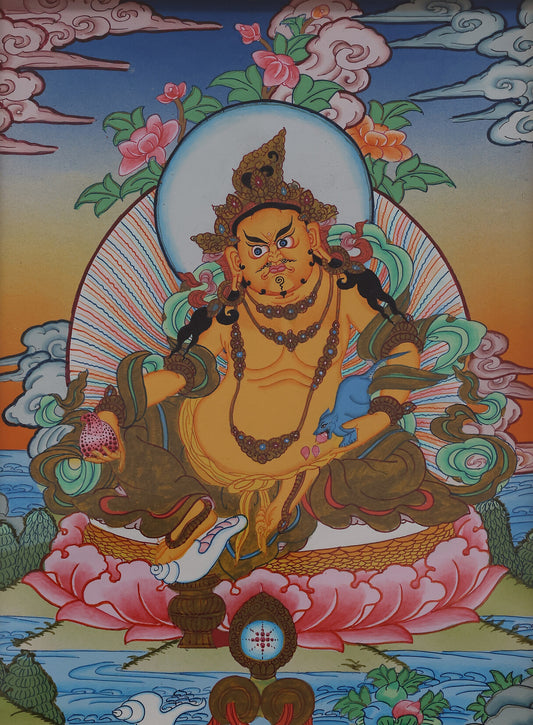
When a 20×30cm hand-painted Yellow Jambhala Thangka from Nepal is laid out before you, what you see is more than just vivid colors and intricate lines: it is a visual scripture of "liberation upon sight" in Tibetan Buddhism, a microcosm of Nepal’s thousand-year-old thangka craftsmanship, and a tangible expression of the "Compassion and Wrath United" belief in wealth protection. As one of the core birthplaces of Tibetan Buddhist art, Nepal’s color thangkas are renowned for "orthodox iconography + traditional craftsmanship"—and this Yellow Jambhala piece is a quintessential carrier of both its cultural and artistic value.

I. Theme: Wealth Protection in Tibetan Buddhism That’s "More Than Just Fortune-Telling"

In the Tibetan Buddhist belief system, Yellow Jambhala (known as "Zambala" in Tibetan) is not a secular "god of wealth" but the core protector in the "Five Directions of Wealth" system. Its theme centers on "Compassion and Wrath United" provision protection: it fulfills both the "worldly provisions" needed for sentient beings’ survival and the "spiritual provisions" essential for practice.
This theme stems from Tibetan Buddhism’s philosophy of "practicing transcendence without separating from the world": Avalokiteshvara (the Bodhisattva of Compassion) manifested as Yellow Jambhala out of pity for sentient beings who abandon their spiritual path due to a lack of provisions. Jambhala subdues karmic obstacles to wealth with wrath, and bestows pure blessings with compassion. In Tibet and Nepal, this thangka is enshrined not only by merchants praying for smooth business or ordinary people hoping for abundant lives but also by monasteries seeking sufficient supplies to sustain Dharma propagation. It connects worldly good wishes with transcendental practice, embodying the Nepalese thangka tradition of "using protector deities to serve believers’ needs."

II. Main Deity Iconography: A "Symbol System of Blessings" in Tibetan Iconographic Measurements

Yellow Jambhala’s image strictly adheres to the protector regulations in the Tibetan Buddhist Iconographic Measurement Sutra—every detail is a visual translation of belief:
  • Body Color & Facial Features: The bright yellow body corresponds to the "earth element," symbolizing stable and abundant wealth. The wrathful features (wide eyes, flame-shaped eyebrows, exposed fangs) are a "demon-subduing form," meant to subdue the karmic obstacles of greed, anger, and delusion. Yet the soft curves of the eyelids and the roundness of the cheeks hint at a "compassionate foundation"—embodying the core Tibetan protector trait of "protecting sentient beings with wrath."
  • Headwear & Adornments: The Five Buddha Crown inlaid with manifestations of the Five Dhyani Buddhas (Vairocana, Akshobhya, Ratnasambhava, Amitabha, Amoghasiddhi) signifies that Yellow Jambhala receives wisdom blessings from these Buddhas, enabling it to "subdue attachment with wisdom and protect provisions with divine power." The double-layered garlands (the upper layer of gemstone garlands represents worldly abundance; the lower layer of treasure garlands symbolizes "untainted blessings") and inlaid gold ornaments (adorned with Nepalese traditional scrollwork patterns) all embody the meaning of "enduring blessings."
  • Posture & Ritual Implements: Jambhala sits in a "relaxed posture" (half-lotus) on a double lotus throne: the left foot rests on the throne, while the right foot steps on a Dharma Wheel—unlike the full-lotus posture of principal deities, this reflects the protector’s trait of "being close to sentient beings and adapting to the world." The left hand holds the Treasure-Vomiting Mongoose (a guardian of dragon-king treasures subdued by Jambhala, tasked with spewing endless gems, the direct visual symbol of "wealth bestowal"). The right hand holds a Cintāmaṇi (Wish-Fulfilling Gem), symbolizing Jambhala’s ability to grant all of sentient beings’ good wishes—whether material provisions or spiritual needs—through pure prayers.

III. Attendant Deity & Background: Belief Logic in a Small Thangka

At 20×30cm, this "portable thangka" has a streamlined layout, but its background elements still carry a complete Tibetan symbolic system:
  • Core Attendant: The Treasure-Vomiting Mongoose: Its blue-gray body corresponds to the "water element," which pairs with Jambhala’s earth element to symbolize "mutual generation of water and earth"—enduring wealth like nourishment from soil and water. The multi-colored gems in its mouth represent diverse forms of wealth (material, blessings, wisdom), not just money.
  • Background Symbols: The double lotus throne (the Mount Meru base anchors provisions; the pink lotus petals warn of "untainted wealth"); Nepalese scroll cloud patterns (symbolizing the fusion of emptiness and manifestation); peony/Kalsang flower (representing thriving blessings); and the Dharma Wheel at the bottom (signifying "righteous circulation of wealth")—every detail reinforces the belief in "obtaining wealth with purity."

IV. Craftsmanship & Style: The Millennium-Old Heritage of Nepalese Color Thangkas

This piece is a classic example of Nepalese "hand-painted color thangkas," with craftsmanship and style that blend tradition and local characteristics:
  • Base & Sketching: Fine Nepalese cotton fabric is used, coated 2-3 times with a lime and peach gum mixture, then sanded smooth after each layer dries (small thangkas demand extreme flatness). The sketch is drawn with charcoal strictly following the Iconographic Measurement Sutra—the body proportion and implement placement have a margin of error of less than 1mm, ensuring "orthodox iconography."
  • Mineral/Earth Pigment Techniques: The main deity’s yellow comes from natural orpiment, the background blue from azurite, the pink from a mix of cinnabar and lime, and earth pigments (ochre) are used for clothing shading. These pigments are rich in color and fade-resistant for centuries, the core guarantee of a thangka’s "heritage value."
  • Stylistic Traits: Unlike the heavy colors of Tibetan thangkas, Nepalese color thangkas are more vivid and saturated, with a focus on natural color transitions (e.g., blue-orange background gradients, petal shading). The decorations are more intricate and delicate (softer cloud curves, plumper flowers), suited to the "exquisite portability" of small thangkas.

Conclusion

This 20×30cm Nepalese Yellow Jambhala Thangka is a symbiosis of Tibetan Buddhist belief and Nepalese traditional craftsmanship: it conveys the concept of "obtaining wealth with purity" through orthodox iconography, preserves its thousand-year artistic life with mineral pigments, and fits believers’ daily worship with its small size. In the Tibetan Buddhist visual system, a thangka is never just a work of art—it is a practice tool that "inspires faith at first sight" and a living carrier of cultural heritage.


#NepaleseYellowJambhalaThangka #TibetanBuddhistThangkaAnalysis #HandPaintedThangkaCraftsmanship #MineralPigmentThangka #TibetanFiveWealthDeities #NepaleseThangkaStyle #SmallPortableThangka #YellowJambhalaSymbolism #TibetanBuddhistSpiritualArt #TraditionalBuddhistArtCrafts #NepaleseHandmadeThangka

Entdecken Sie das perfekte tibetisch-buddhistische Thangka, das zu Ihren Wünschen, Ihrem Lebensstil und Ihrem Raum passt. Jedes Thangka hat eine spirituelle Bedeutung und bringt Segen, wenn es richtig platziert wird.

1. Definieren Sie Ihre Absicht

Reichtum & Erfolg → Gelber Dzambhala (Gottheit des Reichtums)

Mitgefühl und Frieden → Avalokiteshvara, Grüne Tara

Weisheit & Lernen → Manjushri

Gesundheit & Heilung → Medizinbuddha

Langlebigkeit und Familienschutz → Weiße Tara

2. Wählen Sie nach Identität

Unternehmer und Geschäftsinhaber → Reichtumsgottheiten für Wohlstand.

Studenten und Gelehrte → Weisheitsgottheiten für Konzentration und Klarheit.

Heiler und Yoga-Praktizierende → Medizinbuddha für Energie und Gleichgewicht.

Familien und Hausfrauen → Tara-Gottheiten für Harmonie und Sicherheit.

Sammler und Kunstliebhaber → Seltene Mandalas oder Meisterwerk-Thangkas.

3. Passen Sie Ihren Raum an

Heimschrein / Meditationsraum → Mittlere Thangkas (60–80 cm).

Büro / Geschäftshalle → Große Thangkas für Wohlstand und Autorität.

Wohnzimmer / Arbeitszimmer → Dekorative Thangkas für Frieden und Schönheit.

4. Authentische Handwerkskunst

Jedes Thangka ist mit natürlichen Mineralpigmenten und feiner Leinwand handbemalt und spiegelt tibetische Kunstfertigkeit und spirituelle Kraft wider. Überprüfte Quellen gewährleisten Qualität und Respekt für die Tradition.

✨ Wählen Sie Ihr Thangka mit Herz – es ist nicht nur Kunst, sondern ein Segen für Ihr Leben.

Jeder Mensch hat unterschiedliche Bedürfnisse. Die Wahl des richtigen Thangkas kann spirituelle Unterstützung, Schutz, Glück und Segen bieten. Nachfolgend finden Sie Thangka-Empfehlungen für verschiedene Rollen:

1. Unternehmer

  • Bedürfnisse : Weisheit, Reichtum, Gesundheit, beruflicher Erfolg.
  • Empfohlene Thangkas :
    Manjushri : Verbessert die Entscheidungsfindung und Geschäftsweisheit.
    Gottheit des Reichtums : Bringt Reichtum und Wohlstand.
    Medizinbuddha : Unterstützt die Gesundheit und reduziert Stress.
    Mahakala : Schützt Unternehmen vor Konkurrenz und Herausforderungen.

2. Erfolgreiche Einzelpersonen

  • Bedürfnisse : Innerer Frieden, Familienharmonie, Langlebigkeit.
  • Empfohlene Thangkas :
    Amitabha Buddha : Bringt inneren Frieden und Ruhe.
    Avalokiteshvara (Guanyin) : Fördert Harmonie und Glück in der Familie.
    Amitayus (Langlebens-Buddha) : Betet für gute Gesundheit und ein langes Leben.
    Manjushri : Stärkt weiterhin die Weisheit.

3. Hausfrauen/Ehemänner

  • Bedürfnisse : Familienharmonie, Schutz, Gesundheit.
  • Empfohlene Thangkas :
    Avalokiteshvara : Steigert das Familienglück und die Harmonie.
    Schutzgottheiten : Beschützen die Familie vor äußeren Störungen.
    Weiße Tara : Segnet die Familie mit Gesundheit.

4. Studierende und Wissenschaftler

  • Bedürfnisse : Weisheit, Konzentration, akademischer Erfolg.
  • Empfohlene Thangkas :
    Manjushri : Fördert Lernfähigkeit, Gedächtnis und Weisheit.
    Shakyamuni Buddha : Hilft bei der Konzentration und spirituellen Praxis.
    Jixiang Tianmu : Bringt akademisches Glück und Prüfungserfolg.

5. Künstler und Kreativprofis

  • Bedürfnisse : Inspiration, Kreativität, künstlerische Leistung.
  • Empfohlene Thangkas :
    Manjushri : Regt kreatives Denken und Inspiration an.
    Vajrapani : Hilft, kreative Blockaden zu überwinden.
    Maitreya : Sorgt für eine entspannte und optimistische Einstellung und baut Stress ab.

6. Reisende und Abenteurer

  • Bedürfnisse : Schutz, Glück, Erfolg bei Abenteuern.
  • Empfohlene Thangkas :
    Hayagriva : Bietet starken Schutz auf Reisen und beseitigt Hindernisse.
    Mahakala : Bringt Glück und Schutz, insbesondere für Abenteurer.
    Vajrasattva : Hilft, Schwierigkeiten und Herausforderungen während der Reise zu überwinden.

7. Ältere Menschen

  • Bedürfnisse : Gesundheit, Langlebigkeit, spiritueller Frieden.
  • Empfohlene Thangkas :
    Amitayus : Betet für ein langes Leben und gute Gesundheit.
    Medizinbuddha : Fördert Heilung und körperliches Wohlbefinden.
    Avalokiteshvara : Bringt Mitgefühl und inneren Frieden in späteren Jahren.

8. Führungskräfte

  • Bedürfnisse : Führung, Weisheit, Teamarbeit und geschäftlicher Erfolg.
  • Empfohlene Thangkas :
    Manjushri : Verbessert Führungsqualitäten und Entscheidungsfindung.
    Gottheit des Reichtums : Bringt dem Unternehmen und dem Team Erfolg und Wohlstand.
    Avalokiteshvara : Fördert Harmonie und Gleichgewicht innerhalb des Teams.

9. Gesundheits- und Fitnessbegeisterte

  • Bedürfnisse : Gute Gesundheit, Vitalität, Energie.
  • Empfohlene Thangkas :
    Medizinbuddha : Verbessert die körperliche Gesundheit und Vitalität.
    Weiße Tara : Bringt Gesundheit und Verjüngung.
    Vajrasattva : Beseitigt gesundheitliche Probleme und steigert die Energie.

10. Politiker

  • Bedürfnisse : Führung, Weisheit, Frieden.
  • Empfohlene Thangkas :
    Manjushri : Verbessert Führungsqualitäten und Entscheidungsfindung.
    Vairocana Buddha : Hilft, inneren Frieden und Weisheit zu bewahren.
    Avalokiteshvara : Fördert den gesellschaftlichen Frieden und die Harmonie in der Familie.

Für alle Bestellungen über 100 USD ist der Versand kostenlos.

Rücksendungen werden bis zu 10 Tage nach Erhalt des Kaufbelegs bzw. der Sendungsnummer (bei ungetragenen Artikeln) akzeptiert. Sie als Kunde sind verpflichtet, uns vor der Rücksendung des Artikels per E-Mail zu informieren.

Andernfalls fallen die Standardversandkosten an. Weitere Informationen finden Sie in unseren Lieferbedingungen .

Rücksendungen werden bis zu 10 Tage nach Erhalt des Kaufbelegs oder der Sendungsnummer (bei ungetragenen Artikeln) akzeptiert. Sie als Kunde sind verpflichtet, uns vor der Rücksendung des Artikels per E-Mail zu informieren, nur in folgenden Fällen:

– Den falschen Artikel erhalten.
– Artikel kam nicht wie erwartet an (z. B. beschädigte Verpackung).
– Artikel hatte Mängel.
– Über die Lieferzeit hinaus.
– Der Spediteur gestattet keine Besichtigung der Ware vor der Bezahlung.

Die zurückgesendeten Produkte müssen in der Originalverpackung, sicher verpackt, unbeschädigt und ungetragen sein. Dies bedeutet, dass die Artikel zum Schutz während des Transports sicher in einem Karton verpackt sein müssen, möglichst im selben Karton, in dem sie an Sie als Kunde versendet wurden.

Kürzlich angesehen

Nicht vergessen! Die Produkte, die Sie angesehen haben, legen Sie jetzt in den Warenkorb.

Passt gut zu

Erweitern Sie Ihre Auswahl mit perfekt abgestimmtem Zubehör und ergänzenden Produkten.

Leute kauften auch

Hier sind einige unserer ähnlichsten Produkte, die die Leute kaufen. Klicken Sie hier, um den Trendstil zu entdecken.