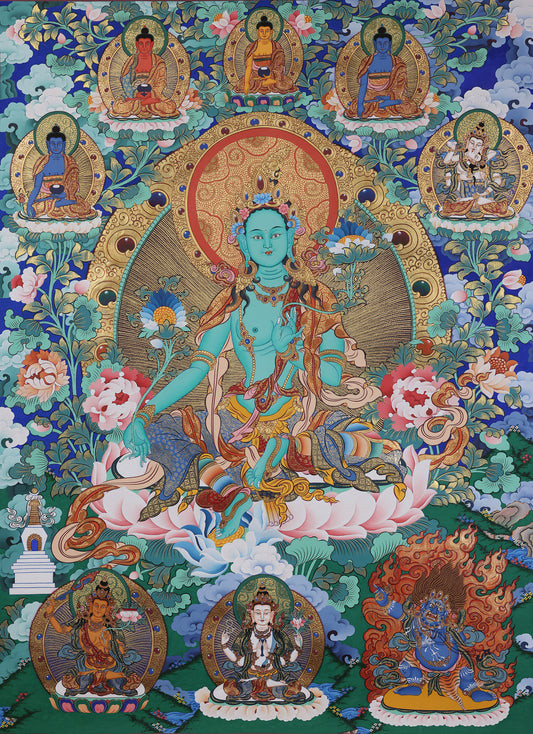
Nepalese Red Thangka of Samantabhadra Bodhisattva: Unlocking the "Vows in Action" Code in Tibetan Buddhist Art (A Deep Dive into 20×30cm Mineral Pigment Hand-Painting)

$499.00 USD
Thangka Name: Red Tang Samantabhadra Bodhisattva
size: 20cm×30cm
origin: Nepal
Eine Frage stellen

Beeil dich! Nur noch [Anzahl] auf Lager!

Geschätzte Lieferzeiten: 12–26 Tage (International), 3–6 Tage (USA).

Rückgabe innerhalb von 45 Tagen nach dem Kauf. Zölle und Steuern werden nicht erstattet.

Nepalese Red Thangka of Samantabhadra Bodhisattva: Unlocking the "Vows in Action" Code in Tibetan Buddhist Art (A Deep Dive into 20×30cm Mineral Pigment Hand-Painting)
$499.00 USD
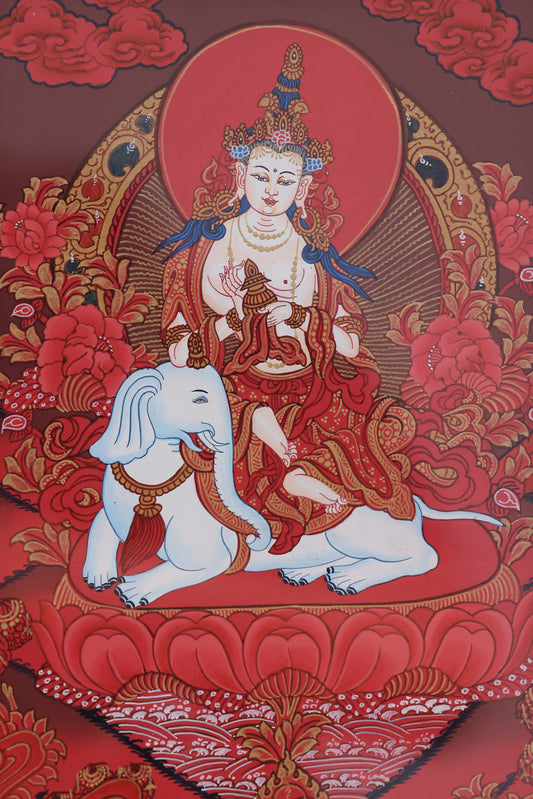
When a 20×30cm Nepalese red thangka unfolds in the palm of your hand, what you touch is not just the texture of cinnabar and gold powder, but the spiritual warmth of "compassion and wisdom united" in Tibetan Buddhism—this is the Samantabhadra Bodhisattva red thangka we’ll unpack today: with mineral pigments as its bones and the doctrine of "great action" as its soul, it holds the secrets of art and belief fusion in the Himalayas.

1. "Vows in Action" in Red Thangka: The Spiritual Anchor of Tibetan Buddhism

In the Tibetan Buddhist system, Samantabhadra Bodhisattva is never an isolated "divine symbol" but a personified embodiment of "practicing the bodhisattva path."

He and Manjushri (who represents "wisdom virtue") are known as the "Two Sages of the Avatamsaka Sutra," jointly assisting Shakyamuni Buddha—Manjushri stands for "principle" and "wisdom," while Samantabhadra stands for "action" and "vows"; their unity is the perfection of "compassion and wisdom united."

This Nepalese red thangka’s choice of Samantabhadra as the main deity aligns perfectly with Tibetan believers’ emphasis on "action": the "Ten Great Vows" in the Samantabhadra’s Vows Sutra are not just scriptural words, but the steps circling Mount Kailash, the recitations with prayer beads, and the daily offerings of 酥油 (butter lamps). The 20×30cm "pocket size" belongs to tsakli in Tibetan Buddhism, designed for personal portable worship and meditative visualization—faith moving from the temple to the palm is the most vivid form of "vows in action."

2. Symbols of the Main Deity: Every Detail is a Code of Doctrine

Samantabhadra’s imagery is a collision between the iconographic rules of the Iconometric Sutra and Nepalese aesthetics:

  • Facial Features and Physique: The rounded cheeks and slightly lowered eyelids embody the "compassionate gaze toward all beings" serene expression; the urna (cranial protuberance) between the eyebrows symbolizes the light of wisdom, and the "three neck folds" are one of the bodhisattva’s "thirty-two auspicious marks"—every proportion speaks to the doctrine of "perfect merit and virtue."
  • Five-Buddha Crown and Ritual Implements: The five-buddha crown, inlaid with the Five Wisdom Tathagatas (Vairocana, Akshobhya, etc.), marks his status as a "equal-enlightenment bodhisattva" and implies the esoteric meaning of "unity of the five wisdoms"; the vase and vajra held in his hands are the concrete forms of "vows" and "action": the vase holds nectar, representing "relieving all beings’ suffering"; the vajra crushes afflictions, representing "strengthening the bodhi heart."
  • Six-Tusked White Elephant: The reclining white elephant is Samantabhadra’s iconic mount; the "six tusks" correspond to the "Six Paramitas" (generosity, morality, patience, diligence, meditation, wisdom), and the white elephant itself symbolizes "unobstructed vows in action"—the golden chains and tassels on the elephant are not only Nepalese art’s ornate aesthetic but also a metaphor for "transforming affliction’s bonds into bodhi’s ornaments."

3. Craftsmanship: "Century-Lasting Colors" in Mineral Pigments

This thangka uses traditional Nepalese red thangka techniques, with every pigment a "gift from the earth":

  • Cinnabar Red Background: Made from cinnabar (mercuric sulfide) as the main material, mixed with local Nepalese red soil and ground to a micron level, then purified through three rounds of boiling—this "prime red" is not only vivid but also resists fading for centuries, a material expression of faith’s "permanence."
  • Lapis Lazuli Blue Hair: Blended with lapis lazuli powder imported from Afghanistan, separated into light and dark layers via "water sorting"; the blue is calm and lustrous—in Nepalese thangkas, lapis lazuli is a symbol of "sanctity," used only for the main deity’s hair and ritual implements.
  • Gold Leaf Lines: 24K gold leaf is ground into powder, mixed with 5-year-aged cow glue (increasing ductility by 50%), and applied with a lynx tail hair brush to create 0.2mm lines—while not as fine as the "hair-thin" lines of Tibetan thangkas, this is top-tier craftsmanship for small Nepalese thangkas.
  • Eye-Opening Ritual: When painting the eyes last, the artist bathes, purifies themselves, and chants sutras—Nepalese people believe "opening the eyes" is the moment the thangka is infused with spirituality; from then on, it is no longer a painting but a "communicable vessel of faith."

4. Style: The "Opulence and Fusion" of Nepal’s Paubha School

This thangka belongs to Nepal’s Paubha school, with distinct regional traits:

  • Full-Frame Composition: The main deity occupies 80% of the frame, with the background filled with red lotus flowers and auspicious clouds, leaving almost no blank space—unlike the "empty negative space" of Tibetan thangkas, this reflects Nepalese painting’s "ornate and full" aesthetic, as if condensing all sacred elements into the palm.
  • Buddhist-Hindu Fusion Details: While following Tibetan Buddhist iconometric rules, it incorporates decorative elements from Hindu temple murals—the elephant’s tassels and crown’s jewel patterns are common in Hindu art, embodying the "Buddhist-Hindu cultural fusion" of the Himalayan region.
  • Color-Focused, Line-Light Expression: Robust, powerful lines (using the "orchid leaf stroke") outline the robes—most Nepalese artists are Hindus, so they have a lighter understanding of Tibetan thangkas’ "lines as practice" concept, prioritizing direct visual impact to make faith’s solemnity "visible at a glance."

Conclusion

This 20×30cm Nepalese red thangka is not an "ornament" but a "miniature universe of faith": it carries permanence through mineral pigments, conveys doctrine via iconographic symbols, and showcases cultural fusion through regional style, condensing Samantabhadra’s "vows in action" spirit into the palm—when you tuck it into your chest, you hold the lifestyle of "proving vows through action," and the millennium-old faith and art of the Himalayan region.

#NepaleseRedThangka #SamantabhadraThangka #TibetanBuddhistArt #MineralPigmentThangka #PaubhaSchool #TsakliArt
Entdecken Sie das perfekte tibetisch-buddhistische Thangka, das zu Ihren Wünschen, Ihrem Lebensstil und Ihrem Raum passt. Jedes Thangka hat eine spirituelle Bedeutung und bringt Segen, wenn es richtig platziert wird.

1. Definieren Sie Ihre Absicht

Reichtum & Erfolg → Gelber Dzambhala (Gottheit des Reichtums)

Mitgefühl und Frieden → Avalokiteshvara, Grüne Tara

Weisheit & Lernen → Manjushri

Gesundheit & Heilung → Medizinbuddha

Langlebigkeit und Familienschutz → Weiße Tara

2. Wählen Sie nach Identität

Unternehmer und Geschäftsinhaber → Reichtumsgottheiten für Wohlstand.

Studenten und Gelehrte → Weisheitsgottheiten für Konzentration und Klarheit.

Heiler und Yoga-Praktizierende → Medizinbuddha für Energie und Gleichgewicht.

Familien und Hausfrauen → Tara-Gottheiten für Harmonie und Sicherheit.

Sammler und Kunstliebhaber → Seltene Mandalas oder Meisterwerk-Thangkas.

3. Passen Sie Ihren Raum an

Heimschrein / Meditationsraum → Mittlere Thangkas (60–80 cm).

Büro / Geschäftshalle → Große Thangkas für Wohlstand und Autorität.

Wohnzimmer / Arbeitszimmer → Dekorative Thangkas für Frieden und Schönheit.

4. Authentische Handwerkskunst

Jedes Thangka ist mit natürlichen Mineralpigmenten und feiner Leinwand handbemalt und spiegelt tibetische Kunstfertigkeit und spirituelle Kraft wider. Überprüfte Quellen gewährleisten Qualität und Respekt für die Tradition.

✨ Wählen Sie Ihr Thangka mit Herz – es ist nicht nur Kunst, sondern ein Segen für Ihr Leben.

Jeder Mensch hat unterschiedliche Bedürfnisse. Die Wahl des richtigen Thangkas kann spirituelle Unterstützung, Schutz, Glück und Segen bieten. Nachfolgend finden Sie Thangka-Empfehlungen für verschiedene Rollen:

1. Unternehmer

  • Bedürfnisse : Weisheit, Reichtum, Gesundheit, beruflicher Erfolg.
  • Empfohlene Thangkas :
    Manjushri : Verbessert die Entscheidungsfindung und Geschäftsweisheit.
    Gottheit des Reichtums : Bringt Reichtum und Wohlstand.
    Medizinbuddha : Unterstützt die Gesundheit und reduziert Stress.
    Mahakala : Schützt Unternehmen vor Konkurrenz und Herausforderungen.

2. Erfolgreiche Einzelpersonen

  • Bedürfnisse : Innerer Frieden, Familienharmonie, Langlebigkeit.
  • Empfohlene Thangkas :
    Amitabha Buddha : Bringt inneren Frieden und Ruhe.
    Avalokiteshvara (Guanyin) : Fördert Harmonie und Glück in der Familie.
    Amitayus (Langlebens-Buddha) : Betet für gute Gesundheit und ein langes Leben.
    Manjushri : Stärkt weiterhin die Weisheit.

3. Hausfrauen/Ehemänner

  • Bedürfnisse : Familienharmonie, Schutz, Gesundheit.
  • Empfohlene Thangkas :
    Avalokiteshvara : Steigert das Familienglück und die Harmonie.
    Schutzgottheiten : Beschützen die Familie vor äußeren Störungen.
    Weiße Tara : Segnet die Familie mit Gesundheit.

4. Studierende und Wissenschaftler

  • Bedürfnisse : Weisheit, Konzentration, akademischer Erfolg.
  • Empfohlene Thangkas :
    Manjushri : Fördert Lernfähigkeit, Gedächtnis und Weisheit.
    Shakyamuni Buddha : Hilft bei der Konzentration und spirituellen Praxis.
    Jixiang Tianmu : Bringt akademisches Glück und Prüfungserfolg.

5. Künstler und Kreativprofis

  • Bedürfnisse : Inspiration, Kreativität, künstlerische Leistung.
  • Empfohlene Thangkas :
    Manjushri : Regt kreatives Denken und Inspiration an.
    Vajrapani : Hilft, kreative Blockaden zu überwinden.
    Maitreya : Sorgt für eine entspannte und optimistische Einstellung und baut Stress ab.

6. Reisende und Abenteurer

  • Bedürfnisse : Schutz, Glück, Erfolg bei Abenteuern.
  • Empfohlene Thangkas :
    Hayagriva : Bietet starken Schutz auf Reisen und beseitigt Hindernisse.
    Mahakala : Bringt Glück und Schutz, insbesondere für Abenteurer.
    Vajrasattva : Hilft, Schwierigkeiten und Herausforderungen während der Reise zu überwinden.

7. Ältere Menschen

  • Bedürfnisse : Gesundheit, Langlebigkeit, spiritueller Frieden.
  • Empfohlene Thangkas :
    Amitayus : Betet für ein langes Leben und gute Gesundheit.
    Medizinbuddha : Fördert Heilung und körperliches Wohlbefinden.
    Avalokiteshvara : Bringt Mitgefühl und inneren Frieden in späteren Jahren.

8. Führungskräfte

  • Bedürfnisse : Führung, Weisheit, Teamarbeit und geschäftlicher Erfolg.
  • Empfohlene Thangkas :
    Manjushri : Verbessert Führungsqualitäten und Entscheidungsfindung.
    Gottheit des Reichtums : Bringt dem Unternehmen und dem Team Erfolg und Wohlstand.
    Avalokiteshvara : Fördert Harmonie und Gleichgewicht innerhalb des Teams.

9. Gesundheits- und Fitnessbegeisterte

  • Bedürfnisse : Gute Gesundheit, Vitalität, Energie.
  • Empfohlene Thangkas :
    Medizinbuddha : Verbessert die körperliche Gesundheit und Vitalität.
    Weiße Tara : Bringt Gesundheit und Verjüngung.
    Vajrasattva : Beseitigt gesundheitliche Probleme und steigert die Energie.

10. Politiker

  • Bedürfnisse : Führung, Weisheit, Frieden.
  • Empfohlene Thangkas :
    Manjushri : Verbessert Führungsqualitäten und Entscheidungsfindung.
    Vairocana Buddha : Hilft, inneren Frieden und Weisheit zu bewahren.
    Avalokiteshvara : Fördert den gesellschaftlichen Frieden und die Harmonie in der Familie.

Für alle Bestellungen über 100 USD ist der Versand kostenlos.

Rücksendungen werden bis zu 10 Tage nach Erhalt des Kaufbelegs bzw. der Sendungsnummer (bei ungetragenen Artikeln) akzeptiert. Sie als Kunde sind verpflichtet, uns vor der Rücksendung des Artikels per E-Mail zu informieren.

Andernfalls fallen die Standardversandkosten an. Weitere Informationen finden Sie in unseren Lieferbedingungen .

Rücksendungen werden bis zu 10 Tage nach Erhalt des Kaufbelegs oder der Sendungsnummer (bei ungetragenen Artikeln) akzeptiert. Sie als Kunde sind verpflichtet, uns vor der Rücksendung des Artikels per E-Mail zu informieren, nur in folgenden Fällen:

– Den falschen Artikel erhalten.
– Artikel kam nicht wie erwartet an (z. B. beschädigte Verpackung).
– Artikel hatte Mängel.
– Über die Lieferzeit hinaus.
– Der Spediteur gestattet keine Besichtigung der Ware vor der Bezahlung.

Die zurückgesendeten Produkte müssen in der Originalverpackung, sicher verpackt, unbeschädigt und ungetragen sein. Dies bedeutet, dass die Artikel zum Schutz während des Transports sicher in einem Karton verpackt sein müssen, möglichst im selben Karton, in dem sie an Sie als Kunde versendet wurden.

Kürzlich angesehen

Nicht vergessen! Die Produkte, die Sie angesehen haben, legen Sie jetzt in den Warenkorb.

Passt gut zu

Erweitern Sie Ihre Auswahl mit perfekt abgestimmtem Zubehör und ergänzenden Produkten.

Leute kauften auch

Hier sind einige unserer ähnlichsten Produkte, die die Leute kaufen. Klicken Sie hier, um den Trendstil zu entdecken.