Nepal Red Thangka of Black Jambhala: Decoding the Tibetan Buddhist Wealth Philosophy, Ancient Craftsmanship, and Newari Art Style in a Miniature Mandala

$499.00 USD
Thangka name: Red Tang Black God of Wealth
size: 20cm×30cm
origin: Nepal
Eine Frage stellen

Beeil dich! Nur noch [Anzahl] auf Lager!

Geschätzte Lieferzeiten: 12–26 Tage (International), 3–6 Tage (USA).

Rückgabe innerhalb von 45 Tagen nach dem Kauf. Zölle und Steuern werden nicht erstattet.

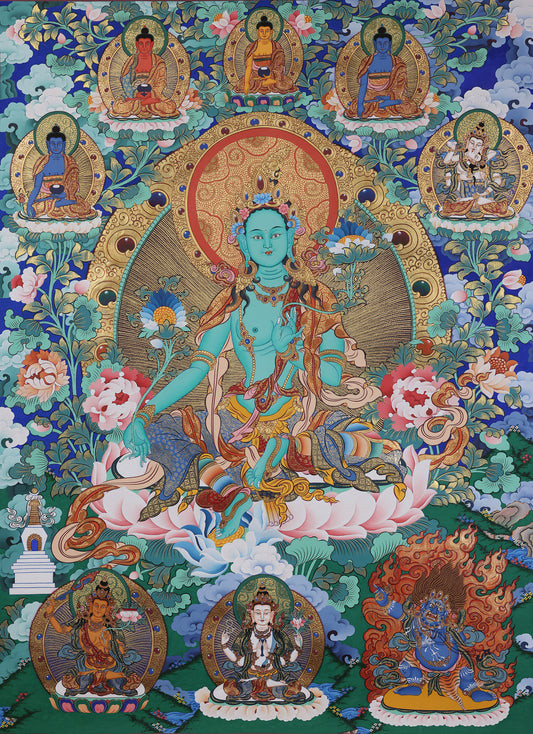
Red thangka depicting Black Jambhala, the Tibetan Buddhist wealth deity, symbolizing prosperity, abundance, and protection
Nepal Red Thangka of Black Jambhala: Decoding the Tibetan Buddhist Wealth Philosophy, Ancient Craftsmanship, and Newari Art Style in a Miniature Mandala
$499.00 USD
When a 20×30cm Nepalese Red Thangka of Black Jambhala is laid out on a desk, it is far more than a "fortune-seeking wall hanging"—it is a miniature mandala of Tibetan Vajrayana Buddhism, embodying the principle of "guiding sentient beings through wrathful form, dispelling hardship through wealth." It is a product of Nepalese artists’ ancient craftsmanship, where mineral pigments converse with the earth, and a vivid expression of how Tibetan Buddhist faith integrates into daily life.
I. Tibetan Buddhist Wealth Philosophy: Black Jambhala Is Not a "God of Wealth"—He Is an Incarnation of Compassion and Wisdom
Within the Tibetan Buddhist pantheon of the Five Wealth Gods, Black Jambhala (Tibetan: Zambala Lönpo) is fundamentally an incarnation of compassion and wisdom manifest by Akshobhya Buddha (the Buddha of the East) to alleviate the suffering of poverty. The "red background" of this thangka already signals its core theme: in Tibetan Vajrayana thangkas, red corresponds to "vitality and the deterrent power of wrathful deities," echoing both Black Jambhala’s wrathful form (meant to subdue the three poisons of greed, anger, and delusion) and the underlying meaning of "converging good fortune."
Unlike the secular conception of a "god of wealth," Black Jambhala’s "bestowal of wealth" is a skillful means (upāya): when devotees enshrine this thangka, they do not merely pray for material abundance. Instead, they seek to "eliminate obstacles such as enemies, theft, and illness," using wealth as a medium to achieve "peace of body and mind, and the ability to practice diligently." This reflects the Vajrayana logic of "using desire to lead beings toward enlightenment": first, satisfy sentient beings’ virtuous wishes with wealth, then guide them to avoid attachment to wealth, and ultimately lead them toward liberation.
II. Symbols of the Main Deity: Purity and Guidance Within Wrath
Every detail of Black Jambhala at the center of the thangka is a Vajrayana code rooted in the Iconographic Measurements Scripture (Zholyig):
  • Form: Cyan-blue skin, three eyes, red hair and beard: The cyan-blue skin symbolizes "innate purity, free from all attachments"; the vertical third eye on the forehead represents "seeing past, present, and future karma"; the red hair and beard, like flames, signify "burning away afflictions and subduing demons."
  • Implements: Kapala bowl and treasure-vomiting rat: The right hand holds a kapala (a bowl made from a human skull), not as a symbol of violence, but as a vessel of wisdom that "dispels the delusion of ‘permanence, pleasure, self, and purity’ through the image of life and death." The left arm cradles a nüli (treasure-vomiting rat), whose mouth holds a wish-fulfilling jewel (Cintāmaṇi), symbolizing "inexhaustible wealth to fulfill all virtuous wishes."
  • Posture: Treading a human figure, coiled by a serpent: The feet pressing on a prostrate human figure symbolize "crushing the karmic obstacles of poverty"; the green serpent (one of the Eight Dragon Kings) coiled around his body represents "mastery over rain and subterranean treasures," implicitly linking wealth to the vitality of nature.
  • Ornaments: Five-Buddha crown and flaming aura: The Five-Buddha crown indicates his identity as an "incarnation of the Five Dhyani Buddhas"; the flaming aura (interwoven with red and gold) serves as both a "field of divine power" and a metaphor for "burning away obstacles with the fire of wisdom."
III. Background: A Vajrayana Cosmos in a Single Image
Though this small thangka lacks elaborate retinue deities, its minimalist background constructs a Vajrayana cosmology:
  • Prostrate figure and jewel pile: The prostrate human figure embodies the "materialization of poverty’s karmic obstacles"; treading upon it symbolizes "smashing the root causes of hardship." The pile of wish-fulfilling jewels beside the figure visualizes "the transformation of karmic obstacles into merit."
  • Moon disc and serpent: The white moon disc beneath Black Jambhala symbolizes "emptiness wisdom"—wealth must be rooted in non-attachment to serve as a support for practice, not a source of affliction. The coiled green serpent is a metaphor for "mastery over the sources of wealth," aligning with Black Jambhala’s reputation as the "swiftest to bestow wealth."
IV. Ancient Craftsmanship: A Millennium of Tradition in Earthly Pigments
Painted with "mineral and earth pigments," every step of this thangka is a devotional practice by Nepalese artists:
  • Canvas: Purification with Aconitum juice: White cotton cloth is soaked in Aconitum (wolfsbane) juice (to repel insects and preserve the fabric) and repeatedly polished until its surface is silk-like. Even for a 20×30cm thangka, canvas preparation takes 3–5 days, part of the "pre-painting ritual."
  • Pigments: Gifts from nature:
    • The cyan-blue hue comes from lapis lazuli (imported from Central Asia): Processed via "rough crushing → fine grinding with a buffalo-horn mortar → water separation," the finest powder is used for the face, medium-grade for the body, and coarse particles for the background. Pyrite impurities in lapis lazuli create natural "golden speckles," lending a sacred texture to the skin.
    • The red background uses cinnabar ore: Washed with white liquor, ground repeatedly, and mixed with yak bone glue, its stability ensures the color will not fade for centuries—embodying both "good fortune and deterrence."
    • Gold details (aura, ornaments) use 24K gold leaf: Hammered until paper-thin, ground into powder, and mixed with honey, it outlines patterns symbolizing "the light of Buddha-nature."
  • Technique: The Rhythm of Newari Art: Created via "charcoal sketch → light ink outlining → layered pigment blending → gold line detailing," the style features fluid, decorative lines. The contours of Black Jambhala’s muscles and scrollwork patterns extend the artistic tradition of Nepalese textiles into thangka painting.
V. Style: Fusion of Newari and Tibetan Aesthetics
This thangka blends the Nepalese Newari school with Tibet’s Menri style:
  • Compact composition: The main deity occupies over 80% of the 20×30cm space, aligning with the Newari tradition of "central deity supremacy" and suiting personal enshrinement.
  • Vibrant colors: The red-gold base contrasts sharply with cyan-blue and black, reflecting the Newari school’s "bold use of color."
  • Wrath with kindness: Though a wrathful deity, Black Jambhala’s rounded facial features (a hallmark of Newari art) subtly convey "compassionate guidance."
Conclusion
This small Red Thangka of Black Jambhala is a three-dimensional carrier of "faith, craftsmanship, and symbolism": it interprets compassion through wrath, guides practice through wealth, and preserves a millennium of tradition in earthy pigments. For devotees, it is a "portable mandala"; for viewers, it is a window into Tibetan Buddhism’s "seeing the infinite in the finite"—every stroke of mineral pigment is a dialogue between nature and faith.

#NepaleseThangka #BlackJambhalaThangka #TibetanBuddhistArt  #NewariArtSchool #MineralPigmentThangka #RedThangkaAnalysis #VajrayanaArt #HandpaintedThangka #BuddhistWealthPhilosophy

Entdecken Sie das perfekte tibetisch-buddhistische Thangka, das zu Ihren Wünschen, Ihrem Lebensstil und Ihrem Raum passt. Jedes Thangka hat eine spirituelle Bedeutung und bringt Segen, wenn es richtig platziert wird.

1. Definieren Sie Ihre Absicht

Reichtum & Erfolg → Gelber Dzambhala (Gottheit des Reichtums)

Mitgefühl und Frieden → Avalokiteshvara, Grüne Tara

Weisheit & Lernen → Manjushri

Gesundheit & Heilung → Medizinbuddha

Langlebigkeit und Familienschutz → Weiße Tara

2. Wählen Sie nach Identität

Unternehmer und Geschäftsinhaber → Reichtumsgottheiten für Wohlstand.

Studenten und Gelehrte → Weisheitsgottheiten für Konzentration und Klarheit.

Heiler und Yoga-Praktizierende → Medizinbuddha für Energie und Gleichgewicht.

Familien und Hausfrauen → Tara-Gottheiten für Harmonie und Sicherheit.

Sammler und Kunstliebhaber → Seltene Mandalas oder Meisterwerk-Thangkas.

3. Passen Sie Ihren Raum an

Heimschrein / Meditationsraum → Mittlere Thangkas (60–80 cm).

Büro / Geschäftshalle → Große Thangkas für Wohlstand und Autorität.

Wohnzimmer / Arbeitszimmer → Dekorative Thangkas für Frieden und Schönheit.

4. Authentische Handwerkskunst

Jedes Thangka ist mit natürlichen Mineralpigmenten und feiner Leinwand handbemalt und spiegelt tibetische Kunstfertigkeit und spirituelle Kraft wider. Überprüfte Quellen gewährleisten Qualität und Respekt für die Tradition.

✨ Wählen Sie Ihr Thangka mit Herz – es ist nicht nur Kunst, sondern ein Segen für Ihr Leben.

Jeder Mensch hat unterschiedliche Bedürfnisse. Die Wahl des richtigen Thangkas kann spirituelle Unterstützung, Schutz, Glück und Segen bieten. Nachfolgend finden Sie Thangka-Empfehlungen für verschiedene Rollen:

1. Unternehmer

  • Bedürfnisse : Weisheit, Reichtum, Gesundheit, beruflicher Erfolg.
  • Empfohlene Thangkas :
    Manjushri : Verbessert die Entscheidungsfindung und Geschäftsweisheit.
    Gottheit des Reichtums : Bringt Reichtum und Wohlstand.
    Medizinbuddha : Unterstützt die Gesundheit und reduziert Stress.
    Mahakala : Schützt Unternehmen vor Konkurrenz und Herausforderungen.

2. Erfolgreiche Einzelpersonen

  • Bedürfnisse : Innerer Frieden, Familienharmonie, Langlebigkeit.
  • Empfohlene Thangkas :
    Amitabha Buddha : Bringt inneren Frieden und Ruhe.
    Avalokiteshvara (Guanyin) : Fördert Harmonie und Glück in der Familie.
    Amitayus (Langlebens-Buddha) : Betet für gute Gesundheit und ein langes Leben.
    Manjushri : Stärkt weiterhin die Weisheit.

3. Hausfrauen/Ehemänner

  • Bedürfnisse : Familienharmonie, Schutz, Gesundheit.
  • Empfohlene Thangkas :
    Avalokiteshvara : Steigert das Familienglück und die Harmonie.
    Schutzgottheiten : Beschützen die Familie vor äußeren Störungen.
    Weiße Tara : Segnet die Familie mit Gesundheit.

4. Studierende und Wissenschaftler

  • Bedürfnisse : Weisheit, Konzentration, akademischer Erfolg.
  • Empfohlene Thangkas :
    Manjushri : Fördert Lernfähigkeit, Gedächtnis und Weisheit.
    Shakyamuni Buddha : Hilft bei der Konzentration und spirituellen Praxis.
    Jixiang Tianmu : Bringt akademisches Glück und Prüfungserfolg.

5. Künstler und Kreativprofis

  • Bedürfnisse : Inspiration, Kreativität, künstlerische Leistung.
  • Empfohlene Thangkas :
    Manjushri : Regt kreatives Denken und Inspiration an.
    Vajrapani : Hilft, kreative Blockaden zu überwinden.
    Maitreya : Sorgt für eine entspannte und optimistische Einstellung und baut Stress ab.

6. Reisende und Abenteurer

  • Bedürfnisse : Schutz, Glück, Erfolg bei Abenteuern.
  • Empfohlene Thangkas :
    Hayagriva : Bietet starken Schutz auf Reisen und beseitigt Hindernisse.
    Mahakala : Bringt Glück und Schutz, insbesondere für Abenteurer.
    Vajrasattva : Hilft, Schwierigkeiten und Herausforderungen während der Reise zu überwinden.

7. Ältere Menschen

  • Bedürfnisse : Gesundheit, Langlebigkeit, spiritueller Frieden.
  • Empfohlene Thangkas :
    Amitayus : Betet für ein langes Leben und gute Gesundheit.
    Medizinbuddha : Fördert Heilung und körperliches Wohlbefinden.
    Avalokiteshvara : Bringt Mitgefühl und inneren Frieden in späteren Jahren.

8. Führungskräfte

  • Bedürfnisse : Führung, Weisheit, Teamarbeit und geschäftlicher Erfolg.
  • Empfohlene Thangkas :
    Manjushri : Verbessert Führungsqualitäten und Entscheidungsfindung.
    Gottheit des Reichtums : Bringt dem Unternehmen und dem Team Erfolg und Wohlstand.
    Avalokiteshvara : Fördert Harmonie und Gleichgewicht innerhalb des Teams.

9. Gesundheits- und Fitnessbegeisterte

  • Bedürfnisse : Gute Gesundheit, Vitalität, Energie.
  • Empfohlene Thangkas :
    Medizinbuddha : Verbessert die körperliche Gesundheit und Vitalität.
    Weiße Tara : Bringt Gesundheit und Verjüngung.
    Vajrasattva : Beseitigt gesundheitliche Probleme und steigert die Energie.

10. Politiker

  • Bedürfnisse : Führung, Weisheit, Frieden.
  • Empfohlene Thangkas :
    Manjushri : Verbessert Führungsqualitäten und Entscheidungsfindung.
    Vairocana Buddha : Hilft, inneren Frieden und Weisheit zu bewahren.
    Avalokiteshvara : Fördert den gesellschaftlichen Frieden und die Harmonie in der Familie.

Für alle Bestellungen über 100 USD ist der Versand kostenlos.

Rücksendungen werden bis zu 10 Tage nach Erhalt des Kaufbelegs bzw. der Sendungsnummer (bei ungetragenen Artikeln) akzeptiert. Sie als Kunde sind verpflichtet, uns vor der Rücksendung des Artikels per E-Mail zu informieren.

Andernfalls fallen die Standardversandkosten an. Weitere Informationen finden Sie in unseren Lieferbedingungen .

Rücksendungen werden bis zu 10 Tage nach Erhalt des Kaufbelegs oder der Sendungsnummer (bei ungetragenen Artikeln) akzeptiert. Sie als Kunde sind verpflichtet, uns vor der Rücksendung des Artikels per E-Mail zu informieren, nur in folgenden Fällen:

– Den falschen Artikel erhalten.
– Artikel kam nicht wie erwartet an (z. B. beschädigte Verpackung).
– Artikel hatte Mängel.
– Über die Lieferzeit hinaus.
– Der Spediteur gestattet keine Besichtigung der Ware vor der Bezahlung.

Die zurückgesendeten Produkte müssen in der Originalverpackung, sicher verpackt, unbeschädigt und ungetragen sein. Dies bedeutet, dass die Artikel zum Schutz während des Transports sicher in einem Karton verpackt sein müssen, möglichst im selben Karton, in dem sie an Sie als Kunde versendet wurden.

Kürzlich angesehen

Nicht vergessen! Die Produkte, die Sie angesehen haben, legen Sie jetzt in den Warenkorb.

Passt gut zu

Erweitern Sie Ihre Auswahl mit perfekt abgestimmtem Zubehör und ergänzenden Produkten.

Leute kauften auch

Hier sind einige unserer ähnlichsten Produkte, die die Leute kaufen. Klicken Sie hier, um den Trendstil zu entdecken.