Analysis of a Nepali Hand-Painted Thangka of Shakyamuni Buddha: Faith and Craft in Tibetan Buddhist Art

$599.00 USD
Thangka name: Colorful Tang Shakyamuni
size: 45cm×65cm
origin: Nepal
Eine Frage stellen

Beeil dich! Nur noch [Anzahl] auf Lager!

Geschätzte Lieferzeiten: 12–26 Tage (International), 3–6 Tage (USA).

Rückgabe innerhalb von 45 Tagen nach dem Kauf. Zölle und Steuern werden nicht erstattet.

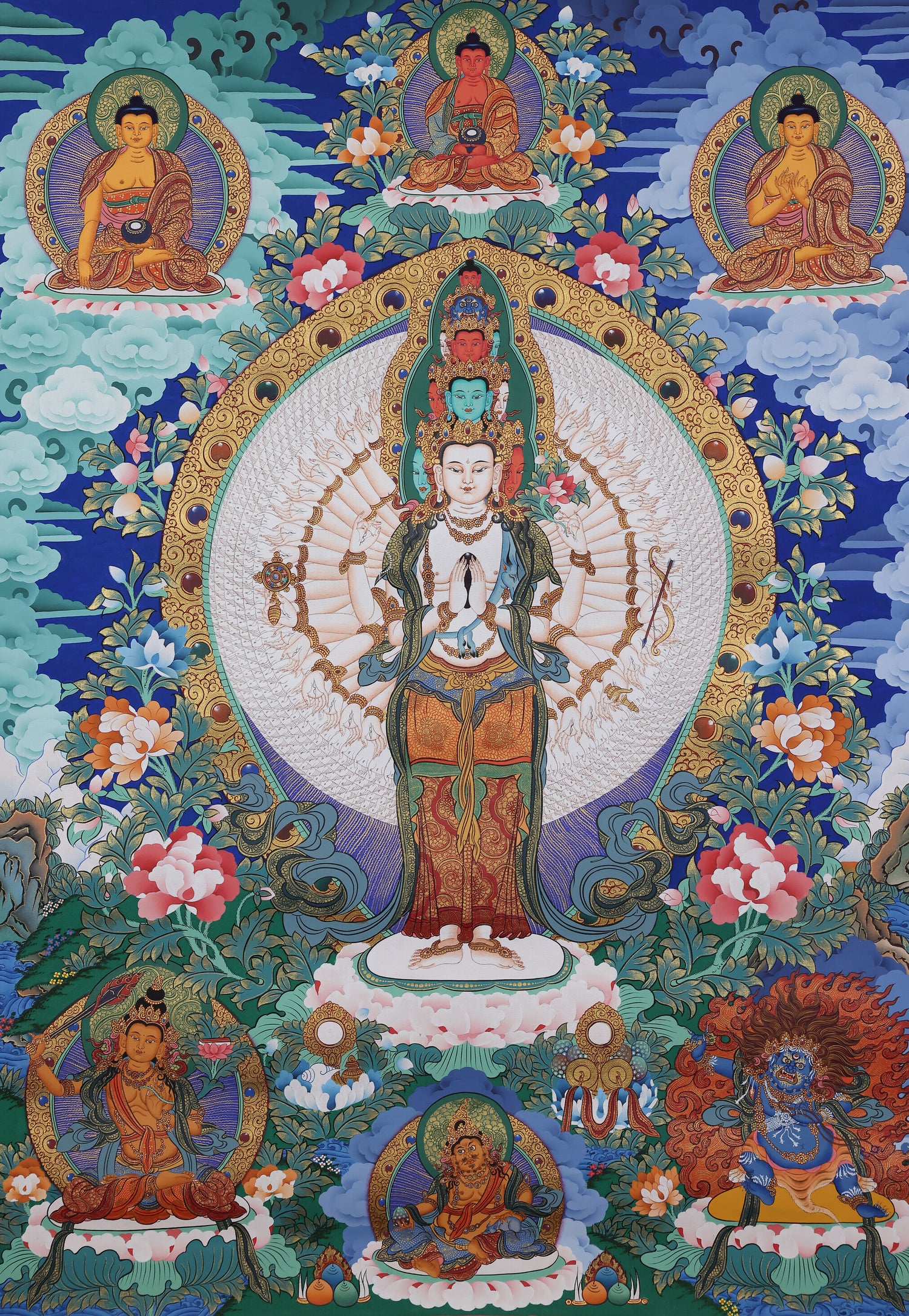
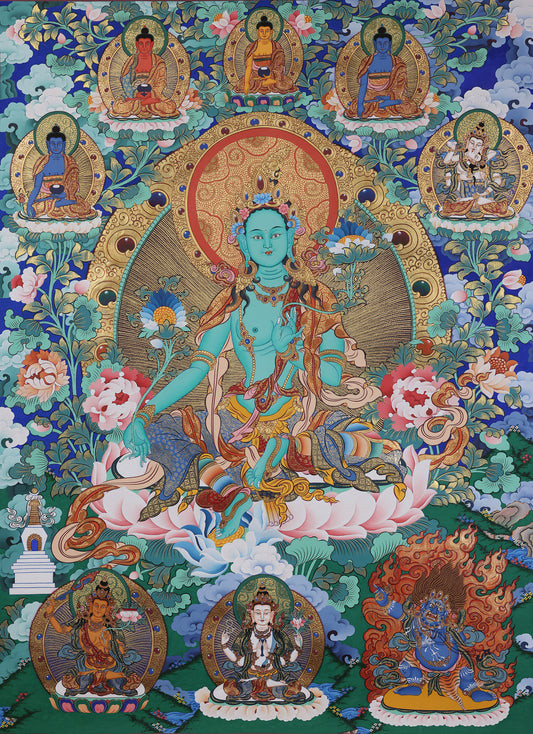
Color Tibetan thangka of Shakyamuni Buddha seated in meditation, symbolizing enlightenment in Tibetan Buddhist culture
Analysis of a Nepali Hand-Painted Thangka of Shakyamuni Buddha: Faith and Craft in Tibetan Buddhist Art
$599.00 USD
In the spiritual world of Tibetan Buddhism, a thangka is never merely a “painting”—it is “tangible Dharma.” A 45×65cm hand-painted Nepali thangka of Shakyamuni Buddha, rendered in rich mineral and earth pigments with delicate Newari brushwork, weaves faith, craft, and regional culture into every inch of its canvas. Today, we unpack this thangka’s theme, deities, craftsmanship, and style through the lens of Tibetan Buddhism, decoding the sacred and artistic layers beneath its surface.

1. Theme: The “Visualized Dharma Lineage” of the Buddha’s Pure Land

The core theme of this thangka is “Shakyamuni Buddha and Retinue Deities in a Pure Land Manifestation”. In the iconographic tradition of Tibetan Buddhist “principal Buddha thangkas,” this “central figure + retinue” composition not only highlights Shakyamuni’s status as the “enlightened one of this age” but also embodies the sacred hierarchy of “Buddha → Retinue → Sentient Beings.”

From a Nepali cultural perspective, Shakyamuni was born in Lumbini, Nepal—so local thangkas infuse his image with “hometown sanctity.” This work’s central Buddha + surrounding retinue layout adheres to Tibetan Buddhist ritual norms while aligning with Nepal’s “Buddha-centered cosmic order,” representing a deep fusion of faith and regional culture.

2. Central Deity: The Symbolic Code of Shakyamuni’s “Enlightenment Form”

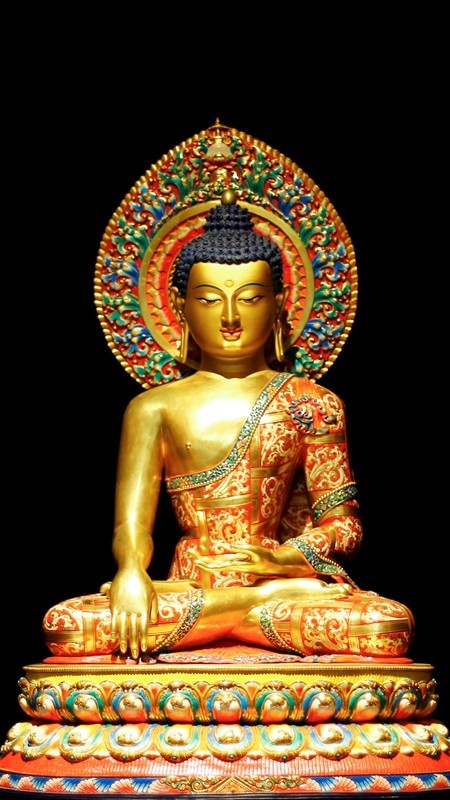
The central figure is Shakyamuni Buddha in his “enlightenment form,” with every detail strictly corresponding to the religious symbols of the Iconometric Sutras:

  • Physical Details: A moon-like face, a raised cranial protuberance (ushnisha, symbolizing perfect wisdom), a cranial hair curl (urna, representing transcendent awareness), and a crimson kasaya (monastic robe) left shoulder bare—retaining the Indian monastic robe tradition while implying “engaging with the world yet transcending it.”
  • Mudra and Implements: Hands form the Dhyana Mudra (meditation gesture), holding a blue vase (filled with nectar, symbolizing nourishing sentient beings’ afflictions with Dharma). Unlike the common Bhumisparsha Mudra (calling the earth to witness enlightenment), this combination emphasizes the Buddha’s “abiding in meditative stability and bestowing peace”—a unique Nepali interpretation of Shakyamuni.
  • Throne Symbolism: A double lotus seat (the lower tier is a Mount Meru lotus platform, representing “abiding in the world without being stained by it”), plump, unfolding petals (symbolizing purity), and base auspicious creatures (lions, makaras) are traditional Nepali artistic motifs for “protective guardianship.”

3. Retinue Deities: The Sacred Layout of the Five Dhyani Buddhas System

The six retinue deities surrounding the central figure belong to Tibetan Buddhism’s “Five Wisdoms Perfection” system (Five Dhyani Buddhas), with identities and symbolism distinct in Newari style:

  • Central Deity: Shakyamuni manifests as Vairocana (the Great Sun Buddha), yellow in color, corresponding to the “Dharmadhatu Wisdom”—the core of the Five Dhyani Buddhas.
  • Four Directions Retinue: Above are Amitabha (western, red, Discriminating Wisdom) and Akshobhya (eastern, blue, Mirror-like Wisdom); left is Ratnasambhava (southern, yellow, Equanimity Wisdom); right is Amoghasiddhi (northern, green, Accomplishment Wisdom).
  • Complementary Deity: The white Vajrasattva at the bottom symbolizes “purifying karmic obstacles and perfecting merit”—a common Nepali thangka element that balances composition and doctrine.

This symmetrical, encircling layout reflects the sacred order of “central Buddha governing the four directions” and aligns with Tibetan Buddhism’s goal of “perfected Five Wisdoms.” Each deity’s independent lotus seat and aura symbolize “individual perfection and collective protection.”

4. Craftsmanship: “Faith in Practice” Through Mineral Pigments

This thangka employs traditional Nepali craftsmanship; every step, from canvas preparation to pigment selection, materializes faith:

  • Canvas Treatment: Handwoven coarse cotton cloth is repeatedly coated with cowhide glue and stone powder, then polished with pebbles—local painters call this “purifying the cloth,” symbolizing the removal of worldly impurities to prepare for the sacred.
  • Pigment Preparation: Mineral pigments (vermilion for red, lapis lazuli for blue, malachite for green) are sourced from the Himalayas, ground for months until “fine as dust”; their colorfastness for centuries corresponds to Buddhism’s “eternal unchanging nature.” Earth pigments (brown, ochre) from Kathmandu Valley clay embody the humble faith of “honoring the sacred with materials from the earth.”
  • Painting Techniques: Linework follows the Iconometric Sutras’ “finger-width proportions”; shading uses the Newari-exclusive “dot-layering method” (creating three-dimensional translucency); 24K gold powder is used for gilding (only on auspicious days), retaining the mineral pigments’ weight while achieving “restrained splendor.”

5. Style: Cultural Fusion in Newari Painting

This thangka belongs to the Nepali Newari style, a fusion of “Paubha painting + Tibetan Buddhist art” with distinct stylistic features:

  • Color Palette: Dominated by red-blue-yellow (corresponding to Tibetan Buddhism’s “space, wind, fire” primary colors), the central Buddha’s warm yellow balances the retinue’s cool tones; the azure sky (symbolizing pure emptiness) and pink lotuses (symbolizing purity in the secular world) echo each other, embodying “unity of worldly and transcendental.”
  • Form Characteristics: Figures have “concentrated features and gentle expressions” (Newari art’s “compassion and purity”), lightweight, body-hugging robes, and texture-rich ornaments (influenced by Indian Pala style).
  • Composition: A mandala-style layout with intentional negative space (avoiding the “crowdedness” of Tibetan thangkas), reflecting the Newari aesthetic of “balanced density and flowing vitality.”

Conclusion

This 45×65cm Nepali thangka is both “visualized Dharma” and a “cultural living fossil”: it carries Tibetan Buddhist doctrine, embodies Nepali craft traditions, and records artistic exchanges between India, Nepal, and Tibet. For practitioners, it is a tool for visualization; for enthusiasts, it is a model of art and faith in symbiosis.

#NepaliThangka #TibetanBuddhistArt #ShakyamuniThangka #NewariStyle #MineralPigmentThangka #ThangkaAnalysis
Entdecken Sie das perfekte tibetisch-buddhistische Thangka, das zu Ihren Wünschen, Ihrem Lebensstil und Ihrem Raum passt. Jedes Thangka hat eine spirituelle Bedeutung und bringt Segen, wenn es richtig platziert wird.

1. Definieren Sie Ihre Absicht

Reichtum & Erfolg → Gelber Dzambhala (Gottheit des Reichtums)

Mitgefühl und Frieden → Avalokiteshvara, Grüne Tara

Weisheit & Lernen → Manjushri

Gesundheit & Heilung → Medizinbuddha

Langlebigkeit und Familienschutz → Weiße Tara

2. Wählen Sie nach Identität

Unternehmer und Geschäftsinhaber → Reichtumsgottheiten für Wohlstand.

Studenten und Gelehrte → Weisheitsgottheiten für Konzentration und Klarheit.

Heiler und Yoga-Praktizierende → Medizinbuddha für Energie und Gleichgewicht.

Familien und Hausfrauen → Tara-Gottheiten für Harmonie und Sicherheit.

Sammler und Kunstliebhaber → Seltene Mandalas oder Meisterwerk-Thangkas.

3. Passen Sie Ihren Raum an

Heimschrein / Meditationsraum → Mittlere Thangkas (60–80 cm).

Büro / Geschäftshalle → Große Thangkas für Wohlstand und Autorität.

Wohnzimmer / Arbeitszimmer → Dekorative Thangkas für Frieden und Schönheit.

4. Authentische Handwerkskunst

Jedes Thangka ist mit natürlichen Mineralpigmenten und feiner Leinwand handbemalt und spiegelt tibetische Kunstfertigkeit und spirituelle Kraft wider. Überprüfte Quellen gewährleisten Qualität und Respekt für die Tradition.

✨ Wählen Sie Ihr Thangka mit Herz – es ist nicht nur Kunst, sondern ein Segen für Ihr Leben.

Jeder Mensch hat unterschiedliche Bedürfnisse. Die Wahl des richtigen Thangkas kann spirituelle Unterstützung, Schutz, Glück und Segen bieten. Nachfolgend finden Sie Thangka-Empfehlungen für verschiedene Rollen:

1. Unternehmer

  • Bedürfnisse : Weisheit, Reichtum, Gesundheit, beruflicher Erfolg.
  • Empfohlene Thangkas :
    Manjushri : Verbessert die Entscheidungsfindung und Geschäftsweisheit.
    Gottheit des Reichtums : Bringt Reichtum und Wohlstand.
    Medizinbuddha : Unterstützt die Gesundheit und reduziert Stress.
    Mahakala : Schützt Unternehmen vor Konkurrenz und Herausforderungen.

2. Erfolgreiche Einzelpersonen

  • Bedürfnisse : Innerer Frieden, Familienharmonie, Langlebigkeit.
  • Empfohlene Thangkas :
    Amitabha Buddha : Bringt inneren Frieden und Ruhe.
    Avalokiteshvara (Guanyin) : Fördert Harmonie und Glück in der Familie.
    Amitayus (Langlebens-Buddha) : Betet für gute Gesundheit und ein langes Leben.
    Manjushri : Stärkt weiterhin die Weisheit.

3. Hausfrauen/Ehemänner

  • Bedürfnisse : Familienharmonie, Schutz, Gesundheit.
  • Empfohlene Thangkas :
    Avalokiteshvara : Steigert das Familienglück und die Harmonie.
    Schutzgottheiten : Beschützen die Familie vor äußeren Störungen.
    Weiße Tara : Segnet die Familie mit Gesundheit.

4. Studierende und Wissenschaftler

  • Bedürfnisse : Weisheit, Konzentration, akademischer Erfolg.
  • Empfohlene Thangkas :
    Manjushri : Fördert Lernfähigkeit, Gedächtnis und Weisheit.
    Shakyamuni Buddha : Hilft bei der Konzentration und spirituellen Praxis.
    Jixiang Tianmu : Bringt akademisches Glück und Prüfungserfolg.

5. Künstler und Kreativprofis

  • Bedürfnisse : Inspiration, Kreativität, künstlerische Leistung.
  • Empfohlene Thangkas :
    Manjushri : Regt kreatives Denken und Inspiration an.
    Vajrapani : Hilft, kreative Blockaden zu überwinden.
    Maitreya : Sorgt für eine entspannte und optimistische Einstellung und baut Stress ab.

6. Reisende und Abenteurer

  • Bedürfnisse : Schutz, Glück, Erfolg bei Abenteuern.
  • Empfohlene Thangkas :
    Hayagriva : Bietet starken Schutz auf Reisen und beseitigt Hindernisse.
    Mahakala : Bringt Glück und Schutz, insbesondere für Abenteurer.
    Vajrasattva : Hilft, Schwierigkeiten und Herausforderungen während der Reise zu überwinden.

7. Ältere Menschen

  • Bedürfnisse : Gesundheit, Langlebigkeit, spiritueller Frieden.
  • Empfohlene Thangkas :
    Amitayus : Betet für ein langes Leben und gute Gesundheit.
    Medizinbuddha : Fördert Heilung und körperliches Wohlbefinden.
    Avalokiteshvara : Bringt Mitgefühl und inneren Frieden in späteren Jahren.

8. Führungskräfte

  • Bedürfnisse : Führung, Weisheit, Teamarbeit und geschäftlicher Erfolg.
  • Empfohlene Thangkas :
    Manjushri : Verbessert Führungsqualitäten und Entscheidungsfindung.
    Gottheit des Reichtums : Bringt dem Unternehmen und dem Team Erfolg und Wohlstand.
    Avalokiteshvara : Fördert Harmonie und Gleichgewicht innerhalb des Teams.

9. Gesundheits- und Fitnessbegeisterte

  • Bedürfnisse : Gute Gesundheit, Vitalität, Energie.
  • Empfohlene Thangkas :
    Medizinbuddha : Verbessert die körperliche Gesundheit und Vitalität.
    Weiße Tara : Bringt Gesundheit und Verjüngung.
    Vajrasattva : Beseitigt gesundheitliche Probleme und steigert die Energie.

10. Politiker

  • Bedürfnisse : Führung, Weisheit, Frieden.
  • Empfohlene Thangkas :
    Manjushri : Verbessert Führungsqualitäten und Entscheidungsfindung.
    Vairocana Buddha : Hilft, inneren Frieden und Weisheit zu bewahren.
    Avalokiteshvara : Fördert den gesellschaftlichen Frieden und die Harmonie in der Familie.

Für alle Bestellungen über 100 USD ist der Versand kostenlos.

Rücksendungen werden bis zu 10 Tage nach Erhalt des Kaufbelegs bzw. der Sendungsnummer (bei ungetragenen Artikeln) akzeptiert. Sie als Kunde sind verpflichtet, uns vor der Rücksendung des Artikels per E-Mail zu informieren.

Andernfalls fallen die Standardversandkosten an. Weitere Informationen finden Sie in unseren Lieferbedingungen .

Rücksendungen werden bis zu 10 Tage nach Erhalt des Kaufbelegs oder der Sendungsnummer (bei ungetragenen Artikeln) akzeptiert. Sie als Kunde sind verpflichtet, uns vor der Rücksendung des Artikels per E-Mail zu informieren, nur in folgenden Fällen:

– Den falschen Artikel erhalten.
– Artikel kam nicht wie erwartet an (z. B. beschädigte Verpackung).
– Artikel hatte Mängel.
– Über die Lieferzeit hinaus.
– Der Spediteur gestattet keine Besichtigung der Ware vor der Bezahlung.

Die zurückgesendeten Produkte müssen in der Originalverpackung, sicher verpackt, unbeschädigt und ungetragen sein. Dies bedeutet, dass die Artikel zum Schutz während des Transports sicher in einem Karton verpackt sein müssen, möglichst im selben Karton, in dem sie an Sie als Kunde versendet wurden.

Kürzlich angesehen

Nicht vergessen! Die Produkte, die Sie angesehen haben, legen Sie jetzt in den Warenkorb.

Passt gut zu

Erweitern Sie Ihre Auswahl mit perfekt abgestimmtem Zubehör und ergänzenden Produkten.

Leute kauften auch

Hier sind einige unserer ähnlichsten Produkte, die die Leute kaufen. Klicken Sie hier, um den Trendstil zu entdecken.