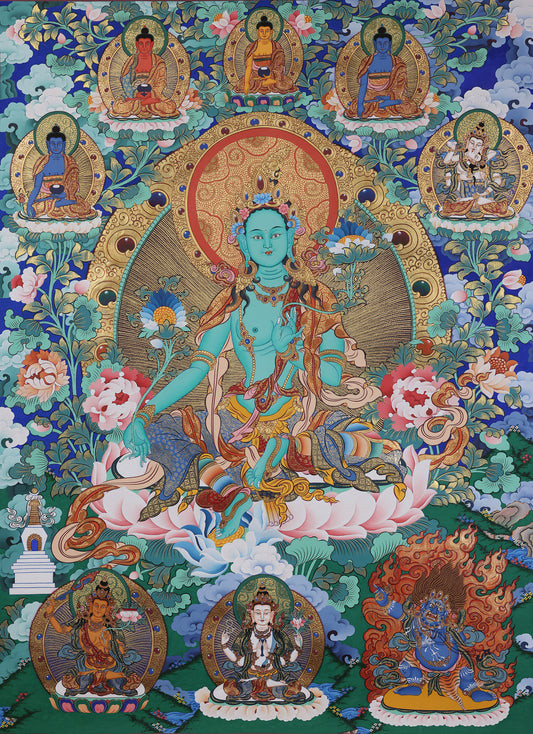
When a 20×30cm Nepali Blue Thangka unfurls on your desk, its deep lapis lazuli blue blending with the glow of gold powder, you’re not just looking at a painting—you’re encountering the Tibetan Buddhist philosophy of “Dharma and Wealth in Harmony,” the millennium-old craft heritage of Nepal’s Newari painting school, and the cultural weight of the Himalayas condensed into a small canvas.
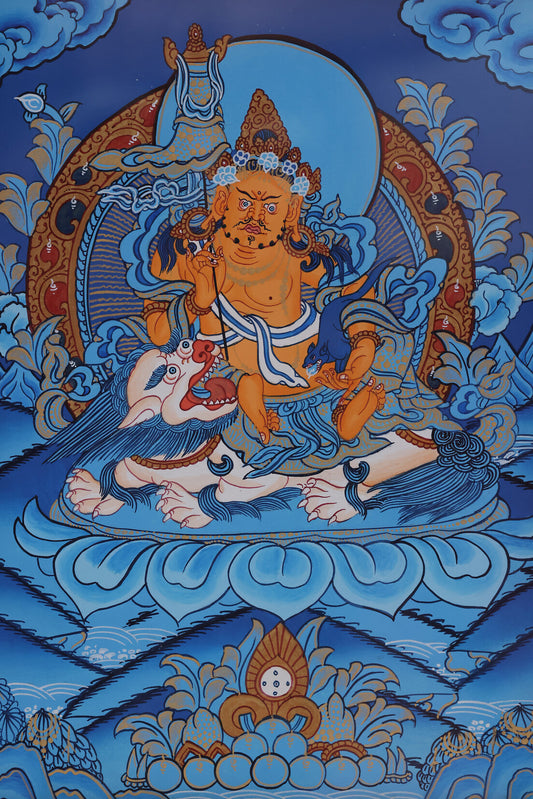
This hand-painted thangka, centered on Vaishravana (the Wealth King) and rendered in mineral and earth pigments, builds a complete “universe of wealth protection” within its compact frame.
In Tibetan Buddhism, Vaishravana is never a mere “god of wealth” in the secular sense.
The core theme of this thangka is
Dharma and Wealth in Harmony: wealth serves as “spiritual provision” to support practice and benefit sentient beings, not a tool for self-indulgence. The Blue Thangka’s base color (lapis lazuli, symbolizing “emptiness” in Tibetan Buddhism) balances Vaishravana’s “wealth attribute”: blue represents “non-attachment to material things,” while the main deity’s yellow form (linked to the merit light of Ratnasambhava Buddha) stands for “wise use of material things.”
When devotees venerate this thangka, they pray for “worldly abundance to uphold the Dharma, and pure Dharma to guide the use of wealth”—a concrete expression of Tibetan Buddhism’s “Middle Way” in daily life.
As the northern protector among Tibetan Buddhism’s “Four Heavenly Kings,” Vaishravana’s iconography in this thangka strictly adheres to the Iconometric Canon and Newari painting traditions:
-
Form: Compassion in a Wrathful Yellow Body
The deity’s bright yellow form symbolizes the “merit of Ratnasambhava Buddha”; his furrowed brows and wide, piercing eyes are not expressions of anger, but a display of majesty—to ward off wealth-stealing evils and protect virtuous wealth. The Newari school’s signature “infant-like face + wrathful demeanor” weaves compassion into ferocity, embodying how “protector deities safeguard sentient beings with power.”
-
Implements: The Vow of the Victory Banner and Treasure Vase Rat
In his right hand, he holds a Victory Banner; its blue-and-gold patterns represent the “convergence of wealth from the heavenly, dragon, and human realms.” In his left hand, he cradles a treasure-vase rat (Nevu-le in Tibetan), Vaishravana’s “vow object”—it only spits jewels (never excretes), symbolizing “wealth used for virtuous deeds, not hoarded.”
-
Mount: The Protection of the Snow Lion
The deity sits atop a snow lion, its mouth agape and mane billowing. The snow lion, a Tibetan Buddhist symbol of “northern protection and obstacle subjugation,” implies that “wealth must be guarded with wisdom and courage.”
Though only 20×30cm, the thangka contains a complete “wealth-protection deity system”:
-
Subtle Attendants: The Space of the Eight Horse-faced Wealth Gods
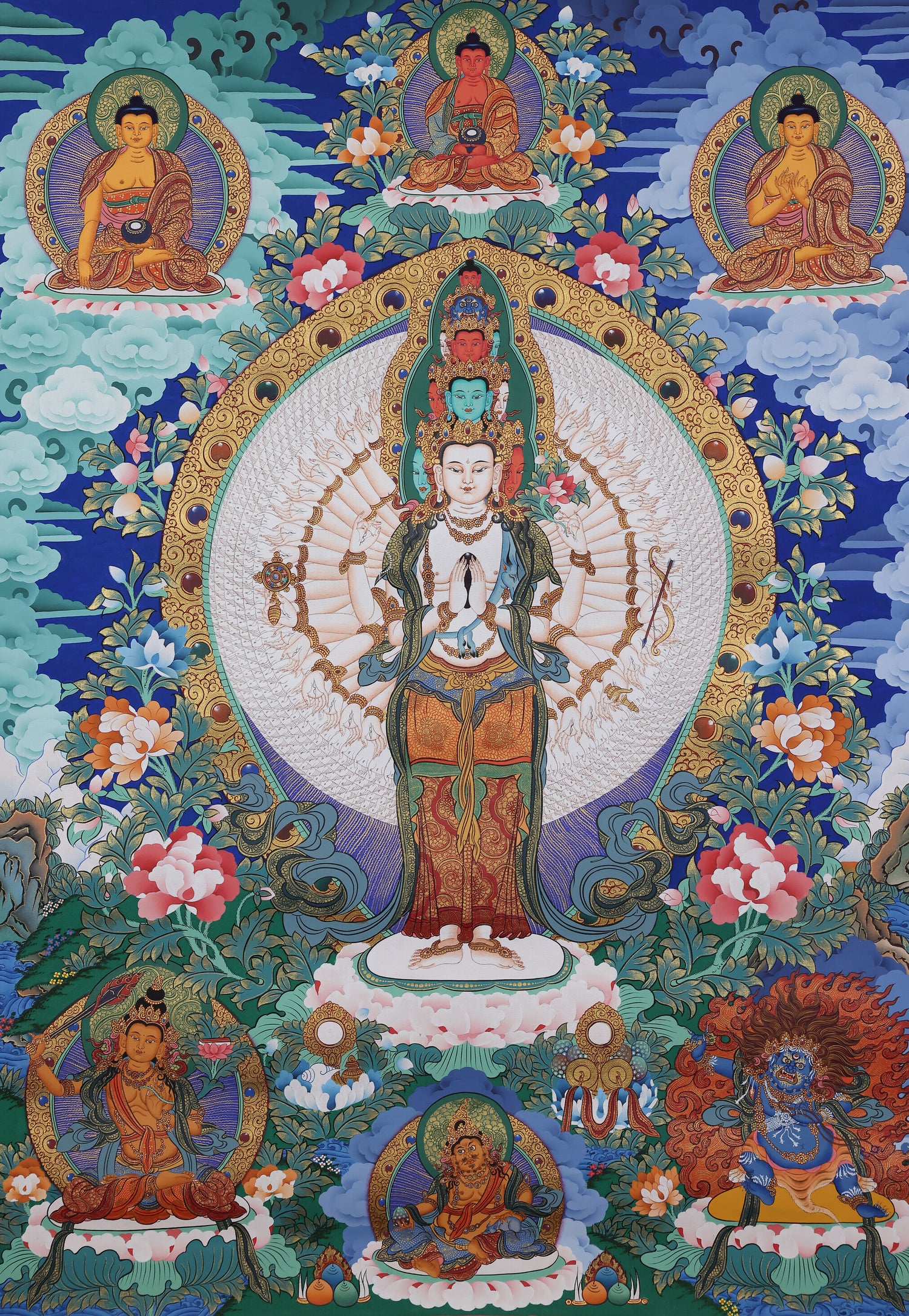
In Tibetan Buddhism, Vaishravana commands the “Eight Horse-faced Wealth Gods” (eight attendants overseeing wealth from eight directions). While the thangka does not depict all eight, the scrollwork and cloud patterns around the main deity are their “spatial metaphor”—clouds symbolize “wealth circulation,” and scrollwork represents “the mountains and lands trodden by the eight horses.”
-
Visible Attendants: Guardians of the Treasure Vault
The small blue beast clinging to the deity’s arm is a “treasure-vault attendant yaksha,” rooted in Hindu yaksha traditions, representing “the meticulous protection of wealth.”
Half the thangka’s value lies in devotion, the other in craft—it is the product of Newari family heritage:
-
Canvas: 15 Days of Polishing
The base is coarse cotton cloth, repeatedly coated with cowhide glue and stone powder, then polished 5–6 times with pebbles until it is as smooth as silk. Even this small 20×30cm piece requires 15–20 days of canvas preparation, ensuring mineral pigments do not fade for centuries.
-
Pigments: From Lapis Lazuli to Gold Powder
All pigments are mineral or earth-based:
- Background blue: “First-grade lapis lazuli” refined via the “water-floating method” (imported from Afghanistan), with lightfastness exceeding 300 years;
- Deity yellow: Orpiment mixed with 98% pure gold powder, bright and aligned with Ratnasambhava Buddha’s iconographic rules;
- Snow lion white: Rinpung white earth blended with tridacna powder, where tridacna’s “sacredness” enhances the mount’s symbolism.
-
Painting: From Ritual to Eye-Opening
The artist first chants sutras and purifies their hands, then uses charcoal to outline the deity per the Iconometric Canon, tracing lines with wolf-hair brushes (thick ink for the deity’s muscles, fine gold for ornaments). Next, “layered glazing” is applied—each layer of pigment dries for 72 hours. Finally, “eye-opening” (dotting the deity’s eyes) is a sacred ritual symbolizing “the infusion of divine nature.”
Its style differs from Tibet’s “solemn formality” or Rebkong’s “vibrant boldness”:
-
Dynamic Form: The deity and snow lion have S-curved limbs (influenced by Hindu iconography), using movement to express “divine vitality”;
-
Color Layers: Blue (emptiness) as the base, gold (sacredness) as ornamentation, and yellow (merit) as the deity—merging spiritual meaning with visual hierarchy;
-
Small-Scale Composition: “Central focus” places the deity in 70% of the frame, with balanced clouds and scrollwork to avoid clutter in the compact space.
This 20×30cm thangka is both a vessel for devotion and a specimen of craft. It shows us that Tibetan Buddhism’s “wealth view” is “wise use, not attachment,” and Nepal’s traditional art is “persistence, not compromise.”
#NepaliBlueThangka #VaishravanaThangkaExplained #TibetanBuddhistThangkaCulture #NewariPaintingTechnique #MineralPigmentThangka