The Wealth Guardian in Thangka Art: The Belief and Wisdom of Vaishravana in Tibetan Buddhism
wudimeng-Jan 02 2026-
0 Kommentare
Vaishravana’s prototype is Kubera, the god of wealth in ancient Indian mythology who attained Brahma’s blessings after a thousand years of asceticism. Originally the leader of the Yaksha clan, he ruled over underground treasures and the northern territories. In the Mahabharata, he is described as "golden-bodied, riding a snow lion, with a rat that spits jewels." With the rise of Buddhism, Kubera was integrated into the Buddhist protector system as Vaiśravaṇa, the Northern Guardian King (one of the Four Heavenly Kings), stationed in the Crystal Palace at the north of Mount Meru, leading the Yaksha armies to protect the Dharma.
By the 7th century, this belief spread to Tibet with Buddhism and gradually merged with local culture: he was not only a war god protecting the nation (revered as a military deity in the Tang Dynasty, and the Japanese warlord Uesugi Kenshin claimed to be his incarnation) but also took on the role of a treasure 本尊 (principal deity of wealth). Tibetan Buddhism holds that he is an emanation of Ratnasambhava Buddha (the Southern Buddha of Treasure Birth), manifesting as a tenth-stage Bodhisattva—protecting the Dharma from obstacles while providing worldly resources for practitioners. The Gelug school founder Tsongkhapa is said to have received Vaishravana’s blessings to obtain resources for building monasteries, further affirming his function of "increasing provisions."
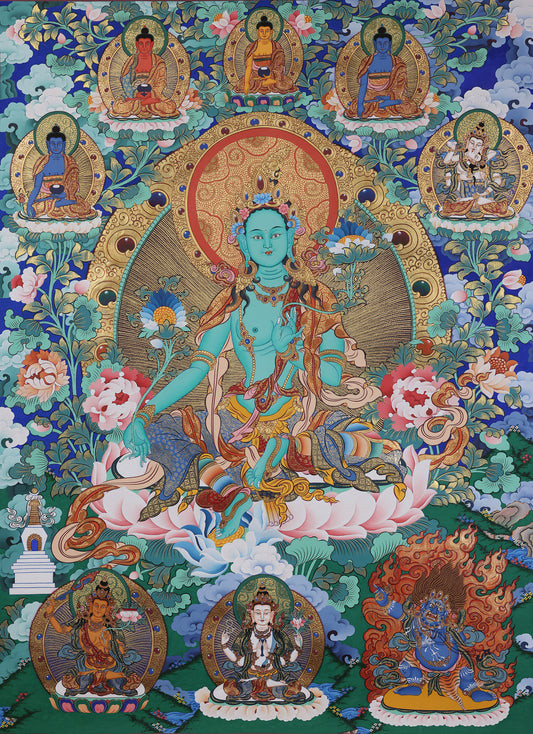
The thangka before you represents Vaishravana’s "standard configuration," with every detail carrying religious significance:
-
Body Color and Adornments: His golden body corresponds to the "earth element," symbolizing abundance and stability; the five-Buddha crown and jewel-studded garlands signify both dignity and the idea that "wealth is a tool for practice."
-
Ritual Implements:
-
Victory Banner (right hand): When turned, it symbolizes the spread of the Dharma, dispelling ignorance and poverty, and also represents smooth undertakings and favorable weather;
-
Treasure-spitting Rat (Nure) (left hand): The rat pouring jewels from its mouth represents endless wealth, while the rat (a natural enemy of snakes, symbols of greed and anger) implies "using wealth to overcome stinginess."
-
Mount: Snow Lion: The white lion is fierce and fearless, deterring evil while preaching the Dharma and distributing treasures; its four paws correspond to the Four Immeasurables (loving-kindness, compassion, joy, equanimity), carrying the king to protect all directions.
-
Retinue and Background: The Eight Wealth Gods (yellow, white, red, green, etc.) surrounding the thangka oversee resources from all eight directions, while the blooming flowers and auspicious clouds in the background represent a "pure land manifestation," meaning wealth and good karma coexist.
The mineral pigments (gold, stone green, cinnabar, etc.) used in Regong thangka art enhance this sacredness: the 24k gold lines outlining the banner and garlands, glinting in the light, embody Tibetan aesthetics of "the mundane as sacred"—worldly wealth is inherently pure provisions, not contrary to ultimate reality.
Tibetan people’s worship of Vaishravana is never merely "utilitarian wealth-seeking," but follows the esoteric logic of "first attracting with desires, then leading to Buddhist wisdom":
-
Worship Rituals:
-
Placement: It must be placed in a clean, bright upper position (e.g., the main spot in the living room), avoiding alignment with kitchens or bathrooms; thangkas should be hung slightly above eye level, and statues placed in a shrine.
-
Offerings: Basic offerings include fresh water (replaced daily), butter lamps, flowers, and fruit; special offerings can include five grains, khadas, or gold/silver ornaments (symbolizing pure wealth).
-
Mantra and Visualization: The core mantra—"Om Bhe 玛 Sha Wara Ye Soha"—should be paired with visualization: "Vaishravana grants me wealth, which I use to benefit sentient beings and support the Triple Gem."
-
Core of Practice: Tibetan esotericism emphasizes the "Bodhicitta vow"—blessings are more powerful if the requested wealth is used for altruistic purposes (e.g., charity, monastery building, aiding the poor); selfish intentions make it harder to receive blessings. As the Avatamsaka Sutra states: "All livelihoods and industries are not contrary to ultimate reality." Wealth is a "tool," not an end.
Today, Vaishravana thangkas are not only sacred objects of worship in Tibet but also adorn studies and shops in Han regions. Yet the true "wisdom of wealth" remains unchanged:
-
Balancing Material and Spiritual Well-being: He reminds people that resolving livelihood worries allows for more focused practice, while spiritual abundance (compassion, wisdom) is the true "inexhaustible treasure."
-
Using Wealth for Good: On the fifth day of the Lunar New Year (when "welcoming the god of wealth" is celebrated), Suzhou’s Xiyuan Temple emphasizes "cultivating the fields of compassion, gratitude, and reverence"—doing good deeds, filial piety, and honoring the Triple Gem bring natural blessings.
-
Overcoming Attachment: Wealth is "right of use," not "ownership." Just as the treasure-spitting rat’s jewels "flow," true abundance lies in "non-greed"—possessing wealth without being bound by it.
When you gaze at this thangka, you may see an auspicious symbol of "attracting wealth and treasures," but in Tibetan Buddhism, Vaishravana is never a secular "god of fortune"—he is a Dharma protector guarding the Dharma and good karma; he is a god of wealth bestowing pure provisions and convenience for practice.
The gilded lines and flowing jewels ultimately point to the same truth: true abundance is freedom from greed, using wealth to benefit sentient beings, and moving toward spiritual awakening amid worldly prosperity.
#TibetanBuddhism #Vaishravana #ThangkaCulture #TibetanAesthetics #WealthWisdom #BuddhistProtector #RegongThangka #PathThroughWealth #IntangibleCulturalHeritage #BuddhistGodOfWealth