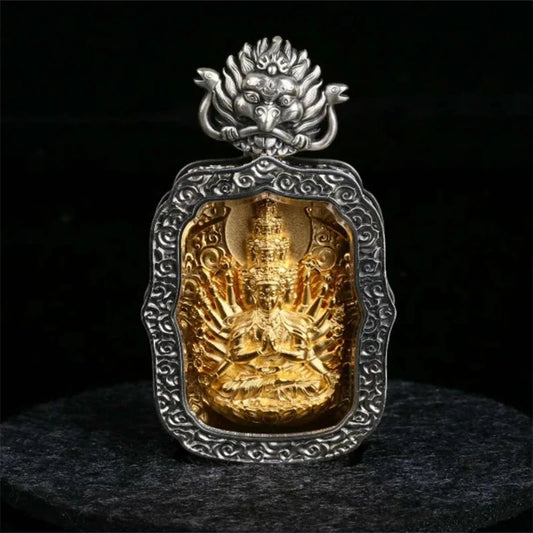
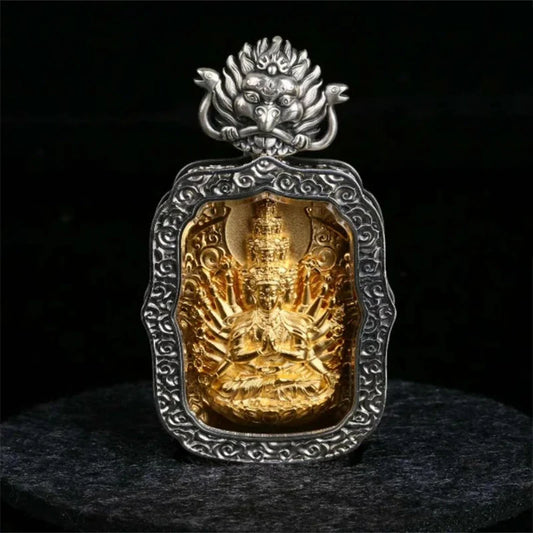
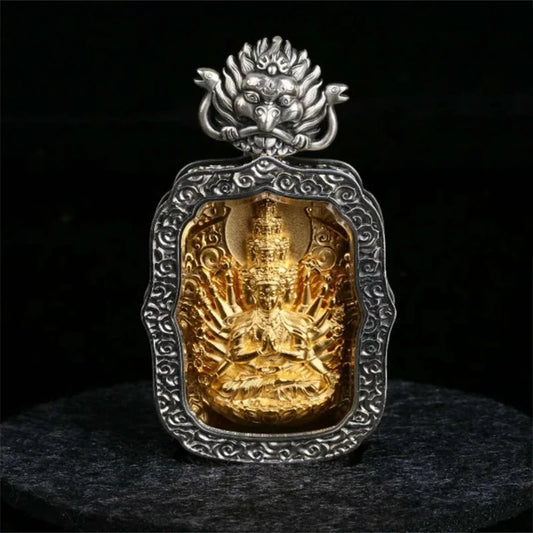
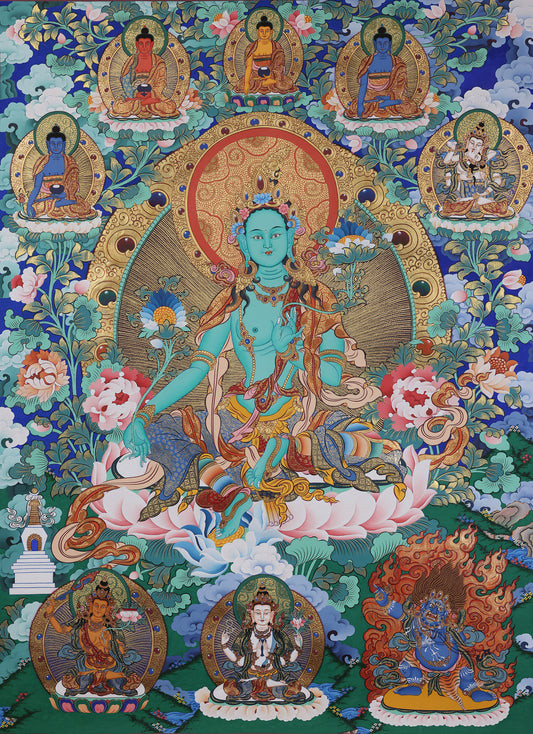
When a vibrantly colored thangka—radiant as plateau sunlight—unfolds before you: the moon-white form, four arms clasped in devotion holding a jewel, the crown topped with Amitabha Buddha, and the eight-petaled white lotus beneath the seat… this is the Four-Armed Chenrezig, called Chenmo in Tibetan, the compassion totem of the Tibetan Plateau. In Tibetan life, Chenrezig is not merely a solemn icon on a thangka, but the "Lord of Great Compassion" who emerged from the Sutra of the Greatly Majestic Maha Cundi Dharani mandala, the redemptive force flowing through the Six-Syllable Mantra.
The "Om Mani Padme Hum" chanted by every Tibetan, young and old, weaves Chenrezig’s bond with all sentient beings into daily life. Yet the origins of this "Snowland Guardian" trace back to 11th-century esoteric Buddhist scriptures and mandala altars.
According to the Sutra of the Greatly Majestic Maha Cundi Dharani (Tibetan translation: Sutra of the Adorned Treasure Casket), the Four-Armed Chenrezig was not originally the central deity of the mandala. In 8th-century Tibetan translations, the mandala’s center was Amitabha Buddha, flanked by attendants: the "Jewel-Holding Bodhisattva" and the "Six-Syllable Mantra Bodhisattva"—the prototype of the Four-Armed Chenrezig: white in form, four-armed, right hand holding a prayer bead, left hand holding a white lotus, with the hands clasped at the chest in the "All-King Mudra."
By the 12th century, as Tibetan Buddhism evolved indigenously, the Four-Armed Chenrezig gradually replaced Amitabha Buddha as the mandala’s core. This shift reflected a restructuring of faith logic: the "Six-Syllable Mantra Bodhisattva," once dependent on Amitabha, was endowed with independent "buddha-nature"—the Amitabha crown atop Chenrezig’s head preserves the connection to the Western Pure Land while declaring Chenrezig’s identity as the "Embodiment of Compassion." Professor Xie Jisheng notes that this process elevated Chenrezig from "Guardian of the Mantra" to "Protector of the Snowlands," who, together with Manjushri (Great Wisdom) and Vajrapani (Great Power), forms the "Three Family Lords"—a foundational practice for Tibetan esoteric practitioners.
The "white form" of the Four-Armed Chenrezig in the thangka is a visual footnote to this faith: white symbolizes "innate purity without defilement," neither dwelling in samsara nor clinging to nirvana—just as Tibetans say, "Chenrezig’s compassion is like snowmelt, nourishing the world yet never lingering."
Every detail of this thangka is a precise weave of esoteric symbols. The Regong thangka’s style—"shaping with lines, rich in color"—amplifies the Four-Armed Chenrezig’s symbolic system:
The four arms are not a display of "supernatural power," but a concretization of the "Four Immeasurables":
-
Clasped hands holding a jewel (center): Represents "the union of wisdom and skillful means," with the wish-fulfilling jewel symbolizing "fulfilling all sentient beings’ wishes";
-
Right hand holding a prayer bead: Each bead turned liberates one sentient being from samsara, a practice of "immeasurable compassion";
-
Left hand holding a white lotus: The lotus, pure despite growing in mud, corresponds to "immeasurable equanimity"—free from greed, anger, and delusion, abiding in equal-mindedness;
-
The four arms as a whole: Encompass "loving-kindness (giving joy), compassion (relieving suffering), sympathetic joy (rejoicing), and equanimity (equality)"—the complete expression of Chenrezig’s compassion.
Thangka painters use smooth lines to outline the graceful posture of the four arms, conveying both the bodhisattva’s dignity and the softness of "compassion for sentient beings"—as the Tibetan thangka saying goes: "Chenrezig’s hands should be like petals holding dewdrops."
-
Five-Buddha Crown: The five buddhas represent the wisdom of the Five Dhyani Buddhas, meaning the Four-Armed Chenrezig unites the compassion of all buddhas;
-
Female deer hide (on the left shoulder): Not a mundane ornament, but a symbol of "not falling into samsara"—the deer represents "tenderness," while the hide implies "transcending worldly bonds";
-
Auspicious ornaments and celestial robes: Jewelry inlaid with lapis lazuli and turquoise symbolize "worldly dignity"; the flowing celestial robe represents "transcendent freedom"—their fusion embodies the idea that "compassion does not abandon sentient beings."
The color use in Regong thangkas reinforces this: the white form is outlined in gold powder, contrasting with the blue, red, and green background, highlighting both "purity" and integration into the "world"—just as Tibetans say, "Chenrezig’s compassion is like warm jade wrapped in gold leaf: sacred yet tangible."
"Om Mani Padme Hum"—these six syllables are the soul of the Four-Armed Chenrezig faith. A Tibetan proverb states: "Chenrezig’s mantra is the echo of the snow mountains; as long as someone chants it, Chenrezig will hear."
In the Sutra of the Greatly Majestic Maha Cundi Dharani, the Six-Syllable Mantra was originally associated with the Eleven-Faced Chenrezig, later becoming bound to the Four-Armed Chenrezig as a "mantra that encapsulates all dharma":
-
Om: Represents the Buddha’s body, purifying sentient beings’ physical karma;
-
Mani: Meaning "jewel," corresponds to the Buddha’s mind, purifying mental karma;
-
Padme: Meaning "lotus," corresponds to the Buddha’s speech, purifying verbal karma;
-
Hum: Represents "accomplishment," unifying body, speech, and mind to free sentient beings from suffering.
The "gaze" of the Four-Armed Chenrezig in the thangka is a visual extension of this mantra: painters depict the bodhisattva’s eyes "half-closed, looking downward"—not "closed," but "watching sentient beings with wisdom eyes." Tibetans believe that as long as the Six-Syllable Mantra is chanted, Chenrezig’s gaze will fall upon them, as the sutra states: "All who are seen by Chenrezig are liberated."
In the practice rituals of the Atisha tradition, practitioners visualize themselves transforming into the Four-Armed Chenrezig, with the syllable Hrih radiating light from their hearts to invite Chenrezig and their retinue, purifying the two obscurations (afflictive and cognitive) with nectar empowerment, and finally becoming "non-distinct" from Chenrezig. This process—"summoning with sound, uniting through visualization"—transforms compassion from a thangka icon into a practitioner’s lived state.
For Tibetans, the Four-Armed Chenrezig is not a "museum artifact," but a spiritual compass permeating daily life:
-
Prayer wheels: Carved with the Six-Syllable Mantra, each turn equals a thousand recitations—a "walking practice";
-
Household thangkas: Almost every Tibetan home enshrines a Four-Armed Chenrezig thangka, offering butter lamps and 青稞酒 daily—a "family’s spiritual center";
-
Festival rituals: During the Shoton Festival and Wangguo Festival, monasteries display giant Four-Armed Chenrezig thangkas, with tens of thousands of worshippers—a "collective spiritual bond."
As Regong thangka inheritor Sangji Cairang says: "When we paint the Four-Armed Chenrezig, we don’t paint a ‘god’—we paint the ‘compassion in our hearts.’ Every brushstroke is accompanied by the Six-Syllable Mantra, so compassion infuses the colors."
The Four-Armed Chenrezig in this thangka is a testament to this symbiosis: the flowing water and auspicious clouds beneath the lotus seat, and the flowers and distant mountains in the background, are a microcosm of the "world"—Chenrezig does not dwell in heaven, but "walks with sentient beings in their lives, accompanying them with compassion."
When we gaze at this thangka, we see not just a bodhisattva icon, but the spiritual embodiment of Tibetan Buddhism’s "union of compassion and wisdom": the four arms are the action of compassion, the white lotus is the pure original intention, and the Six-Syllable Mantra is the sound of redemption.
From the Sutra of the Greatly Majestic Maha Cundi Dharani mandala to the colors of Regong thangkas, the Four-Armed Chenrezig faith has evolved through "change" and "constancy": forms have changed—from attendant to central deity, from scripture to thangka—but the compassion to "relieve sentient beings’ suffering and grant them joy" has never wavered.
As a Tibetan folk song sings: "The snow mountains do not age, nor does Chenrezig’s compassion; the rivers do not stop, nor does the sound of the Six-Syllable Mantra."
Would you like me to compile a Four-Armed Chenrezig Iconography Symbolism Chart to help you quickly organize its symbolic system?
#FourArmedChenrezig #TibetanBuddhismArt #ThangkaSymbolism #OmManiPadmeHumMeaning #RegongThangka #ChenrezigInTibetanCulture #BuddhistIconography #SnowlandProtector #TibetanSpiritualPractices #GreatCompassionBodhisattva